Lecture 2 — History & the Clinical Relationship
Part B: The Clinical Relationship: Consent, Autonomy, and Confidentiality
Brendan Shea, PhD
An Introduction to Bioethics.
Before We Start
Mrs. R is 61, in for fatigue and weight loss. The colonoscopy found colon cancer — serious, but treatable. She is frightened, and her daughter Dana does most of the talking. Mrs. R asks: “So what happens now?”
Four residents tell you how they would answer her:
- “I’d lay out all three options with the survival numbers and let her pick.”
- “I’d tell her what I’d weigh in her shoes, and why, then ask what she thinks.”
- “I’d tell her the right move is surgery and get her scheduled. She’s frightened; she needs a plan.”
- “I’d ask what matters most to her — more time, or fewer side effects — before we talk options.”
- You are the attending. Which resident do you back, and what do you say to the other three?
- Is any of them simply wrong, or does it depend on the patient?
Read the four aloud, in four different voices. The facts never change across them; only what the clinician does with authority changes.
Where We Left Off
The New Question
- Part A showed why unchecked professional authority became impossible to defend after Nuremberg, Willowbrook, and Tuskegee.
- The cure cannot be “the doctor never decides.” Clinicians still hold real expertise, real duties, and real time pressure.
- Patients usually come to medicine wanting guidance, not a list of facts to sort alone.
- So Part B’s question is constructive: what should replace “doctor knows best”?
- The answer this lecture builds is shared, transparent, autonomy-respecting care — and the tools that make it real.
Today
By the end of Part B, you will be able to:
- Distinguish the four Emanuel & Emanuel models of the clinician–patient relationship
- Explain the four elements of valid informed consent and where consent law came from
- Tell an unwise decision apart from an incapacitated one, using a capacity standard
- Identify the main limits on confidentiality, including Tarasoff and modern record access
- Work through a truth-telling conflict involving family and culture
Why This Relationship Is Hard
What’s Missing From This Picture?
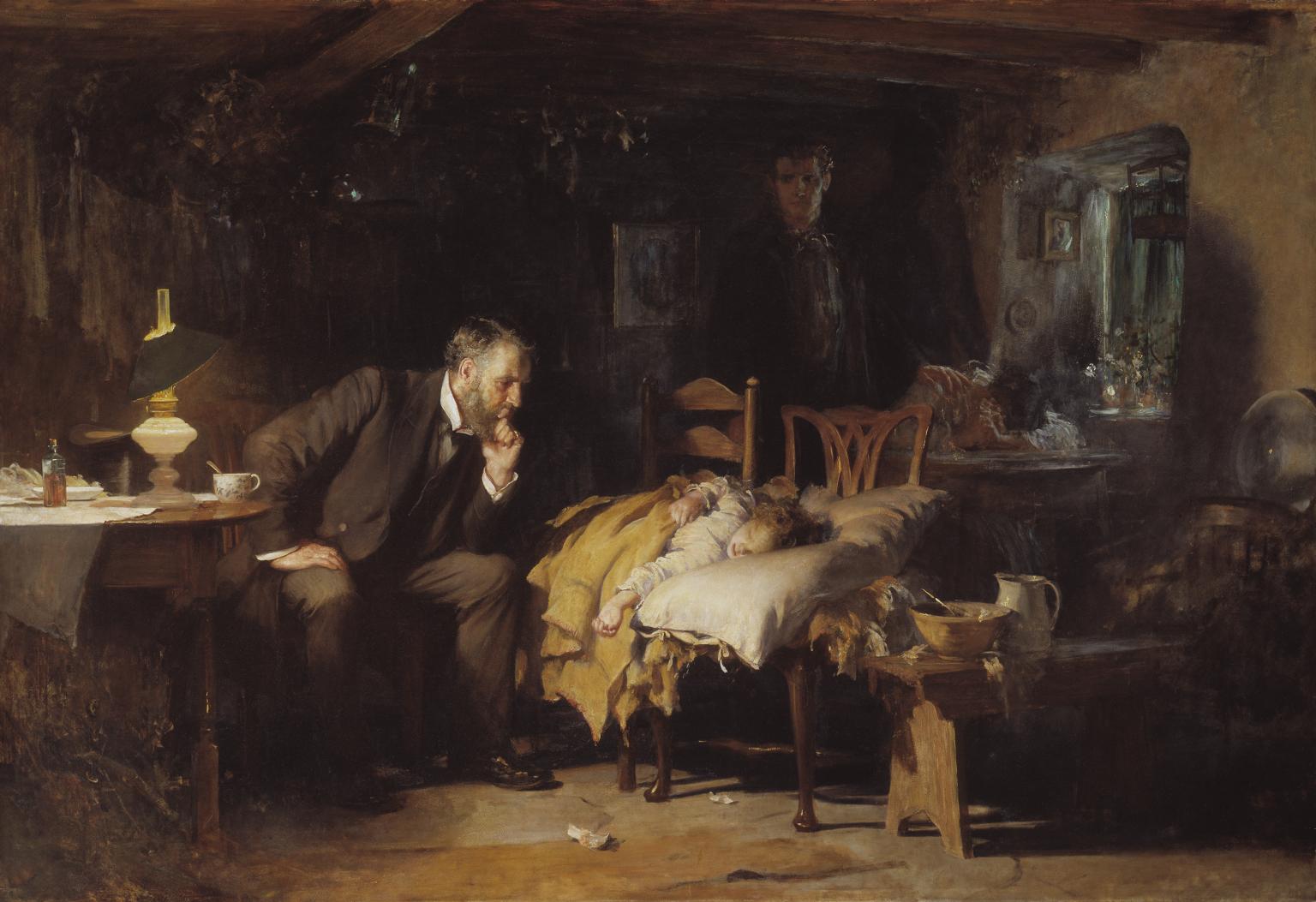
Sir Luke Fildes, The Doctor (1891), via Wikimedia Commons, public domain.
- Luke Fildes’s The Doctor (1891) was the most reproduced image of medicine in the English-speaking world, and for a century it was how the profession saw itself.
- The physician watches, interprets, and quietly decides. The parents wait in the shadows.
- The one person with no voice in the picture is the patient.
- The modern apparatus of consent exists to put that voice back.
Three Sources of Asymmetry
- The patient is sick, frightened, and often in pain, and the information is unequal from the first minute.
- What is at stake is rarely a technical fact. It is what kind of life is worth living, which is the patient’s question.
- Ethical care does not pretend the asymmetry away. It manages it openly.
The Core Tension
Autonomy versus Beneficence
- Autonomy is the patient’s right to make informed choices about her own body.
- Beneficence is the clinician’s duty to act for her welfare.
- Most of the time they run together: good information and a good recommendation are both in her interest.
- They pull apart when what the clinician judges best is what the patient does not want.
- A competent patient’s refusal is a conflict of values, not a misunderstanding to clear up.
Four Ways to Be in the Room
Four Models at a Glance
Ezekiel and Linda Emanuel mapped the clinician–patient relationship into four models in a 1992 JAMA paper that is still the standard reference (Emanuel and Emanuel 1992):
| Model | Which resident | Main clinician role | Main risk |
|---|---|---|---|
| Paternalistic | 3 | Decide what is best | Patient becomes passive |
| Informative | 1 | Provide facts and options | Clinician becomes a vending machine |
| Interpretive | 4 | Help clarify the patient’s values | Clinician may over-read the patient |
| Deliberative | 2 | Recommend and reason about values | Persuasion can slide into pressure |
What the Research Actually Shows
- The dominant model today is shared decision-making: the clinician brings expertise about options and risks, the patient brings expertise about her own values.
- Structured decision aids (booklets, videos, option grids) measurably improve knowledge and produce choices that better match patients’ values.
- Patients differ sharply. Most want full information, but the decision control they want ranges from “you decide, doctor” to “I decide, period.”
- That variation is the empirical case against a single correct model.
- The professional skill is to ask how much steering this patient wants, and to revisit it as illness and confidence change.
Which Model Fits?
Match a model to each case — and say why:
- An unconscious trauma patient in the ED
- A patient choosing between two cancer regimens with similar odds
- An older adult unsure whether dialysis still fits her goals
- A patient who asks you, “What would you do if it were your mom?”
And: should Mrs. R get the same model at every visit?
Now Mrs. R arrives having read everything online, convinced by an ad and an AI chatbot that she needs one specific drug. Does the informative model still work when a patient cannot judge her own information?
After You’ve Discussed
Note
- No model wins everywhere. Emergencies push left toward paternalism; chronic illness usually works best in the interpretive/deliberative middle.
- Choosing the model is itself a shared decision. The deepest move is to ask the patient how much steering they want — and to revisit it as the illness, and the patient, change. “Advice” with the steering hidden is the move to watch for.
Mrs. R Signs a Form
Consent Is a Process, Not a Signature
- Informed consent is how the abstract principle “respect for persons” becomes a concrete clinical act (Faden and Beauchamp 1986).
- A signed form can document that a conversation happened; it can never substitute for the conversation.
- A competent refusal is as valid an exercise of consent as a yes. Consent is the right to decide, not the duty to agree.
- Outside emergencies, valid consent must come before the intervention, not be backfilled after.
- The legal doctrine is roughly a century old, and it began with a single sentence from a judge.
Where Consent Law Begins
“Every human being of adult years and sound mind has a right to determine what shall be done with his own body; and a surgeon who performs an operation without his patient’s consent commits an assault.”
Justice Benjamin Cardozo, Schloendorff v. Society of New York Hospital (1914) (New York Court of Appeals 1914)
The term “informed consent” was not coined until Salgo (1957). The modern standard for how much to disclose was set in Canterbury v. Spence (1972).
How Much Must You Disclose?
| Standard | The test it uses | The problem it has |
|---|---|---|
| “Reasonable physician” (older) | Disclose what a typical doctor would disclose | Lets the profession set its own bar |
| “Reasonable patient” (Canterbury, 1972) | Disclose what a reasonable patient would consider material to the decision | Whose “reasonable patient”? |
| Subjective / this patient (emerging) | Disclose what this patient would find material | Hard to prove, but closest to real autonomy |
Most U.S. jurisdictions now use some version of the Canterbury “reasonable patient” rule — disclosure is measured from the patient’s side of the table, not the doctor’s.
The Four Elements of Valid Consent
| Element | The practical question |
|---|---|
| Disclosure | Was the relevant information provided? |
| Understanding | Does the patient actually grasp it? |
| Voluntariness | Is the choice free from controlling pressure? |
| Capacity | Can the patient make this decision now? |
Disclosure & Understanding, with Mrs. R
- Disclosure — you explain the cancer, the surgery, the major risks, the alternatives, and what happens if she does nothing.
- Understanding — you ask her to say it back: “What did you hear?” She says, “You’re removing part of my colon, and I might need a bag for a while.”
- That is real understanding. Signing while nodding is not: patients routinely forget or misunderstand much of what they were told.
- Teach-back, having the patient restate the plan in her own words, is the most reliable low-tech check that disclosure landed.
- Use plain language, an interpreter when indicated, and slow down when fear or pain has narrowed her attention.
Voluntariness, with Mrs. R
- Dana answers every question before her mother can, and the appointment becomes a conversation between you and the daughter.
- Asked directly what she wants, Mrs. R says quietly, “Whatever my daughter thinks is best.”
- That may be authentic deference, or it may be pressure wearing the face of family love.
- Influence does not destroy voluntariness; families always influence. Control does.
- A signed form can still document a choice that was never the patient’s, which is why you sometimes see the patient alone.
Capacity Is Not What People Think
- Capacity is decision-specific and time-specific: a patient can lack it for a complex surgery at 3 a.m. and have it for a simple choice the next morning.
- It is not intelligence, a psychiatric diagnosis, or agreeing with the clinician. A person can be floridly eccentric and still have capacity.
- It runs on a sliding scale: the graver and more irreversible the consequences, the higher the bar before accepting the decision.
- So a low-stakes refusal is honored almost automatically, while a life-or-death refusal triggers careful reassessment.
- Capacity is a judgment about this decision, not a verdict on the person.
A Practical Capacity Check
The standard clinical test, Appelbaum and Grisso’s four abilities, asks whether the patient can (Appelbaum 2007):
- communicate a stable choice
- understand the relevant information
- appreciate how it applies to them specifically
- reason through the options coherently
Failing only the last two — appreciation and reasoning — is what usually distinguishes incapacity from a merely unusual choice.
The Consent Checklist
Refusal Is the Real Test
- Easy cases are consent cases. The hard cases are refusals, where a competent person says no to something that would clearly help.
- An informed refusal demands the same four elements as an informed consent.
- The landmarks: Jehovah’s Witness patients refusing transfusion, and Bouvia v. Superior Court (1986), where a woman with cerebral palsy won the right to refuse force-feeding (California Court of Appeal 1986).
- Dax Cowart, burned and blinded at 25 in a 1973 explosion, lucidly demanded through fourteen months of treatment that it stop. He was treated anyway. Until his death in 2019 he insisted he was glad to be alive and gravely wronged (Cowart and Burt 1998).
This is the chapter’s paired case study. You don’t need the full facts yet — only enough to feel the autonomy/beneficence collision before you read it properly.
Thought Question
A competent adult refuses a blood transfusion that would almost certainly save their life.
- Is honoring the refusal respect — or abandonment?
- What is the clinician still obligated to keep doing after the refusal?
- Mrs. R, in tears, says “I can’t even think about this right now.” Is that a refusal, indecision, or lost capacity — and how would you tell?
- Change one fact: the refusal is not religious. She read online that transfusions are dangerous. Does the reason change what you owe her?
After You’ve Discussed
Note
- Respecting a decision is not endorsing the reasoning. You can believe she is wrong and still be bound by her refusal.
- The capacity bar is applied unevenly. We rarely test capacity when patients say yes; we scrutinize it when they say no. If every risky refusal counted as incapacity, informed consent collapses back into paternalism. The honest question is what danger is enough to re-assess — not to override.
Confidentiality and Hard Conversations
Why Confidentiality Matters
- Confidentiality is one of medicine’s oldest promises, in the Hippocratic Oath long before any statute.
- Its value is partly instrumental: patients disclose stigmatized facts (drug use, sexual history, suicidal thoughts) only if they trust the information will be held.
- Its value is also intrinsic: control over who knows your medical story is part of being treated as a person, not a case.
- When adolescents doubt confidentiality, they measurably withhold information and forgo care.
- So confidentiality is ethical before it is legal, and breaking it damages care even when no one finds out.
HIPAA Is Not a Gag Order
- HIPAA is the U.S. federal health-privacy rule, and one of the most misunderstood laws in medicine (U.S. Department of Health and Human Services, Office for Civil Rights 2025).
- It permits sharing for treatment, payment, and operations, and to avert a serious and imminent threat. It is not a vow of silence.
- It runs on a “minimum necessary” principle: access and share only what the task in front of you requires.
- Misreading it has real costs. Families get stonewalled and care coordination suffers because staff believe it forbids all disclosure.
- If Mrs. R’s sister calls for an update, you generally cannot confirm she is a patient without Mrs. R’s authorization. That is the rule working.
May Disclose vs. Must Disclose
You may disclose when
- The patient authorizes it
- It is necessary for treatment
- Law permits limited operational use
- A serious threat may justify a warning
- Legal process requires a response
You must disclose
- Suspected child abuse or neglect
- Certain infectious diseases
- Some court-ordered disclosures
- Some state-mandated reporting
- (The exact list varies by state)
The Chart Is Now a Letter to the Patient
- Since 2021, the 21st Century Cures Act’s information-blocking rule gives patients near-immediate access to their notes and most results.
- Open notes is now the default. The patient will likely read exactly what you wrote, often before you discuss it.
- Transparency improves trust, recall, and error-catching, and patients report feeling more in control.
- The hard cases are real: documenting a suspected abuse, a stigmatizing differential, or “poor historian,” knowing she will read it.
- The emerging norm is to write the chart as if addressed to the patient, because now it effectively is.
Tarasoff: Two Rulings, One Lesson
- Prosenjit Poddar, a UC Berkeley student, told campus psychologist Lawrence Moore he intended to kill Tatiana Tarasoff after she rejected him.
- Moore alerted campus police, who detained Poddar and released him. No one warned Tatiana, and Poddar killed her in 1969.
- The California Supreme Court ruled twice: Tarasoff I (1974) created a duty to warn, Tarasoff II (1976) a duty to protect (Supreme Court of California 1976).
- The dissent argued the rule would chill therapy and deter the patients who most need help from speaking freely.
- That tradeoff was never settled. It went to fifty state legislatures, which is why the duty differs by where you practice.
Tarasoff I vs. Tarasoff II
| Tarasoff I (1974) | Tarasoff II (1976) | |
|---|---|---|
| Duty | Duty to warn the victim | Duty to protect the victim |
| Options | Tell the identifiable target | Warn, notify police, hospitalize — whatever a reasonable clinician would do |
| Trigger | A serious threat to an identifiable person | Same — but the response is broader and clinically judged |
| Today | Some states still use a narrow “warn” rule | Many adopted “protect”; some make it permissive, a few reject it entirely |
There is no single national Tarasoff rule. There is a default ethical question — serious, specific danger to an identifiable person — that each state answers differently.
In the Court’s Words
“We conclude that the public policy favoring protection of the confidential character of patient-psychotherapist communications must yield to the extent to which disclosure is essential to avert danger to others. The protective privilege ends where the public peril begins.”
Tarasoff v. Regents of the University of California (1976) (Supreme Court of California 1976)
The Case Nobody Warns You About
You are a nursing student on a med-surg unit. Your old roommate is admitted two doors down — and you have chart access.
You’re genuinely worried about her. You open her chart “just to see if she’s okay.” You tell no one. No one is harmed.
Snooping Is Not Hypothetical
- Every chart access is logged, and automated audits flag a record opened by someone not on the care team.
- After staff repeatedly accessed celebrities’ records, UCLA’s health system fired employees, faced a federal settlement, and saw one worker criminally convicted.
- “I only looked, I didn’t tell anyone” is not a defense. The unauthorized access is itself the violation.
- The consequences stack: termination, loss of licensure, HIPAA penalties, sometimes prosecution.
- The trigger is almost always curiosity about someone the snooper knows, which is exactly the roommate scenario.
Thought Question
Start with the roommate’s chart, then turn the privacy default on its head:
- You looked “just to check she’s okay.” What exactly is the wrong, if no one ever finds out?
- Does it change if she were your patient? If she’d want you to know? If you tell no one?
- Now a patient tells you: “Sometimes I think about killing my ex — I know where she works.” What would you need to know before warning anyone?
- What if the threat is posted on Instagram rather than said in your office? Does that change what you owe the person named?
After You’ve Discussed
Note
- Access is not authorization. Being able to open a chart is not permission. The test is “do I need this to care for this patient?” Curiosity, worry, and good intentions are not exceptions.
- The default flips, but the question doesn’t. Snooping over-discloses; Tarasoff under-discloses. Both are answered the same way — by asking what is genuinely necessary: to provide care, or to prevent serious, specific harm.
How Truth-Telling Flipped
- The reversal took a single professional generation (Oken 1961; Novack et al. 1979).
- What felt like obvious kindness was a convention, not a moral fact.
- Conventions about disclosure still vary across cultures, so you ask this patient rather than assume.
Back to Mrs. R: “Please Don’t Tell Her”
The biopsy is worse than expected. Before you go in, Dana stops you in the hallway:
“In our family, we don’t tell elders news like this. It will crush her. Please talk to me, not her.”
The team wants to respect the family’s culture. The team also wants to respect Mrs. R.
Thought Question
- Whose decision is this — Mrs. R’s, Dana’s, or the team’s?
- What is the first thing you should find out, and who do you ask?
- What if you ask Mrs. R and she says, “I don’t want the details — talk to Dana”?
- Now a genetic test shows Mrs. R carries a mutation her adult siblings may also carry, and she does not want them told. Same problem, or a different one?
After You’ve Discussed
Note
- Only Mrs. R can waive her own right to know. A competent patient may choose not to receive information (“just talk to my daughter”) — that is respected autonomy; the family withholding it from her, unasked, is not. So it isn’t “autonomy vs. culture”: ask her, before the bad news, how much she wants to know and whom she wants involved.
- The genetic case is different in kind: a third party’s welfare is now at stake. That is closer to Tarasoff than to truth-telling.
Pulling It Together
Common Mistakes to Avoid
- Reducing autonomy to consumerism — handing the patient a menu and calling abandonment “respect for choice.”
- Pathologizing disagreement — treating every unwise or emotional decision as proof of lost capacity.
- Treating HIPAA as a gag order — shutting out families and stalling care in the name of a rule that does not require it.
- Assuming one cultural script — defaulting either to blunt disclosure or to family control instead of asking this patient.
- Confusing the form with the process — believing a signature settles a question the conversation never actually reached.
Wrapping Up Part B
Part A explained why modern medicine rejects unchecked paternalism. Part B asked what replaces it: guided, transparent, autonomy-respecting care. Following Mrs. R, we saw the four clinician–patient models, the four elements of valid consent and the case law (Schloendorff → Canterbury) behind them, the difference between an unwise choice and an incapacitated one, and confidentiality and truth-telling as defaults with disciplined, evolving exceptions — from Tarasoff to open notes. Through all of it you chose a model with Mrs. R rather than for her, and asked her, not Dana, how she wanted the truth handled.
Review Questions
Write a brief answer to each, or use them as discussion prompts.
Recall
What are the four elements of valid informed consent, and why is a signature by itself not enough?
Apply
A patient with kidney failure clearly explains the risks of refusing dialysis, but her son insists that no “reasonable” mother would refuse treatment and asks the team to override her. How should the team assess capacity and respond to the son’s demand?
Debate
Should patients usually get near-immediate electronic access to clinicians’ notes, test interpretations, and differential diagnoses, even when that may increase anxiety, misunderstanding, or conflict?
Key Terms
- Paternalistic model — Emanuel & Emanuel’s first model: the clinician decides what is best and presents only the recommended course.
- Informative model — the clinician supplies the facts and the patient chooses; values are treated as the patient’s private business.
- Interpretive model — the clinician helps the patient clarify and articulate values, then maps them to options.
- Deliberative model — the clinician engages the patient in moral discussion about which health-related values are best worth pursuing.
- Informed consent — a valid authorization with four elements: disclosure, understanding, voluntariness, and competence/capacity.
- Capacity — the clinical judgment that a patient can understand, appreciate, reason about, and communicate a choice; decision-specific, not global.
- Confidentiality — the duty to protect information patients share in the clinical relationship.
- HIPAA — the U.S. statute setting baseline rules for the privacy and security of identifiable health information.
References
Appelbaum, Paul S. 2007. “Assessment of Patients’ Competence to Consent to Treatment.” New England Journal of Medicine 357 (18): 1834–40. https://doi.org/10.1056/NEJMcp074045.
California Court of Appeal. 1986. Bouvia v. Superior Court, 179 Cal. App. 3d 1127.
Cowart, Dax, and Robert Burt. 1998. “Confronting Death: Who Chooses, Who Controls?” Hastings Center Report 28 (1): 14–24. https://doi.org/10.2307/3528337.
Emanuel, Ezekiel J., and Linda L. Emanuel. 1992. “Four Models of the Physician-Patient Relationship.” JAMA 267 (16): 2221–26. https://doi.org/10.1001/jama.1992.03480160079038.
Faden, Ruth R., and Tom L. Beauchamp. 1986. A History and Theory of Informed Consent. Oxford University Press.
New York Court of Appeals. 1914. Schloendorff v. Society of New York Hospital, 211 n.y. 125. Opinion of Cardozo, J.
Novack, Dennis H., Robin Plumer, Raymond L. Smith, Herbert Ochitill, Gary R. Morrow, and John M. Bennett. 1979. “Changes in Physicians’ Attitudes Toward Telling the Cancer Patient.” JAMA 241 (9): 897–900. https://doi.org/10.1001/jama.1979.03290350017012.
Oken, Donald. 1961. “What to Tell Cancer Patients: A Study of Medical Attitudes.” JAMA 175 (13): 1120–28. https://doi.org/10.1001/jama.1961.03040130004002.
Supreme Court of California. 1976. Tarasoff v. Regents of the University of California, 17 Cal. 3d 425 (1976). Supreme Court of California decision.
U.S. Department of Health and Human Services, Office for Civil Rights. 2025. Summary of the HIPAA Privacy Rule. HHS. https://www.hhs.gov/hipaa/for-professionals/privacy/laws-regulations/index.html.
Bioethics OER · CC BY-NC 4.0 · Brendan Shea