Lecture 4 — Abortion
Part A: Four Arguments in Standard Form
An Introduction to Bioethics.
You Wake Up Connected
You wake up in a hospital bed. In the bed beside you is a famous, unconscious violinist. The Society of Music Lovers has discovered that you alone have the right blood type to keep his failing kidneys filtering. Overnight they kidnapped you, sedated you, and plugged his circulatory system into yours. The hospital director apologizes. The violinist will die if you unplug. He needs you for nine months.
Write or discuss:
- Are you morally required to stay plugged in for nine months?
- If you unplug, have you killed him — or simply refused to save him?
- Where, exactly, does this scenario stop resembling a pregnancy?
This is Judith Jarvis Thomson’s 1971 case. We reconstruct it as an explicit argument later in the chapter.
After You’ve Discussed
Note
- A right to life is not automatically a right to use someone else’s body. These are two different rights, and people slide between them.
- There is a moral difference between “killing” and “letting die.” Where you draw that line will decide many other cases in this course.
Today
By the end of Part A, you will be able to:
- Tell validity from soundness, and spot the equivocation on “human” that runs through abortion arguments
- State Don Marquis’s future-like-ours argument and the strongest objection to it
- Apply Mary Anne Warren’s five marks of personhood to borderline cases (zygote, newborn, adult with advanced dementia, dolphin, AI)
- Reconstruct Judith Jarvis Thomson’s violinist case as a formal argument and locate at least two disanalogies critics press against it
- Explain how Rosalind Hursthouse’s virtue-ethics approach reframes the abortion question away from the status of the fetus
- Identify, for any abortion argument, the load-bearing premise — the one premise the disagreement actually turns on
Standard Form, Recapped
Earlier in the course we treated an argument as premises plus a conclusion. Today we write them in standard form: numbered premises, then the conclusion.
- An argument is valid when the conclusion follows: if the premises were true, the conclusion would have to be.
- It is sound when it is valid and every premise is actually true.
- Most serious abortion arguments are valid. The fight is over whether one premise is true, so the skill is finding that premise.
The Equivocation Trap
The word “human” has two very different senses, and arguments about abortion routinely slide between them without anyone noticing.
Biological sense. “Human” = a living member of the species Homo sapiens. A zygote, a fingernail clipping, a tumor of human tissue — all human in this sense.
Moral sense. “Human” = a being with the kind of mental and moral life that grounds a right to life. An adult patient, plausibly a newborn — human in this sense.
The trap. “The fetus is human” is true in the biological sense — but the conclusion “it is wrong to kill the fetus” only follows if “human” means the moral sense. Sliding between the two senses inside a single argument is the fallacy of equivocation, and it is the single most common error in abortion debates on both sides.
A Short Biological Primer
- A zygote is the single cell formed at fertilization, when sperm and egg fuse.
- An embryo is the developing organism from implantation (~2 weeks) through the eighth week, when the major organ systems first form.
- A fetus is the developing human from the ninth week of gestation until birth.
- Viability is the point at which a fetus could plausibly survive outside the womb with intensive medical support — currently around 22–24 weeks.
Gestational age vs. fertilization age. Clinicians count pregnancy from the first day of the last menstrual period (LMP), about two weeks before fertilization. So a “12-week pregnancy” describes a roughly 10-week-old embryo or early fetus.
Timeline of Fetal Development
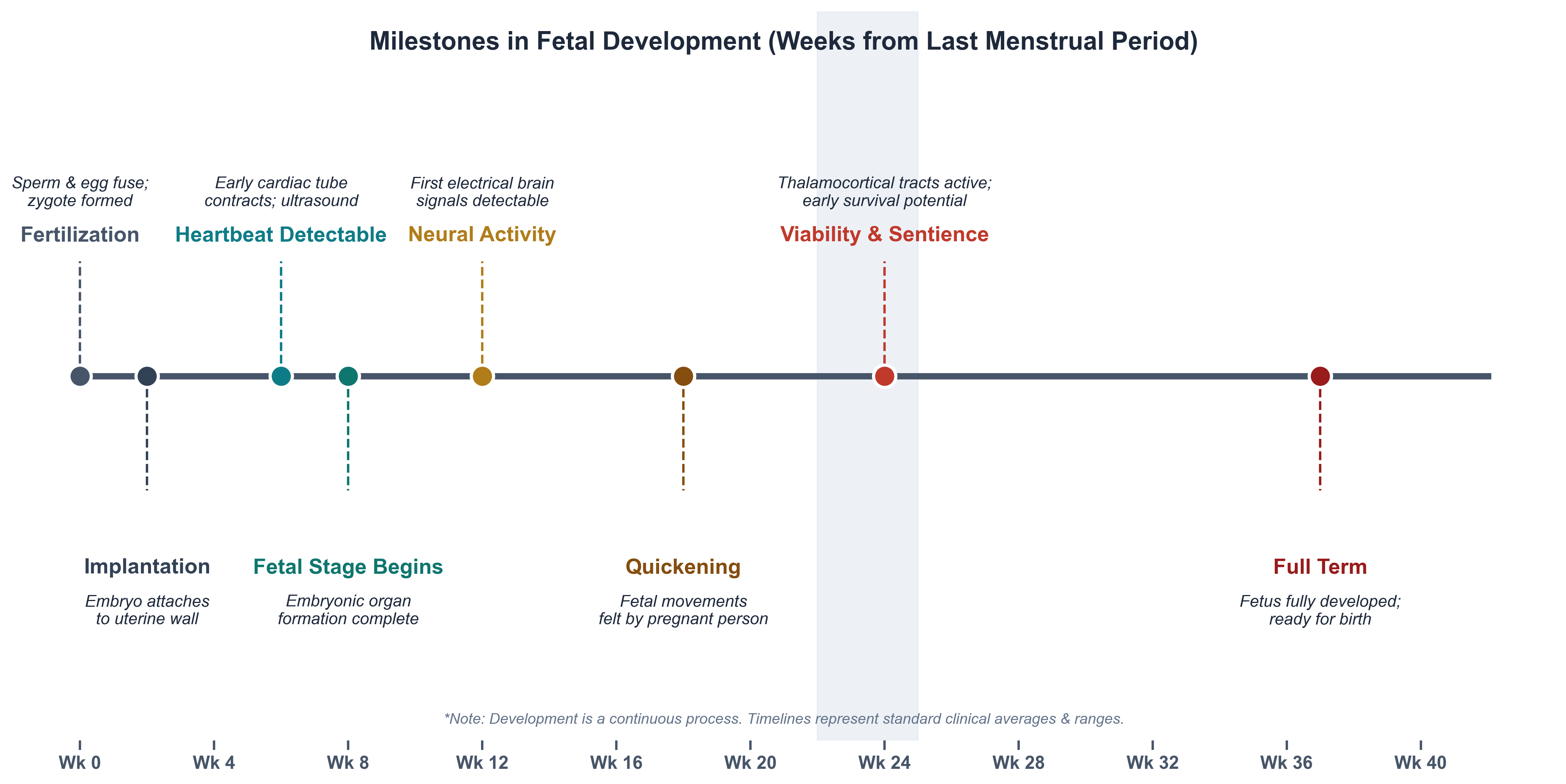
Adapted from clinically standard developmental timelines.
How Abortion Is Actually Performed
Medication abortion (up to ~10–11 wk; ~63% of US abortions in 2023). Often at home.
- Mifepristone blocks progesterone, ending the pregnancy.
- Misoprostol, taken 24–48 hours later, causes the uterus to contract and expel the pregnancy.
Procedural abortion in clinics (any gestational age; ~37% of US abortions).
- Aspiration / vacuum (most first-trimester procedures): the uterine contents are removed through a thin tube; takes ~5–10 minutes.
- Dilation and evacuation (D&E) (second trimester): cervix dilated; instruments and suction used to empty the uterus.
The pre-2022 picture is shifting. After Dobbs (2022), state-by-state law has become the dominant variable in what is actually available to a given patient. Part B picks this up.
Who Actually Has Abortions
- About 1 in 4 US women will have an abortion by age 45.
- About 60% of those obtaining abortions are already mothers.
- The typical patient is in her 20s, low-income, and identifies as Christian.
- The most-cited reasons are economic instability, timing, and responsibilities to existing children.
- About 80% of US abortions occur in the first trimester; under 1% occur after 21 weeks, almost always for severe fetal anomaly or maternal life.
Public images of abortion often imagine a single, young, childless patient making a quick decision. The data describe a different population: women already raising children, deciding from inside the constraints of an existing family.
Figures from Guttmacher Institute and CDC Abortion Surveillance, 2020–2023.
What Makes Something Matter Morally?
To have moral status is to count, in your own right, in moral reasoning. Each candidate criterion gives a different verdict on the early fetus.
| Criterion | What it means | Early fetus? | Lines up with |
|---|---|---|---|
| Biological humanity | A living member of Homo sapiens | Yes | The conservative right-to-life argument |
| Potentiality | Will become a person if not killed | Yes | Marquis |
| Sentience | Able to feel pleasure and pain | No, until ~24 weeks | Most pro-choice arguments |
| Personhood | Consciousness, reasoning, self-awareness | No | Warren |
Four Arguments
Argument 1 — The Future-Like-Ours Argument
Marquis: Abortion Deprives a Fetus of a Future Like Ours
Don Marquis, “Why Abortion Is Immoral” (1989)
- What makes killing an adult human being seriously wrong is that it deprives the victim of all the experiences, projects, activities, and relationships that would otherwise have made up their future.
- Whatever it is that makes killing wrong in adults is what makes it wrong in any case.
- A standard human fetus, if not killed, has a future containing experiences, projects, activities, and relationships of the same general kind — a future like ours.
- Therefore, killing a standard human fetus is seriously wrong, for the same reason killing an adult is.
The Strange Company Marquis’s Principle Keeps
Marquis’s principle — killing is wrong when it deprives a being of a valuable future — has consequences that surprise people on both sides of the debate.
- Contraception is not wrong. There is no being yet to be deprived; sperm + egg = no subject of a future.
- Removing life support from a permanently comatose patient may not be wrong — there is no valuable future to lose.
- Abortion of an anencephalic fetus (no brain development possible) is permissible — no future of the relevant kind.
- Most abortions for socioeconomic reasons are seriously wrong — the fetus’s future doesn’t care about the mother’s circumstances.
- Abortion for fetal Down syndrome is wrong — those futures are valuable too.
- Killing many animals may be wrong if they have futures of value (Marquis himself is cautious here).
Objection to Marquis
The Identity Objection (targets P3)
A common reply in the secondary literature (Harman 2025, sec. 2.2)
- For losing a future to be a harm to me, the future being lost must be mine — it must belong to a continuous psychological subject who can be deprived.
- A zygote or early embryo has no psychological life at all — no memories, no plans, no point of view from which a future could be “lost.”
- So the early embryo is not the subject of any future; talk of “its future” is more like talk of the future of a sperm-and-egg pair before they meet.
- Therefore, even granting Marquis’s general principle, it does not yet show that early abortion deprives anyone of a future.
Argument 2 — The Personhood Argument
Warren: A Fetus Is Not Yet a Person
Mary Anne Warren, “On the Moral and Legal Status of Abortion” (1973)
- The right to life belongs to persons — beings with a recognizable mental and moral life — not to every member of the biological species Homo sapiens.
- To be a person in this morally relevant sense is to possess (some significant set of) consciousness, reasoning, self-motivated activity, the capacity to communicate, and self-awareness.
- A fetus, at any stage of development, possesses none of these traits to any meaningful degree.
- Therefore, a fetus is not a person and does not yet have the right to life that persons have.
Objection to Warren
The Infanticide Objection (targets P2 and P3)
A standard reply, pressed in many forms since Warren’s paper
- A newborn infant lacks all five of Warren’s marks of personhood to any greater degree than a third-trimester fetus does.
- So if Warren’s criteria are correct, killing a newborn is not killing a person, and is therefore not a violation of the right to life.
- But killing a newborn is obviously a grave moral wrong.
- Therefore, either Warren’s criteria are wrong, or Warren’s account is missing something — full moral status cannot rest on present psychological capacities alone.
Warren’s reply (1982): infanticide is wrong because others want and can care for the infant. That moves the moral weight off the infant and onto social facts.
Activity — Personhood Scoreboard
Score each entity on each of Warren’s five criteria using 0 (none), ½ (some), or 1 (clearly present). Then write a one-sentence verdict: is this entity a person, on Warren’s account?
| Entity | Conscious | Reasons | Self-motivated | Communicates | Self-aware |
|---|---|---|---|---|---|
| Zygote (day 1) | |||||
| Fetus, 24 weeks | |||||
| Newborn infant | |||||
| Adult dolphin | |||||
| Adult with advanced dementia | |||||
| Large language model (ChatGPT) |
Write or discuss. Which row was hardest? What does that suggest about Warren’s criteria?
Argument 3 — The Bodily Autonomy Argument
Thomson: A Right to Life Is Not a Right to Use Another’s Body
Judith Jarvis Thomson, “A Defense of Abortion” (1971)
- Even granting that the fetus is a person with a full right to life, a right to life does not include the right to use another person’s body without that person’s ongoing consent.
- A pregnant person who has not consented to the pregnancy (e.g., rape, contraceptive failure) has not granted the fetus the use of her body.
- Withdrawing the use of one’s body from another is not unjust killing; it is the refusal to extend an extraordinary form of aid.
- Therefore, in at least some cases, abortion does not violate any right of the fetus and is morally permissible.
Objection to Thomson
The Responsibility Objection (targets P2)
A standard reply (Harman 2025, sec. 1.2)
- If you voluntarily engage in an activity knowing it has a foreseeable chance of producing a dependent being, you have implicitly taken on responsibility for that being.
- Consensual sex is such an activity, even with contraception: pregnancy is a known, foreseeable possibility.
- Therefore, in the typical case of pregnancy from consensual sex, P2 is false — the pregnant person has implicitly granted the fetus the use of her body, the way the violinist analogy does not assume.
- So Thomson’s argument, even if sound in the rape case, does not generalize to most actual abortions.
Argument 4 — The Virtue-Ethics Argument
Hursthouse: The Question Is About Character, Not Status
Rosalind Hursthouse, “Virtue Theory and Abortion” (1991)
- An action is right if and only if it is what a fully virtuous person (honest, courageous, just, practically wise) would characteristically do in the circumstances.
- Whether having an abortion is what a virtuous person would do depends on the agent’s motives, circumstances, and what the choice expresses about her character.
- Some abortions plainly express vices — callousness, vanity, irresponsibility, refusal to face the seriousness of what is happening.
- Other abortions plainly express virtues — clear-eyed acknowledgment of a serious matter, care for existing children or dependents, honesty about one’s own limits.
- Therefore, whether a particular abortion is morally right or wrong is not settled by the metaphysical status of the fetus alone; it turns on the character and circumstances of the choice.
Objection to Hursthouse
The Action-Guidance Objection (targets P1)
A standard line of criticism of virtue ethics generally
- A pregnant person facing this decision needs guidance: a way to tell what to do now, not a description of what some idealized virtuous person would do.
- “Do what a virtuous person would do” is unhelpful — if I knew what the virtuous person would do, I would not need the theory; and if I do not know, the theory does not tell me.
- Hursthouse offers vocabulary (callous, light-minded, courageous) rather than rules, but two thoughtful people can apply that vocabulary to the same case and reach opposite verdicts.
- Therefore, virtue ethics may describe what we admire in decisions about abortion, but it does not actually guide the decision itself.
Hursthouse’s reply: no theory escapes this. Utilitarians must predict consequences they cannot know; Kantians must interpret maxims.
Activity — A Different Question
Hursthouse refuses to settle abortion at the level of the fetus’s status. Instead, she asks what the decision expresses about a person.
Write or discuss. Consider three pregnant people, each at 10 weeks, each choosing to terminate:
- A: a 16-year-old who became pregnant the first time she had sex, terrified to tell her parents, sees no way to continue school.
- B: a 32-year-old who already has two young children, is barely paying rent, and knows another child would mean none of them eat enough.
- C: a 26-year-old who would have to cancel a long-planned European vacation if she carried to term.
- On Hursthouse’s view, does her judgment of the decision differ across the three cases? Why?
- Does it differ in ways that Marquis, Warren, or Thomson could even talk about?
- Is anything important missed by Hursthouse’s focus on character?
The Landscape So Far
Four arguments, side by side, each with the premise its disagreement turns on.
| Argument | Verdict | Load-bearing premise | What you’d have to deny |
|---|---|---|---|
| Marquis (FLO) | Most abortion is seriously wrong | P3: the fetus has a future “like ours” | That a being with no current psychology is the subject of a future |
| Warren (personhood) | Early-fetus abortion is permissible | P2: personhood is defined by these five marks | That consciousness-style criteria are the right ones (also worry: infants) |
| Thomson (autonomy) | Abortion is permissible even if the fetus is a person | P3: refusing body-use is not killing | That there’s a meaningful difference between killing and refusing aid |
| Hursthouse (virtue) | “It depends” — on motives and circumstances | P1: rightness is what the virtuous person would do | That morality reduces to character and not to rules or rights |
Activity — Circle the Weakest Premise
For each of the four arguments above, name the single premise you find weakest and explain in one sentence why.
Write or discuss.
- Marquis: The premise I would push back on is __________ because __________.
- Warren: The premise I would push back on is __________ because __________.
- Thomson: The premise I would push back on is __________ because __________.
- Hursthouse: The premise I would push back on is __________ because __________.
Then: do your four “weakest” premises share something? If they do, that shared thing is your deepest commitment in this debate.
Mini-Recap
We learned a tool — standard form — and used it on four classical arguments. Marquis grounds the wrongness of abortion in a future like ours; Warren denies that the fetus is yet a person; Thomson grants personhood and still defends bodily autonomy; Hursthouse refuses to settle the question at the level of the fetus at all and looks instead to character. In Part B we ask a different question: should the law track any of these arguments?
Review Questions
Write a brief answer to each, or use them as discussion prompts.
Recall
State Marquis’s future-like-ours argument in standard form (three or four premises). Then identify the single premise that is doing the most work — and explain in one sentence why critics target it.
Apply
A patient at 11 weeks is terminating because prenatal testing revealed Tay-Sachs disease, which kills affected children in early childhood. Which of our four thinkers (Marquis, Warren, Thomson, Hursthouse) would most support her decision, and which would most resist it?
Debate
Some critics charge that Thomson’s violinist case proves too much: if it justifies abortion, it also seems to justify a parent unplugging from a sick child who depends on continued bodily aid. Is there a principled difference between the two cases? Defend your answer using the standard-form tools from today.
Key Terms
- Standard form — an argument written as numbered premises and a marked conclusion, so the inference is visible.
- Valid / sound — valid = conclusion follows from premises; sound = valid plus all premises true.
- Moral status — the property of mattering, morally, in one’s own right.
- Personhood (Warren’s sense) — having a significant set of consciousness, reasoning, self-motivated activity, communication, self-awareness.
- Future like ours (Marquis) — a future containing the kinds of experiences and projects that make adult human futures valuable.
- Bodily autonomy (Thomson) — the right to determine what may be done with and to one’s body, even when another’s life depends on it.
- Virtue ethics (Hursthouse) — the view that right action is what a fully virtuous person would characteristically do.
References
Bioethics OER · CC BY-NC 4.0 · Brendan Shea