Lecture 11 — Gender, Identity & Disability
Part A: Gender-Affirming Care — Deciding Under Uncertainty
Brendan Shea, PhD
An Introduction to Bioethics.
A Decision in Room 4
A Case to Sit With
Riley is 15. Assigned female at birth, Riley has identified as a boy for three years: socially transitioned at school, new name, consistent and insistent. His dysphoria has worsened since puberty began: failing grades, withdrawal, one ER visit for self-harm last spring. After eighteen months of assessment, the gender clinic has recommended puberty-suppressing medication. Riley’s mother supports it. His father is opposed, not hostile but afraid: “He’s fifteen. How can anyone know?”
You are the clinic nurse, and both parents ask what you think.
- What facts would you most want before answering, and which of them are actually knowable?
- Whose judgment should carry the most weight here: Riley’s, the parents’, the clinicians’, or the state’s? What earns that weight?
After You’ve Discussed
Note
Everyone in Room 4 wants Riley to flourish. His father is not a bigot, his mother is not reckless, and the clinicians are not ideologues. They disagree about something narrower and harder: what to do when you cannot be sure.
The evidence on gender medicine for minors is genuinely low-certainty, and low-certainty evidence does not automatically favor either side. “Don’t give irreversible treatment without strong proof it helps” and “don’t withhold possibly life-saving treatment without strong proof it harms” are both appeals to caution, pointed in opposite directions.
Ground rules for this topic: every position gets its strongest version, from the serious people who hold it. The lecture hands you tools; the conclusions stay yours.
Today
By the end of Part A, you will be able to:
- Define sex, gender identity, and gender dysphoria, and describe what care for minors actually involves, step by step.
- State what the systematic reviews found, and explain why low-certainty evidence licenses neither side’s default.
- Explain how the philosophers, the medical authorities, and the courts divide, and what U.S. v. Skrmetti (2025) decided.
What Care Involves
Three Words That Do Different Jobs
Sloppy vocabulary wrecks this conversation faster than any other in the course, so we fix terms first.
| Term | What it names |
|---|---|
| Sex | the biological package (chromosomes, gonads, anatomy) recorded at birth |
| Gender identity | a person’s internal, persistent sense of being male, female, or neither |
| Gender dysphoria | a clinical diagnosis: marked distress from the mismatch between the two, lasting at least six months |
Being transgender is not a disorder in the DSM. Distress is what medicine treats, and how best to treat it is the whole dispute. The diagnosis describes the present; it is not a prediction.
The Referral Surge, and Its Two Readings
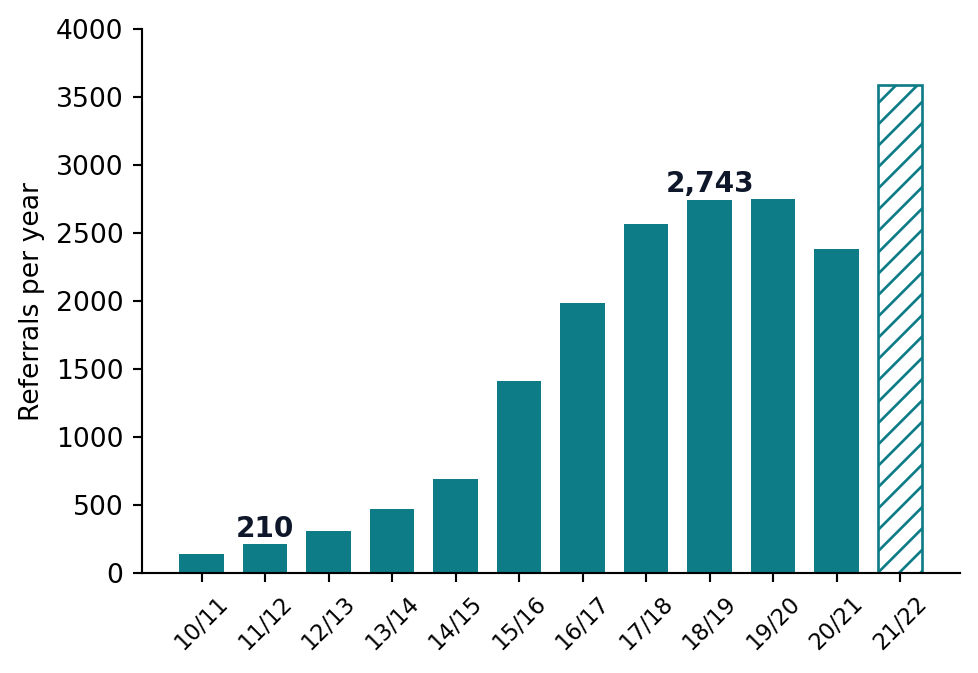
England’s youth gender service went from 210 referrals in 2011/12 to over 2,700 a year by 2018/19, now mostly birth-registered females in their early teens (Cass 2024).
- Visibility: stigma fell, so people suffering in silence came forward.
- A new population: today’s patients differ so much from those first studied that old evidence may not transfer.
Nobody has shown which reading is right.
The Pathway, by Age and Reversibility
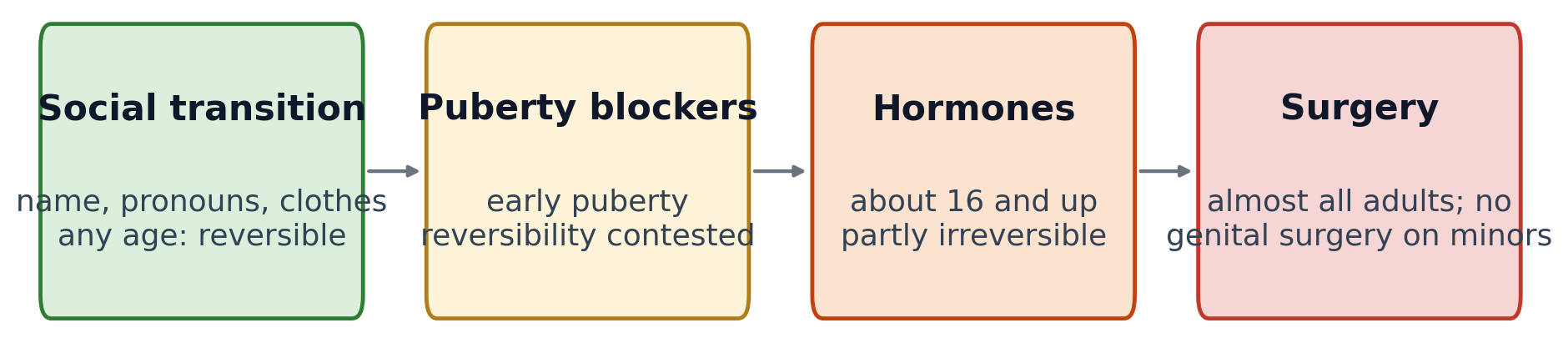
- Each arrow is a decision point, not a conveyor belt, and whether it works like one is itself a contested question.
- Public debate routinely blurs a 9-year-old’s pronouns, a 15-year-old’s hormones, and surgery: three decisions with different reversibility, evidence, and ethics. Getting the facts right is an ethical duty.
What Puberty Blockers Are
Puberty blockers (GnRH agonists), in plain language
They pause the hormones of puberty. They were developed for precocious puberty (a seven-year-old entering puberty) and used for decades: stop the drug, and puberty proceeds. Open questions remain about bone density and brain development during a years-long pause.
The model came from Amsterdam in the 1990s, the Dutch protocol: carefully screened adolescents could have puberty paused, buying time before any permanent step.
The original group was small and tightly selected: childhood-onset dysphoria, stable, supportive families. The core dispute is whether those results transfer to today’s very different patients.
Reversible chemistry is not the same as a reversible path, and that is where the evidence fight begins.
The Evidence
What the Systematic Reviews Found
The University of York ran systematic reviews for England’s Cass Review, the same machinery you met in research ethics. Their results matched earlier reviews in Sweden and Finland (Cass 2024).
- Puberty blockers: no consistent, reliable evidence of mental-health benefit. The studies are small, uncontrolled, and short.
- Hormones: some evidence of benefit, graded low or very low certainty.
- Hilary Cass’s summary: an area of “remarkably weak evidence.”
Important
Low certainty does not mean “no effect.” It means the true effect may differ substantially from what studies suggest, in either direction. Much of pediatrics runs on low-certainty evidence. The usual reason to set a higher bar here: these treatments are partly irreversible and the patients are minors.
Two Numbers Both Sides Claim
| The number | Read as success | Read as a warning |
|---|---|---|
| 87–98% of teens who start blockers go on to hormones (Brik et al. 2020; Carmichael et al. 2021) | screening works: those selected really needed transition | the “pause” is an on-ramp; consent to blockers is consent to more |
| About 1% regret, a figure often cited from older studies of adults | regret is rare | those adults were screened under stricter rules, many were lost to follow-up, and today’s teens may differ |
Same numbers, opposite lessons. What would settle it is the missing comparison: what would have happened without treatment.
The Trial That Couldn’t Start
“Just run a randomized trial” is the obvious answer. Recall research ethics: blinding is impossible (patients know whether puberty stopped), equipoise is disputed in both directions, and whoever picks the outcome measure half-decides the result.

“More research,” which every side endorses, is itself ethically hard. And “wait for evidence” is also a decision.
Two Defaults, One Evidence Base
The disagreement reduces to a choice between two rules for acting under uncertainty.
| The precaution default | The access default | |
|---|---|---|
| The rule | no irreversible treatment for minors without strong evidence of benefit | no withholding treatment from suffering patients without strong evidence of harm |
| Treats which error as worse? | treating someone who would have changed course | denying someone who needed it |
| Burden of proof sits on | the treatment | the restriction |
Both defaults are caution, and the evidence is silent on exactly the question they answer. Choosing between them is an ethical act, one every authority, court, and philosopher in this debate has made.
The Philosophers
The Case for Treating
Simona Giordano (2008) wrote the founding defense (Giordano 2008).
- Unwanted puberty also makes irreversible changes, to a patient who did not consent.
- So blockers are the cautious option: they buy time while preventing harm.
- If a pause may save the child’s life, it is deferring that is unethical.
Florence Ashley (2019) went further and questioned the gatekeeping itself (Ashley 2019).
- Long assessment treats trans identity as something to verify, and the waiting is the harm.
- Their alternative: support as the default; youth shouldn’t have to prove their gender.
- The reply: that default assumes a teen’s present identity predicts the adult’s.
The Skeptic, and the Scrambler
Moti Gorin (2024) asks: what is this care aiming at? (Gorin 2024)
- If it aims to relieve distress, the evidence that it lastingly does so is weak.
- If it aims to align body with identity, it treats a teen’s present self-view as authoritative about a future self, which medicine does nowhere else.
- His conclusion is not a ban. It is that the affirming default is unjustified until the evidence improves.
Maura Priest (2019) scrambles the politics: teens should get blockers even over their parents’ objection (Priest 2019).
- The state already limits parents who “mean well but cause harm”: vaccination, schooling, medical neglect.
- Her view unsettles both camps: parental-rights conservatives, and progressives who object when bans override parents.
- In Room 4, Riley’s father is the obstacle. Should that matter?
Gorin was also one of nine named contributors to the final (November 2025) version of the HHS report in the next section. Knowing who wrote a review is part of weighing it.
Feinberg, Claimed by Both Sides
You know Joel Feinberg’s right to an open future from genomics: children have rights held in trust that adults must not close off (Feinberg 1980). In this debate, both sides use it.
Blockers keep the future open
Unwanted puberty closes options permanently: the deeper voice, the changed body. A pause holds every door open until the patient can choose as an adult.
The pathway closes it
If blockers work as an on-ramp (recall that continuation rate), the “pause” quietly closes the door to reconciling with one’s birth sex before the patient can know what an adult self would want.
Which reading is right depends on the factual question (pause or on-ramp?) that the evidence can’t yet answer.
Thought Question
Return to Room 4 and seat the four philosophers around Riley’s bed.
- What would each (Giordano, Ashley, Gorin, Priest) say should happen next for Riley, and which single factual question, if answered, would most change their advice?
- Riley’s father asks you directly: “If we wait two years, what do we lose? If we proceed now, what do we lose?” Answer him honestly, using both versions of the open future.
- Which of the four principles is doing the most work in your answer?
After You’ve Discussed
Note
Pediatric ethics has a name for the fight over Riley’s maturity: risk-relative capacity. The capacity a decision requires scales with its stakes. A 15-year-old can consent to a flu shot, but refusing chemotherapy triggers a very different process.
Both sides accept this and still disagree, because they disagree about which choice is the high-stakes one: starting blockers, or going through unwanted puberty. Risk-relative capacity doesn’t settle Riley’s case. It names what the disagreement is.
The Authorities Disagree
The Map of Dueling Authorities
| Authority | Position | Standard invoked |
|---|---|---|
| AAP & Endocrine Society (U.S.) | affirming model; blockers and hormones after assessment | clinical consensus + observational studies |
| WPATH SOC8 (2022) | supports access; removed most minimum ages | consensus of the specialty field |
| Finland (2020), Sweden (2022) | psychosocial support first; medication exceptional | national evidence reviews |
| Cass Review (England, 2024) | extreme caution; blockers only within research | systematic reviews |
| HHS report (U.S., 2025) | psychotherapy first; questions the affirming model | evidence review; contributors named only in the final version |
Every row claims the evidence; the rows contradict. Note that the European turn began before Cass, in countries with no American-style culture war.
The Cass Review and Its Critics
The Review (2024)
- A four-year independent review for the NHS, led by pediatrician Hilary Cass.
- Conclusions: assessment first; blockers only within research, a restriction later made indefinite (Cass 2024).
The critique, and a test of process
- A Yale-led team: the Review held this care to a stricter standard than the rest of pediatrics (McNamara et al. 2024).
- The reply: irreversible treatment in minors is exactly where a higher bar belongs.
- The BMA’s 2026 evaluation upheld the evidence reviews, but found some claims only partly supported, and later restrictions beyond Cass’s advice (British Medical Association 2026).
Thought Question
Back in Room 4, Riley’s father has done his reading. He puts the HHS 2025 report on the table (U.S. Department of Health and Human Services 2025): “The government reviewed everything. It says therapy first.” Riley’s mother puts the Endocrine Society guideline next to it: “The actual specialists disagree.”
Both documents are real. Both claim the evidence. They are looking at you.
- What can you honestly say about why expert bodies disagree, without dismissing either as “just politics”?
- What would you examine to weigh each document: who wrote it, by what method, reviewed how?
- Is there anything you can offer this family that doesn’t depend on resolving the expert dispute?
After You’ve Discussed
Note
The distinction that organizes expert disputes: burden of proof versus standard of proof. Burden asks who must prove their case: the treatment, or the restriction? Standard asks how much evidence counts as enough.
The U.S. medical societies and the European reviews disagree about both, but their deepest split is the burden. Most “the evidence says” claims in this debate are burden-and-standard claims in disguise: value judgments wearing lab coats.
The Law
From Clinic to Courtroom
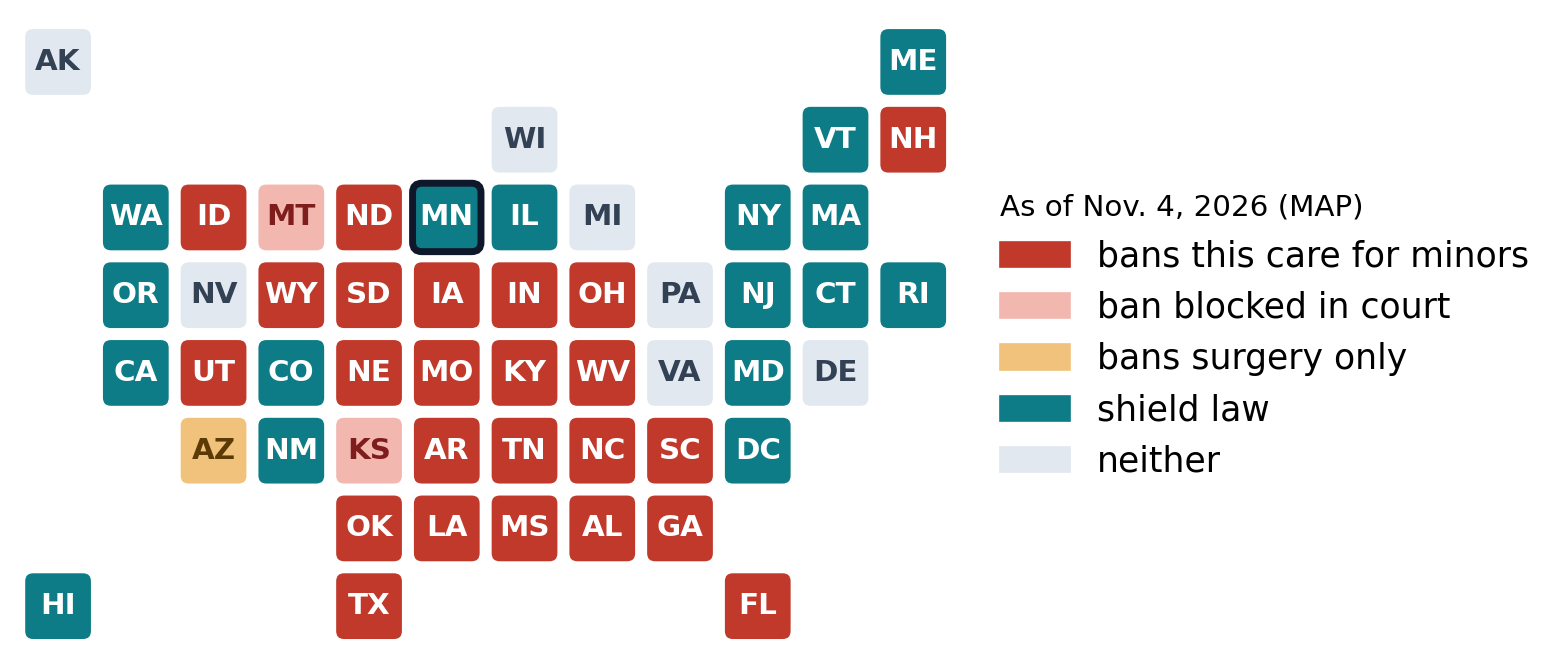
27 states ban this care for minors (courts have blocked two of those bans). 16 states and D.C., including Minnesota (outlined), have shield laws.
Skrmetti: Who Decides?
In June 2025 the Supreme Court upheld Tennessee’s ban, 6–3. The law sorts by age and medical purpose, not sex, the majority said, so only the most deferential review applied.
“We leave questions regarding its policy to the people, their elected representatives, and the democratic process.”
Chief Justice John Roberts, for the majority (Supreme Court of the United States 2025)
“By retreating from meaningful judicial review exactly where it matters most, the Court abandons transgender children and their families to political whims.”
Justice Sonia Sotomayor, dissenting
The Court decided who decides, not whether the bans are wise.
Practicing in the Patchwork
- Federal pressure reaches refuge states. A 2025 executive order told federally funded hospitals to stop this care for patients under 19. Courts have blocked its funding cutoffs, including in Minnesota, while appeals continue.
- Hospitals stopped anyway. Some children’s hospitals ended this care even where it is legal, because they would not gamble their federal funding on a lawsuit’s outcome.
- Records matter. Where a family came from, and what goes in writing, can carry legal weight across state lines.

Carol M. Highsmith Archive, Library of Congress. Public domain.
Thought Question
Every framework, clinical, philosophical, and legal, hits the same wall: someone must draw an age line for partly irreversible treatment, under uncertainty.
- Where would you put the line for puberty blockers? Is your line for hormones different? Why?
- Who should hold the pen: the family, the clinical team, a national guideline body, or the legislature? What does each get wrong?
- Tennessee’s line was 18, drawn by legislators; the Dutch protocol’s was about 12 and 16, drawn by clinicians. Defend one, or propose a third process and say who can veto whom.
After You’ve Discussed
Note
A final distinction: legal permission versus professional obligation. Law tells you what may be done where you stand; it never tells you what good care requires. After Skrmetti the two diverge state by state. A clinician in Memphis may believe care is needed that she legally cannot give; one in Minneapolis may legally give care she doubts. Conscience runs both ways.
Medicine has lived in this gap before, in the post-Dobbs exception cases. The skill is the same: know the law exactly, know your judgment honestly, and never confuse the two.
Mini-Recap
One question ran throughout: what should medicine, families, and the state do when evidence is low-certainty and the stakes are high in both directions? The reviews found weak evidence, and weak evidence licenses neither default. That is why the philosophers can share the data and split on the ethics, and why Feinberg’s open future lands on both sides of the same bed. The authorities split the same way. Skrmetti then handed the dispute to legislatures, leaving clinicians in a state-by-state patchwork.
Paired case: U.S. v. Skrmetti: the arguments on both sides, and what happened after the ruling.
Review Questions
Recall
State what the York systematic reviews concluded about puberty blockers and hormones, and explain, using the precaution and access defaults, why both sides claim that finding supports them.
Apply
Pediatric melatonin for sleep, off-label stimulant doses, and many NICU treatments also rest on low-certainty evidence. Pick one, run it through the two-defaults table, and identify what, if anything, makes the gender-care case relevantly different.
Debate
Cass recommended puberty blockers be available only within research trials, and then the trial itself stalled. Is “research-only access” a principled middle path or a ban in disguise? Defend your answer using equipoise.
Key Terms
- Gender dysphoria — DSM-5-TR diagnosis: marked, lasting distress from a mismatch between gender identity and birth sex.
- Puberty blockers (GnRH agonists) — drugs that pause puberty; long used for precocious puberty.
- Low-certainty evidence — the true effect may differ substantially from estimates; not the same as “no effect.”
- Continuation rate — the share of blocker patients who go on to hormones.
- Precaution vs. access default — opposite rules for acting under uncertainty; both are forms of caution.
- Risk-relative capacity — the capacity a minor’s decision requires scales with its stakes.
- Burden vs. standard of proof — who must prove their case, and how much evidence is enough.
- Shield / refuge law — state law protecting patients who travel for care, and their clinicians.
Further Reading
- Cass, Hilary. The Cass Review: Final Report. NHS England, 2024. (Read the foreword and recommendations yourself; most partisans clearly haven’t.)
- Gorin, Moti. “What Is the Aim of Pediatric ‘Gender-Affirming’ Care?” Hastings Center Report, 2024, with the replies to it in the same journal.
- Giordano, Simona. Children with Gender Identity Disorder: A Clinical, Ethical, and Legal Analysis. Routledge, 2012. (The fullest version of the founding pro-treatment case.)
References
Ashley, Florence. 2019. “Thinking an Ethics of Gender Exploration: Against Delaying Transition for Transgender and Gender Creative Youth.” Clinical Child Psychology and Psychiatry 24 (2): 223–36. https://doi.org/10.1177/1359104519836462.
Brik, Tessa, Lieke J. J. J. Vrouenraets, Martine C. de Vries, and Sabine E. Hannema. 2020. “Trajectories of Adolescents Treated with Gonadotropin-Releasing Hormone Analogues for Gender Dysphoria.” Archives of Sexual Behavior 49 (7): 2611–18. https://doi.org/10.1007/s10508-020-01660-8.
British Medical Association. 2026. Cass Review: Evidence, Interpretation, and Implementation. BMA Council paper C93 2025–26, May 2026. https://www.bma.org.uk/advice-and-support/equality-and-diversity-guidance/lgbtplus-equality-in-medicine/lgbtqplus-equality-in-medicine.
Carmichael, Polly, Gary Butler, Una Masic, et al. 2021. “Short-Term Outcomes of Pubertal Suppression in a Selected Cohort of 12 to 15 Year Old Young People with Persistent Gender Dysphoria in the UK.” PLoS ONE 16 (2): e0243894. https://doi.org/10.1371/journal.pone.0243894.
Cass, Hilary. 2024. The Cass Review: Independent Review of Gender Identity Services for Children and Young People — Final Report. NHS England. https://webarchive.nationalarchives.gov.uk/ukgwa/20250310143846/https://cass.independent-review.uk/home/publications/final-report/.
Feinberg, Joel. 1980. “The Child’s Right to an Open Future.” In Whose Child? Children’s Rights, Parental Authority, and State Power, edited by William Aiken and Hugh LaFollette. Littlefield, Adams.
Giordano, Simona. 2008. “Lives in a Chiaroscuro. Should We Suspend the Puberty of Children with Gender Identity Disorder?” Journal of Medical Ethics 34 (8): 580–84. https://doi.org/10.1136/jme.2007.021097.
Gorin, Moti. 2024. “What Is the Aim of Pediatric ‘Gender-Affirming’ Care?” Hastings Center Report 54 (3): 35–50. https://doi.org/10.1002/hast.1583.
McNamara, Meredithe, Anne Alstott, et al. 2024. An Evidence-Based Critique of “the Cass Review” on Gender-Affirming Care for Adolescent Gender Dysphoria. Yale School of Medicine and Yale Law School.
Priest, Maura. 2019. “Transgender Children and the Right to Transition: Medical Ethics When Parents Mean Well but Cause Harm.” The American Journal of Bioethics 19 (2): 45–59. https://doi.org/10.1080/15265161.2018.1557276.
Supreme Court of the United States. 2025. United States v. Skrmetti, 605 u.s. ___.
U.S. Department of Health and Human Services. 2025. Treatment for Pediatric Gender Dysphoria: Review of Evidence and Best Practices.
Bioethics OER · CC BY-NC 4.0 · Brendan Shea