Central Questions
- What is virtue ethics, and how does Aristotle understand human character and flourishing?
- What makes technology a moral concern — not just a tool but a shaper of who we are becoming?
- How might social media and AI undermine intellectual virtues like curiosity and open-mindedness?
- How might digital environments erode moral virtues like empathy, patience, and honesty?
- Are virtue ethics arguments for technology regulation compatible with individual liberty?
Introduction: What Is Virtue Ethics?
Most ethical debates about technology focus on actions: Should platforms remove harmful content? Should companies collect data on children? Both share a framing — ethics as sorting permitted actions from prohibited ones. A different tradition asks something more fundamental: not "What should I do?" but "What kind of person am I becoming?"
This is the central question of virtue ethics, the oldest sustained tradition in Western moral philosophy, rooted in Aristotle. Rather than a decision procedure for individual acts, it asks about character — the stable dispositions to perceive, feel, and act that define who we are over time. Technology is then a moral issue because the daily practices of digital life shape the people we are becoming.
Chapter 1 traced a recurring pattern: each technology reshapes not just what people can do but how they think and relate. Writing atrophied oral memory; print enabled mass propaganda; mass media created the preconditions for totalitarianism. Virtue ethics names what is at stake: our intellectual and moral character. If character is formed by what we repeatedly do, the habits built by hours of daily screen time are not ethically neutral.
This chapter develops three arguments — that social media and AI may undermine intellectual virtues, erode moral virtues, and cumulatively threaten eudaimonia — then surveys policy responses and the strongest objections.
We are what we repeatedly do. Excellence, then, is not an act, but a habit.
Will Durant, The Story of Philosophy (1926), summarizing Aristotle
That sentence is almost always credited to Aristotle. It is not his. The words are Will Durant's , written in 1926 to summarize Aristotle on habituation in Book II of the Nicomachean Ethics . Over the following century the quotation marks quietly migrated from the summarizer to the philosopher summarized. A vivid paraphrase attached to a famous name travels further than an accurate citation, and every repetition makes the attribution look better established. Durant captures Aristotle faithfully, which is why it spread — but the difference between "Aristotle wrote this" and "someone summarized Aristotle this way" is the distinction this chapter's intellectual virtues protect.
Thought Questions
- Deciding how to spend the next hour, how would your answer to "What should I do?" differ from "What kind of person am I becoming?"
- Had you seen the "we are what we repeatedly do" line attributed to Aristotle? What would it take for you to check an attribution before repeating it?
- Which of your own habits of thought were formed by a technology rather than chosen by you?
Aristotle's Ethical Framework
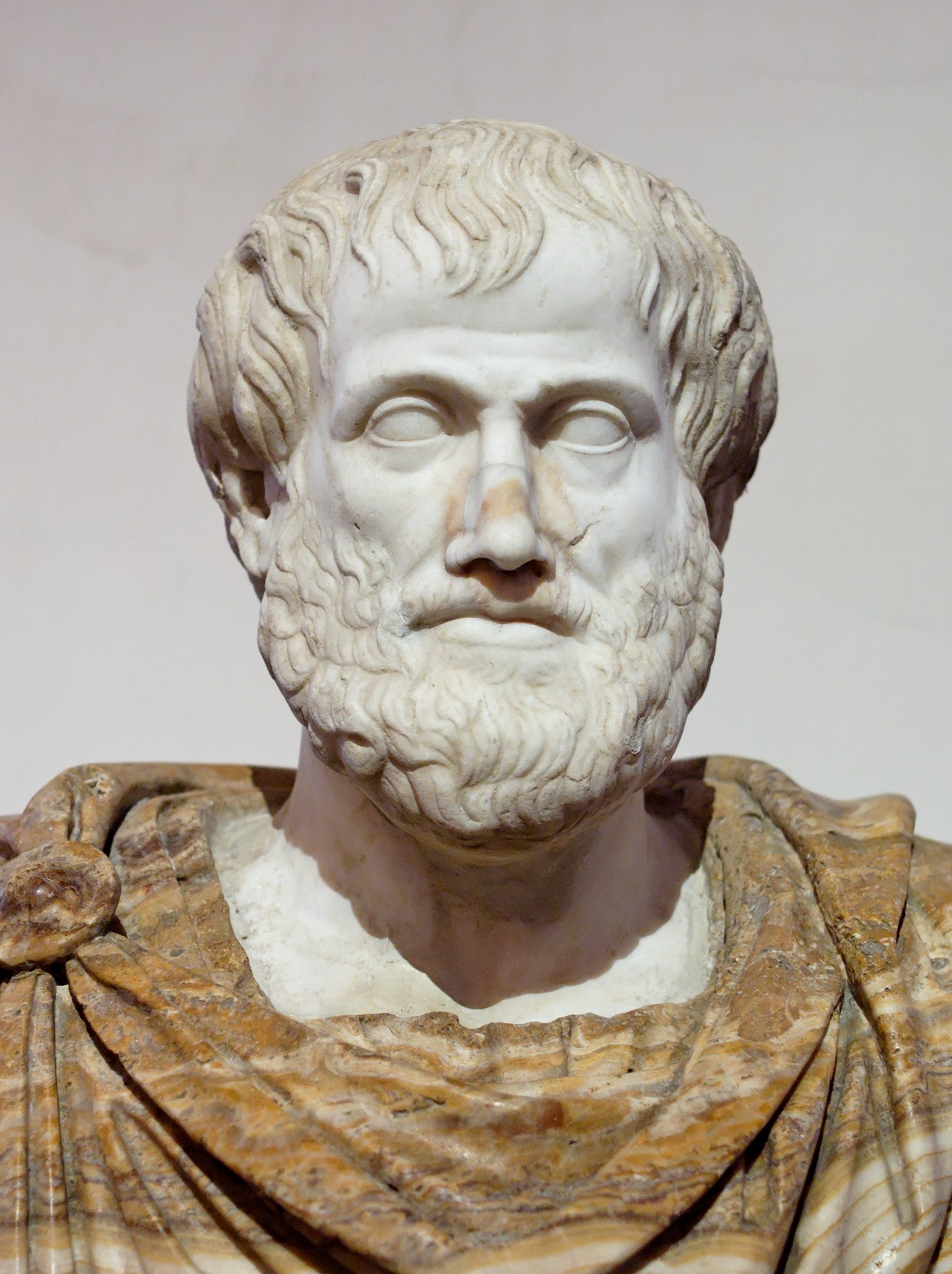
Aristotle (384–322 BCE). Roman marble copy of a Greek bronze by Lysippos, c. 330 BCE. Museo Nazionale Romano, Rome. Public domain.
Aristotle (384–322 BCE)
Born in Stagira, Aristotle studied at Plato's Academy for twenty years before founding the Lyceum in Athens. He tutored the young Alexander the Great and was known to medieval scholars simply as "the Philosopher." His Nicomachean Ethics, named for his son Nicomachus, remains one of the most carefully argued works of moral philosophy ever written. Unlike Plato, who grounded ethics in ideal Forms, Aristotle began with the observable world.
Aristotle begins the Nicomachean Ethics with a simple observation: every action aims at some good. We eat to satisfy hunger, study to acquire knowledge, work to earn money. But is there a highest good, pursued for its own sake alone? He argues that the answer is eudaimonia, usually translated "happiness" or "flourishing," but richer than either word conveys.
Eudaimonia
Aristotle's term for human flourishing: the activity of the soul in accordance with virtue, sustained over a complete life. It names a way of living well, not a way of feeling good.
Eudaimonia is neither the pleasant emotional state of a good day nor the life satisfaction you report when surveyed. It is what your life amounts to when you have exercised your distinctively human capacities — above all, reason — excellently. One can feel pleasure while doing something vicious; a person living in eudaimonia is, by definition, living well.
| Eudaimonia | Hedonic Happiness | Life Satisfaction | |
|---|---|---|---|
| Focus | Living virtuously | Feeling pleasure | Judging life positively |
| Timeframe | Complete life | Momentary | Retrospective |
| Source | Virtuous activity | Pleasant experiences | Meeting expectations |
| Can be wrong? | No — it's constitutive of a good life | Yes — you can feel happy doing wrong | Yes — you can be mistaken about your life |
The last row does the most work. Hedonic happiness and life satisfaction report how a life seems from the inside, and both can be mistaken; eudaimonia is a claim about how the life is actually going. Social media is very good at momentary pleasure — whether those pleasures contribute to flourishing is a separate question.
Virtue and the Doctrine of the Mean
How does one achieve eudaimonia? Through virtue (in Greek, aretē), a stable disposition to act, feel, and perceive in an excellent way. Virtues are not rules followed from outside but traits of character internalized through practice. The courageous person does not overcome fear by an act of will on each occasion — courage has become part of who they are.
Aristotle famously describes each virtue as a mean between two extremes: courage between cowardice and recklessness, generosity between miserliness and profligacy. The mean is not a mathematical midpoint but what suits the situation and the person — patience with a search engine differs from patience in a friendship. The person with practical wisdom, phronesis, perceives what virtue requires in each case.
Aristotle distinguishes two categories of virtue. Intellectual virtues are excellences of the reasoning mind: theoretical wisdom (sophia), practical wisdom (phronesis), scientific understanding (episteme), intuitive reason (nous), and craft knowledge (techne). Moral virtues are excellences of character: courage, temperance, justice, generosity, honesty. Phronesis is the "master virtue," required to apply all the others correctly; it cannot be reduced to rules or algorithms.
Phronesis (practical wisdom)
The capacity to perceive what a particular situation calls for and to act accordingly. Aristotle treats it as the master virtue, because every other virtue depends on knowing how much, when, toward whom, and in what manner it should be exercised.
Crucially, both types of virtue are acquired through practice. As Aristotle writes, "We become just by doing just acts, temperate by doing temperate acts, brave by doing brave acts." The environment in which we practice therefore matters immensely — which is why technology is a moral concern at the deepest level. It structures where we practice being human.
(Reason)"] -->|"cultivate"| B["Virtue
(Aretē)"] B -->|"expressed in"| C["Flourishing
(Eudaimonia)"] style A fill:#d8e6f5,stroke:#003875 style B fill:#d8e6f5,stroke:#003875 style C fill:#003875,color:#fff,stroke:#003875
Thought Questions
- What would the mean be for time spent online — and who should determine it, you or the platform?
- Describe a skill where you can see the right move without stating the rule you are following. How close is that to phronesis?
- Suppose someone reports being very satisfied with a life you consider wasted. Does Aristotle's account give you grounds to disagree, and should it?
The Modern Revival of Virtue Ethics
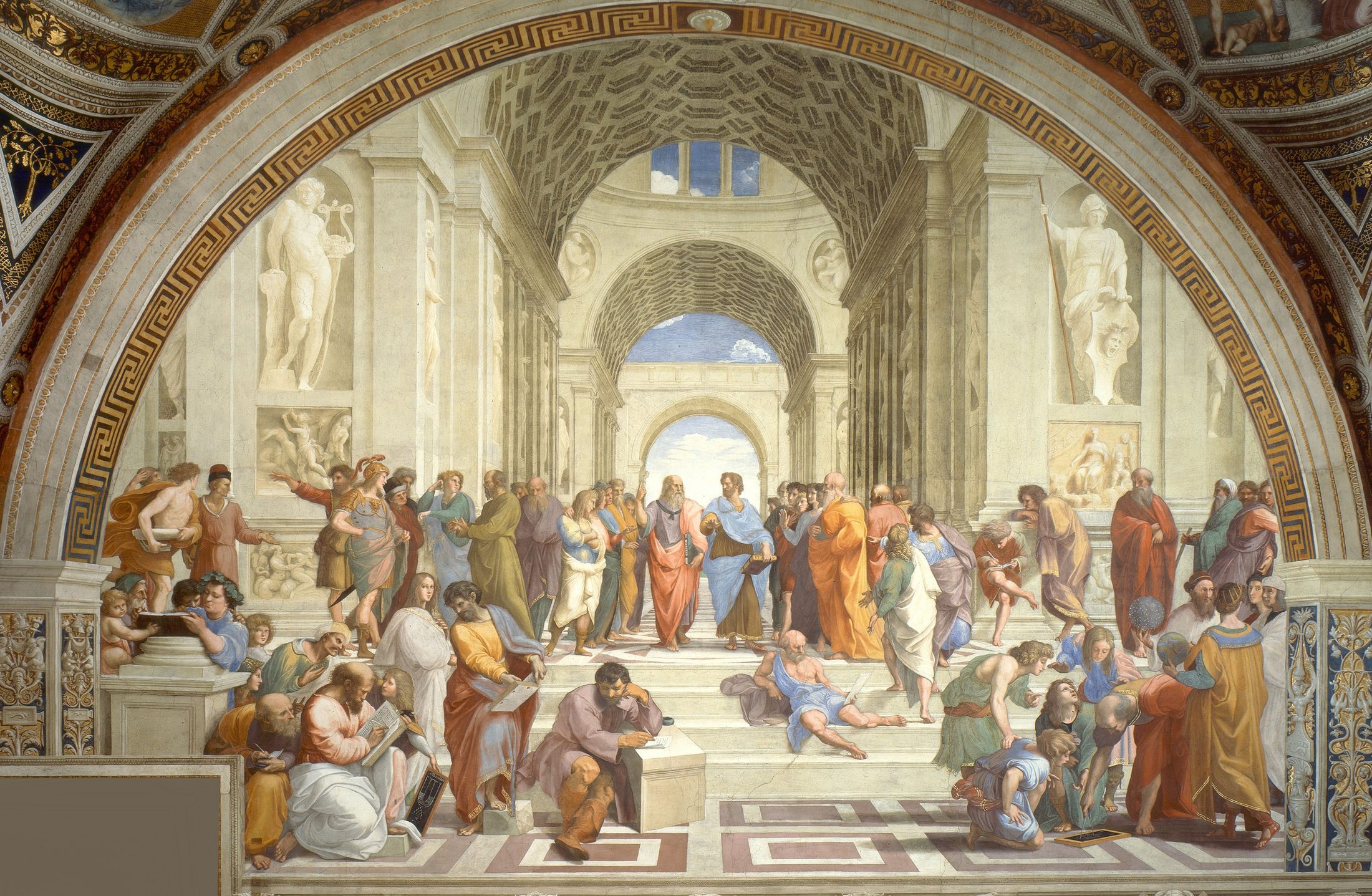
For much of the twentieth century, moral philosophy was dominated by Kantian deontology (ethics as rule-following) and utilitarian consequentialism (ethics as maximizing well-being). Both evaluated individual actions rather than character. The revival of virtue ethics began in the late twentieth century, driven by dissatisfaction with both.
Alasdair MacIntyre (1929–2025)
Scottish-American philosopher, for many years at the University of Notre Dame, whose landmark book After Virtue argued that modern moral philosophy had collapsed into fragmented, incommensurable viewpoints — what he called "emotivism," the view that moral statements are merely personal preferences dressed up in objective-sounding language. Virtues, he contended, are intelligible only within the social practices and traditions that give them meaning.
MacIntyre's diagnosis hits close to home. Moral discourse on platforms optimized for engagement rather than truth becomes what he feared: a clash of incompatible emotional reactions, amplified by algorithms that reward outrage. He writes that he "can only answer the question 'What am I to do?' if I can answer the prior question 'Of what story or stories do I find myself a part?'" Replacing narrative coherence with a feed of disconnected moments is, on this view, a threat to the preconditions of moral life.
The British-born New Zealand philosopher Rosalind Hursthouse answered a common objection: that virtue ethics fails to guide action. It generates "v-rules" — "Do what is honest," "Don't do what is cruel" — which derive their content from character rather than obligation and must be applied with practical wisdom. The virtuous person is not following a checklist but seeing what honesty requires here and now.
Martha Nussbaum developed the capabilities approach: flourishing requires the ability to exercise core human capacities — life; bodily health; senses, imagination, and thought; emotions; practical reason; affiliation; play; and control over one's environment. This connects virtue ethics to justice and policy, and gives us a checklist for asking whether social media helps or hinders.
Shannon Vallor
American philosopher of technology, since 2020 the Baillie Gifford Professor in the Ethics of Data and AI at the University of Edinburgh, where she directs the Centre for Technomoral Futures. Her Technology and the Virtues is the most systematic application of Aristotelian ethics to digital technologies. Technology is not ethically neutral: through habitual use we cultivate either virtues or vices. She proposes twelve "technomoral virtues" for the digital age, from honesty and self-control to magnanimity and technomoral wisdom. Character is still shaped by habituation — but our habituating environment now includes billions of hours with systems designed for profit rather than flourishing.
A useful label for the ambiguity Vallor describes is the Greek pharmakon, "poison" and "cure" at once — the word Plato's Socrates used for writing in the Phaedrus . Social media is not inherently vicious; it could be designed to cultivate patience, honest discourse, and genuine connection. But as presently constituted, Vallor argues, it habituates users toward vice. The question is not whether technology shapes our character — it already does — but whether we will control how.
Thought Questions
- MacIntyre claimed you cannot answer "What am I to do?" without knowing what story you are part of. What story does your social media presence tell, and did you choose it?
- Run Nussbaum's capabilities list against a platform you use daily. Which capabilities does it support, and which does it crowd out?
- Which virtue would you add to Vallor's twelve for the age of AI, and what practice would develop it?
Intellectual Virtues Under Threat
The intellectual virtues Aristotle prized — curiosity, love of truth, humility, open-mindedness, courage, autonomy — are not possessions but active dispositions. One becomes intellectually humble by repeatedly confronting the limits of one's knowledge; curious by following questions wherever they lead. Like physical fitness, intellectual virtue atrophies without practice.
What's the Argument?
Argument 1: The Intellectual Vice Argument
- Intellectual virtues are cultivated through sustained, effortful cognitive practices: sustained attention, active memory work, critical analysis, and deep reading.
- Social media and AI systematically replace or undermine these practices.
- Habituation in intellectually passive behaviors cultivates intellectual vice rather than virtue.
The first premise is about how minds develop, the second an empirical claim about what technologies do, the third a restatement of Aristotle on habituation. Each is separately contestable, and this section examines them in turn — as commitments to be checked, not a verdict reached.
The Attention Crisis
In The Shallows , journalist and technology critic Nicholas Carr argued that internet use is rewiring the brain for distraction. The case is not that the internet makes us less intelligent, but that habitual media use trains the mind toward shallow, rapid scanning at the expense of sustained attention. Deep reading — following complex arguments, inhabiting another perspective — needs attention held over long periods, a capacity Carr argues is degraded by constant interruptions and notifications.
Jonathan Haidt's work on adolescent mental health adds a generational dimension. The shift to smartphones as the main medium of teenage social life, which he dates to around 2012, coincided with rising reported depression and anxiety and declines in book-reading and face-to-face talk. Whether these trends are causally connected is genuinely disputed; the eudaimonia section takes up that dispute. The proposed mechanism is continuous partial attention: no task gets full concentration because attention is always partly on incoming notifications. William James called the capacity to return a wandering attention voluntarily "the very root of judgment, character, and will" .
| Period measured | Average time on one screen before switching |
|---|---|
| 2004 | ~2.5 minutes |
| ~2012 | ~75 seconds |
| Late 2010s onward | ~47 seconds |
The 47-second figure is among the most frequently mangled statistics in the debate. In observational studies of knowledge work, Mark's teams measured how long focus stayed on one screen before shifting — screen-switching behavior, not the mind's capacity for concentration. Popular retellings convert it into "the human attention span has fallen to 47 seconds," a much stronger claim the research does not establish. The finding still matters: a better-than-threefold increase in switching over two decades is a real change. A virtue ethicist committed to the love of truth should be first to notice a statistic upgraded in transit. Treat phone-checking counts the same way — estimates range from roughly 60 to well over 150 a day depending on whether checking is self-reported or logged.
Outsourcing Memory and Cognition
A related concern involves what cognitive scientists call cognitive offloading — using technology as an external supplement to mental processes that were previously performed internally.
Cognitive offloading
Shifting part of a mental task onto something outside the mind — a note, a calculator, a search engine, a chatbot — so that the external resource carries work the brain would otherwise do.
Offloading is ancient and often sensible; a shopping list is cognitive offloading. What makes the digital case distinctive is scale and automaticity. The best-known evidence, from Betsy Sparrow and colleagues and described below, is that people who expect to look something up later are less likely to encode it. This "Google Effect" may be shifting us from knowers who have internalized information to retrievers who know where to find it.
Case Study
The Google Effect Experiments (2011)
In July 2011, psychologists Betsy Sparrow, Jenny Liu, and Daniel Wegner published "Google Effects on Memory" in Science : four experiments testing whether knowing that a computer will remember something for you changes whether you remember it yourself.
In one, participants typed forty short trivia statements into a computer. Half were told the file would be saved; half that it would be erased. All were asked to remember them. Those who believed the information had been saved recalled significantly fewer, despite identical typing and instructions. In a further experiment, participants who saved each statement into a named folder recalled the folder better than the statement — memory reorganized around retrieval paths.
Two cautions: the effects were modest, and later replication work has been mixed, so treat this as suggestive rather than settled. Still, the mechanism is the one virtue ethics cares about — not laziness, but a reliable external memory silently changing what minds bothered to do.
Carr notes that the medieval monks who invented many techniques of deep reading understood something important: committing texts to memory is not rote learning but a process that lets ideas combine and generate new thoughts. Stored externally, information cannot do this. And when AI tools compose arguments on our behalf, we lose not only the product of the effort but the intellectual character it was building.
Epistemic Bubbles and Echo Chambers
Philosopher C. Thi Nguyen draws a distinction easy to miss. An epistemic bubble is an information gap: you are simply not exposed to certain viewpoints. An echo chamber is more insidious — outside voices have been discredited, so contrary evidence reinforces suspicion of the messenger instead of updating belief. Bubbles are corrected by exposure; echo chambers cannot be, because the mechanism of correction is disabled.
| Epistemic Bubble | Echo Chamber | |
|---|---|---|
| Mechanism | Other voices simply not heard | Other voices actively discredited |
| Result | Missing information | Systematic distrust of outside sources |
| Fix | Exposure to other views | Rebuilding trust — much harder |
Algorithmic curation creates bubbles by design. Someone who clicks a few videos skeptical of vaccine safety is served progressively more from the same cluster of creators — not because they are correct, but because that pattern predicts more engagement. They now "know" much about vaccine skepticism and little about the scientific literature. At the echo chamber stage, they have also learned to treat anyone citing mainstream sources as a paid shill.
AI and Intellectual Dependency
The most recent challenge comes from large language models. Vallor warns of "moral deskilling": the erosion of human capacities when machines take over tasks we once performed . The worry is analogous to the one about calculators but deeper — a calculator bypasses one skill, while an AI that writes your argument may bypass the whole struggle through which analytical thinking develops.
Consider two students writing a philosophy essay. One spends an hour struggling to articulate Kant's categorical imperative, discarding drafts, rereading the original, finally arriving at a formulation they can defend. The other types a prompt and gets a polished paragraph in ten seconds. The second has a product; the first has a capacity — and the capacity, built through the struggle, is the whole point. Whether the concern is warranted will take years to settle empirically, but it is the question a virtue ethicist would ask.
Thought Questions
- When was the last time you read something complex for thirty or more minutes without checking your phone? Does the difficulty matter?
- Can you think of knowledge or skills you once had that you now rely on technology for? How does that feel?
- The "47 seconds" statistic is true of screen-switching and false about attention spans. What would you check before repeating a striking number you saw online?
Moral Virtues Under Threat
If intellectual virtues are developed through effortful cognitive practice, moral virtues are developed through the irreplaceable work of living alongside other people. Empathy develops through exposure to others' vulnerability; patience through waiting; honesty through repeatedly choosing truth over convenience. Consider what is lost when a difficult conversation that would once have been face-to-face is conducted by text. The recipient does not see your hesitation; you do not sit with their pain. Both have been spared the discomfort that is, arguably, where moral learning happens.
What's the Argument?
Argument 2: The Moral Vice Argument
- Moral virtues are cultivated through embodied, face-to-face social practices involving vulnerability and reciprocity.
- Digital mediation systematically replaces or degrades these practices.
- Online environments actively habituate users toward moral vices: cruelty, impatience, dishonesty, and performative virtue.
The structure mirrors Argument 1, and so do its vulnerabilities. The third premise is boldest: not merely that online life offers fewer chances to practice virtue, but that it supplies active practice in vice. That is what this section defends, and what an opponent should attack first.
Face-to-Face Conversation as Moral Practice
MIT sociologist Sherry Turkle has spent decades studying how people relate to technology. In Reclaiming Conversation , she argues that face-to-face conversation is irreplaceable as the context in which empathy develops. In person we receive a continuous stream of non-verbal information — expression, posture, tone, eye contact — that makes another's inner life viscerally present, and we get immediate feedback when our words land wrong. Avoiding those demands is exactly what text-based communication allows.
The demands are, Turkle argues, the moral substance of relationship. "Face-to-face conversation is the most human — and humanizing — thing we do," she writes. "Fully present to one another, we learn to listen. It's where we develop the capacity for empathy." There is some quantitative support: a cross-temporal meta-analysis by Sara Konrath and colleagues, pooling seventy-two samples of American college students who took the Interpersonal Reactivity Index between 1979 and 2009, found self-reported empathic concern and perspective-taking down roughly 40 percent, sharpest after 2000 . Two qualifications: these are self-reports, not observed behavior, and the data end in 2009, before smartphones were widespread — so the study cannot show smartphones caused the decline, only that something was already eroding self-reported empathy in the early internet era.
Online Disinhibition and the Normalization of Cruelty
Psychologist John Suler identified what he called the "online disinhibition effect" : the well-documented phenomenon that people behave more aggressively, dishonestly, and cruelly online than they would in person. He catalogued the features of online environments that produce this effect.
| Factor | Effect on Behavior |
|---|---|
| Anonymity | "You don't know me" — reduced accountability for actions |
| Invisibility | Can't see the victim's pain — reduced empathy cues |
| Asynchronicity | No immediate feedback — easier to say things you'd regret in person |
| Dissociative imagination | Online self feels separate from the "real" self |
| Minimization of authority | Flattened hierarchies reduce ordinary social restraints |
Suler's list is not a list of excuses but of the ordinary restraints in-person life supplies and online environments remove. Online disinhibition is therefore a moral habituation problem, not a content-moderation problem. Every time a person says something cruel online that they would not say to a face, they practice cruelty — and every cruel act, if Aristotle is right, shapes character in that direction.
Case Study
Justine Sacco and the Eleven-Hour Flight (December 2013)
On 20 December 2013, Justine Sacco, a corporate communications director at the media company IAC, posted a tasteless joke to her Twitter account before boarding an eleven-hour flight from London to Cape Town: "Going to Africa. Hope I don't get AIDS. Just kidding. I'm white!" She had 170 followers. Then she turned off her phone.
By the time she landed, #HasJustineLandedYet was the top trending topic worldwide. Thousands who had never heard of her spent the day composing jokes, calls for her firing, and — in many cases — wishes that she be raped or infected with HIV. One user went to Cape Town airport to photograph her arrival. She was fired, and Jon Ronson later reconstructed the episode in So You've Been Publicly Shamed .
What makes the case philosophically interesting is not the tweet but the pile-on. Ronson found that participants, interviewed afterward, were largely decent people who experienced the day as a satisfying act of collective justice. Every factor in Suler's table was in play: they could not see her, she could not answer, the crowd gave cover, the reward arrived immediately. This is what Aristotle predicts should be corrupting — not one monstrous choice by one monstrous person, but ordinary people getting a great deal of pleasurable practice at cruelty and calling it justice.
Outrage as a Business Model
Jonathan Haidt's research on social media's transformation of public discourse pinpoints 2009 as pivotal . That year Facebook added the Like button and Twitter the Retweet — small design choices that altered the incentive structure of online communication. Content generating anger and moral outrage gets more engagement, and engagement is rewarded by amplification. The cycle is self-reinforcing: emotional temperature rises, users are trained toward extremism, and what was once inflammatory becomes routine.
One name for what this rewards is moral grandstanding — a term introduced by the philosophers Justin Tosi and Brandon Warmke in 2016 for the use of public moral talk as a vehicle for self-promotion , and taken up by Haidt and others to describe what engagement-optimized platforms select for. The grandstander performs outrage rather than acting: an hour spent sharing angry posts counts as "doing something" while addressing nothing. On an Aristotelian view this is worse than inaction, habituating a person toward the performance of virtue while bypassing its practice.
Dishonesty and the Curated Self
Digital platforms also reward systematic inauthenticity. The curated profile creates a performed identity that diverges from lived experience — an ongoing dishonesty toward one's audience and oneself. Over time, Turkle argues in Alone Together , the performance can feel more real than the reality: people manage their lives to generate content rather than living directly.
Hannah Arendt warned that the erosion of a shared sense of reality is one of the preconditions of tyranny.
The ideal subject of totalitarian rule is not the convinced Nazi or the convinced Communist, but people for whom the distinction between fact and fiction and the distinction between true and false no longer exist.
Arendt was describing the 1930s and 1940s, not the internet, and the analogy should not be pressed far. But her point was structural: tyranny does not require that everyone believe a lie, only that enough people stop believing the difference between true and false is worth maintaining. When deepfakes and strategic misinformation make it hard to know what is real, practices that depend on a shared factual world are threatened. Honesty has collective political stakes.
| Virtue | Traditional Practice | Digital Replacement |
|---|---|---|
| Empathy | Face-to-face conversation | Text-based interaction |
| Patience | Waiting, delayed gratification | Instant everything |
| Civility | Social norms, accountability | Anonymous or pseudonymous cruelty |
| Honesty | Reputation, trust-building over time | Curated, optimized personas |
| Temperance | Natural limits on stimulation | Infinite scroll, autoplay, push notifications |
The right-hand column is deliberately unflattering, and a fair reader should push back. Each row is a substitution rather than a loss: text reaches people conversation cannot; pseudonymity shelters harassers but also whistleblowers. The claim is not that every digital practice is worse, but that the replacements demand less of us — and virtue is built by what demands something of us.
Thought Questions
- Have you ever written something online that you would not have said to someone's face? What made it easier?
- In what ways does your social media profile represent who you actually are, and in what ways who you want to appear to be?
- Justine Sacco's tweet was genuinely offensive. Was a proportionate response available to the thousands who saw it, and what would it have looked like?
Eudaimonia Under Threat
Beyond specific virtues, the deepest Aristotelian concern is the shape of a complete life. Eudaimonia requires the integrated exercise of our highest capacities across time, amid genuine relationships, purposeful activity, and honest self-knowledge. Social media and AI may fragment attention, commodify relationships, and distort self-understanding in ways that threaten those conditions.
What's the Argument?
Argument 3: The Diminished Flourishing Argument
- Eudaimonia requires the integrated exercise of virtue across a complete life, including meaningful relationships, purposeful activity, and self-knowledge.
- Social media and AI fragment attention, commodify relationships, and distort self-understanding.
- These effects directly impede the conditions necessary for eudaimonia.
The Mental Health Crisis
The most widely discussed evidence for the eudaimonia argument is the rise in reported adolescent distress since roughly 2012. Haidt argues in The Anxious Generation that depression, anxiety, and self-harm among American teenagers — particularly girls — began climbing sharply around that year, close to the point at which smartphones became the majority technology among American teens. Social media, he proposes, enables comparison at a previously impossible scale; add phones displacing sleep and screens displacing face-to-face time, and the conditions are particularly corrosive for developing minds.
Public health authorities have taken the worry seriously without endorsing the causal claim. The 2023 United States Surgeon General's advisory concluded that the evidence of harm justified precaution but was insufficient to establish that social media is safe — not the same as concluding it is the cause . This is the chapter's most contested claim, so it deserves the strongest case against.
Objection
Critics including the developmental psychologist Candice Odgers and the researchers Amy Orben and Andrew Przybylski argue that the causal claim outruns the evidence. Nearly all the underlying studies are correlational, and the correlations are small: in one large reanalysis the association between digital technology use and adolescent well-being was comparable to that of wearing glasses or eating potatoes . Reverse causation is at least as plausible — struggling teenagers may turn to their phones rather than being made to struggle by them. Rival explanations for the post-2012 rise must be beaten, not assumed away: changing diagnostic practice, reduced stigma, academic pressure, economic insecurity. Odgers's Nature review puts it bluntly: the book tells a compelling story, but the science does not yet support the conclusion that social media is rewiring childhood .
Haidt's reply is that the skeptics look at the wrong evidence: correlational studies of average daily use find small effects because the harm is concentrated and the measure crude, while deactivation experiments and the same inflection appearing across many countries tell a stronger story. Critics respond that deactivation experiments are short, small, and inconsistent, and that international synchrony is what any globally shared event would produce .
Where does that leave the virtue ethicist? Aristotle held that eudaimonia requires conditions supporting human development, so how those conditions are designed for the young is unavoidably an ethical question. But the answer depends on disputed facts, and a chapter that quietly resolved the dispute in its own favor would practice the vice it warns against. The smartphone hypothesis is serious, live, and unproven.
Commodified Relationships and the Loneliness Epidemic
Alone Together captures a paradox: we are more "connected" than any humans in history, yet loneliness is now a public health problem. Social media friendship is measured by metrics — followers, likes, streaks — only loosely related to what makes friendship nourishing: shared vulnerability, mutual care, reciprocal knowledge of one another's inner lives.
Dating apps extend this to romance, subjecting partners to rapid evaluation and easy disposal in ways that may undermine the patience intimacy requires. Parasocial relationships — the one-sided bonds users form with influencers and increasingly AI companions — offer the texture of relationship without its reciprocal demands. Turkle worries that we have come to "expect more from technology and less from each other" , eroding our capacity for the connection eudaimonia depends on.
Algorithmic Identity and Distorted Self-Knowledge
Aristotle placed self-knowledge at the foundation of the ethical life. "Know thyself" was for him a demanding requirement: virtue requires perceiving our own motivations clearly and understanding the gap between who we are and who we aspire to be. That self-knowledge is threatened when our self-image is partly constructed by algorithms.
Recommendation algorithms build a mirror image of you from your behavior. But it reflects what captures your attention, not what you reflectively endorse. The loop between your behavior, the algorithm's model, and the content it feeds you can lock people into identities they would not have chosen — replacing the examined life with a product optimized from a browsing history.
Thought Questions
- How many of your online connections would you describe as genuine friendships? What distinguishes a genuine friend from a follower?
- Have you ever felt that spending time on social media made you feel worse about your own life? What was the mechanism?
- Orben and Przybylski found that social media use predicts adolescent well-being about as strongly as wearing glasses does. Does that change your view, or is it measuring the wrong thing?
Policy Responses
If the diagnosis is correct, what follows practically? Two categories of response are available: individual responses that change personal habits, and structural responses that address design and regulation. Virtue ethicists see both as necessary, since willpower is limited and environmental design shapes what habits are even possible.
| Individual Responses | Structural Responses | |
|---|---|---|
| Examples | Phone-free meals, digital sabbaths, attention training | Age restrictions, design mandates, algorithm transparency |
| Advantages | Personal agency, immediately actionable | Addresses root causes, applies equally |
| Limits | Willpower is exhaustible; advantage goes to tech firms | Raises paternalism concerns; difficult to enforce |
The bottom row is where the interesting arguments live. Individual responses are limited because willpower runs out and the platforms do not; structural responses must survive political objection and the problem of enforcement. Vallor calls the individual ones — digital detoxes, attention training, face-to-face commitments — essential but insufficient: they cultivate the eroded virtues, but require swimming against a powerful commercial current.
Australia's Under-16 Ban: A Natural Experiment
Until recently, arguments about restricting children's access to social media were entirely hypothetical. That changed in December 2025, when Australia became the first country to put such a restriction into force nationwide — letting us watch a structural response meet the enforcement problem in public.
Case Study
Australia's Under-16 Social Media Ban (2024–2026)
The Online Safety Amendment (Social Media Minimum Age) Act 2024 took effect on 10 December 2025 . The design matters: the legal duty falls on platforms, which must take "reasonable steps" to prevent under-16s from holding accounts; no penalty attaches to a child or parent. Ten services are covered — Instagram, TikTok, YouTube, X, Reddit and others — but not WhatsApp, Discord, or Roblox.
After seven months the results were instructively mixed. Platforms removed or restricted more than five million under-16 accounts, yet eSafety data showed usage falling only from 85.9% to 81.5% . A Molly Rose Foundation survey of 1,050 Australian 12- to 15-year-olds found 61% of former account-holders still had access to at least one and 70% called getting around the ban "easy" . Only 4–5% used a VPN: the workaround was social, not technical — a parent's ID, a friend's account, a false birth date.
An April 2026 National Bureau of Economic Research paper co-authored by Cass Sunstein found fewer than one in three 14- and 15-year-olds complying at four months, and roughly one in twenty two months later . Teenagers reported needing about two of every three peers to comply before they would — a tipping point — and those who complied reported more boredom and more difficulty keeping up with friends.
Enforcement stayed quiet: no fines as of July 2026, though investigations into five major platforms opened in March, and no clear decline in cyberbullying or image-abuse complaints. Public support among Australian adults nonetheless rose.
Read as a natural experiment, the case is more interesting than either side's talking points. It did not fail: a four-point drop in a behavior this entrenched is real. Nor did it do what it promised: four in five under-16s are still on social media, most who left could return tomorrow, and nobody has been fined. Three ethical questions follow.
First: does a law count as working if it is popular but unenforced? On one view an unenforced law is theatre — a government claims to have acted while the harm continues, and young people learn that rules are things you route around. On another, legislation expresses a public norm, and norms shift slowly. The two-thirds tipping point suggests a law's real work may be to move a population toward that threshold rather than to punish individuals, in which case seven months is far too early to score it. Aristotle, who thought law's function was to habituate rather than punish, would have preferred this reading — though a law nobody obeys habituates nobody.
Second: is it fair that partial compliance mainly costs the students who obeyed? The teenagers who followed the rule reported more boredom and more difficulty keeping up with friends — because their friends had not. Where a restriction's benefit depends on nearly everyone accepting it, partial compliance delivers not a partial benefit but a pure cost, landing on the children who did what was asked — perverse habituation, giving compliant children practice at being penalized for compliance.
Third: who bears the privacy cost of mandatory age assurance? A platform cannot keep out under-16s without forming a view about how old everyone is — face estimation, document checks, or behavioral inference, applied to the whole adult population to exclude a minority of children. The cost of protecting children's flourishing is thus paid partly by adults, in a currency (identity data) that Chapter 6 will show is hard to contain, and it falls hardest on those with the least documentation. The Australian law softens this — platforms may not require government identification without offering an alternative — but no age-assurance technique is at once accurate, cheap, and privacy-preserving.
Thought Questions
- Usage fell from 85.9% to 81.5% and no platform has been fined. If you had to call the law a success or a failure now, which — and what evidence would change your mind?
- Public support for the ban rose to 77–79% among adults while only about 38% of Australian children supported it. Whose judgment should carry more weight here, and why?
- The children who complied reported more boredom and social exclusion than those who did not. Does that make the law unjust, or make the case for enforcing it more strictly?
Other Structural Proposals
Other structural proposals include design mandates removing features that habituate users toward vice (infinite scroll, autoplay, manipulative notifications); algorithm transparency requirements; digital literacy education; and AI governance frameworks. The justification is the same for all: we are entitled to design our shared environment to be more conducive to flourishing.
Thought Questions
- Which of Vallor's practical recommendations — digital sabbaths, attention training, face-to-face priority — could you realistically implement? What would it take?
- Design mandates would ban specific features rather than specific content. Is that a smaller intrusion on liberty than a content rule, or a larger one?
- Should platforms be required to disclose what their algorithms optimize for? Would knowing change how you use them?
Objections and Responses
The virtue ethics critique faces serious objections from several directions. Taking them seriously is itself an exercise in intellectual virtue.
Objection 1: The Paternalism Problem (Berlin and Mill)
- Virtue ethics assumes a particular conception of the good life — one centered on sustained attention, face-to-face connection, and active memory work.
- In a pluralistic society, the state should not impose any single conception of the good (Isaiah Berlin's negative liberty: freedom from interference, not freedom to flourish) .
- Restricting social media — or designing technology to cultivate particular virtues — treats adults as children unable to choose their own good.
- Therefore, virtue ethics arguments for technology regulation constitute paternalistic overreach.
The objection has two ancestors. John Stuart Mill's On Liberty insisted that "his own good, either physical or moral, is not a sufficient warrant" for coercing a competent adult — the harm principle. Berlin's distinction is between negative liberty, the absence of interference, and positive liberty, being free to realize your genuine potential. His concern, sharpened by bitter twentieth-century experience, was that appeals to people's "true" interests have justified some of history's worst tyrannies.
The objection is serious, but three responses are available. Most virtue ethics proposals focus on children, and protecting the development of those without full autonomy is a far less controversial state interest. The relevant choice may not be between free markets and intervention but between two manipulations: platforms optimizing for engagement, and design oriented toward flourishing — if the environment already shapes "choice architecture," the question is not whether to design it but how. And some interventions, such as transparency requirements and defaults rather than bans, change the environment of choice without eliminating options.
Objection 2: The Nietzschean Challenge — Who Decides What Virtue Is?
- Virtue ethics assumes we can reliably identify which character traits count as virtues and which as vices.
- But historically, "virtues" have often reflected power structures, cultural prejudices, or what Nietzsche called "herd mentality" — conformity to conventional expectations rather than genuine human excellence .
- Some characteristics labeled "vices" online — irreverence, confrontation, non-conformity — may be necessary for authentic excellence.
- Therefore, the virtue ethics critique of technology may reflect conservative cultural bias rather than genuine ethical insight.
Nietzsche argued that the virtues of the heroic aristocrat — ambition and self-assertion — were suppressed in favor of "slave morality": the praise of meekness and conformity that suits those who cannot dominate but can form majorities. In this light, the critique of social media might reflect the preferences of an intellectual class whose own practices happen to be threatened by digital populism.
The Aristotelian response appeals not to cultural consensus but to human nature: some traits are better for us because they more fully express our rational and social nature. Whether that satisfies is still debated. But Nietzsche's "higher man" presumably also needs the honesty and self-examination the critique protects, so even on Nietzschean terms, technologies cultivating self-deception, passivity, and comparison anxiety seem unlikely routes to excellence.
A third objection is empirical, and this chapter has already conceded much of it: the correlations are small, reverse causation is live, and rival explanations for the post-2012 rise have not been ruled out. What that does not settle is what to do meanwhile. Australia acted on a disputed hypothesis and accepted the cost of being wrong; other governments waited and accepted a different cost. Neither is obviously the more rational response to uncertainty, and noticing that is more useful than pretending the evidence is stronger or weaker than it is.
Thought Questions
- Is there a meaningful difference between protecting children from social media and "protecting" adults? Where should that line be drawn?
- If the evidence of harm is genuinely uncertain, does the burden of proof fall on those who want to regulate or on those who want to leave things alone?
- Mill would allow interference only to prevent harm to others. Can the case against engagement-optimized platforms be made entirely in those terms, without appealing to flourishing?
Key Points
- Virtue ethics asks not "What should I do?" but "What kind of person am I becoming?" — making the habitual practices of digital life a central ethical concern.
- Aristotle argued that virtues are stable traits developed through practice, so the environment in which we practice shapes the character we acquire.
- Eudaimonia is not pleasure or life satisfaction but the active exercise of our highest capacities across a complete life.
- Intellectual virtues may be undermined by the attention crisis, cognitive offloading, echo chambers, and AI dependency.
- Moral virtues may be eroded when digital mediation replaces face-to-face practice, disinhibition normalizes cruelty, and outrage-optimizing algorithms reward performance over action.
- The causal evidence is contested: Haidt's smartphone hypothesis about post-2012 adolescent distress is opposed by Odgers, Orben, and Przybylski, who find the correlations small and the causal question open — hold it seriously but provisionally.
- Australia's under-16 ban (in force 10 December 2025) shows the limits of structural intervention: usage fell only from 85.9% to 81.5%, circumvention was social rather than technical, and no fines were issued.
- Beware laundered statistics: the "47 seconds" figure measures time on one screen before switching, not attention span, and "we are what we repeatedly do" is Will Durant, not Aristotle.
- Shannon Vallor argues that habitual digital practices cultivate either virtues or vices, so design for virtue is possible and necessary — against which Berlin's negative liberty and Nietzsche's "who decides what counts as virtue?" remain the central challenges.