Central Questions
- What is work, and why does it matter to human life?
- What makes work meaningful — and why should meaningful work be ethically protected?
- How might AI transform — or threaten — the value we derive from work?
- Can AI do "real" work, especially creative work — or does genuine creativity require something AI cannot supply?
Part I: What Is Work?
In 1936, Charlie Chaplin released Modern Times, in which the Little Tramp is sucked into a conveyor belt and literally fed through the gears of an industrial machine. The image is funny precisely because it is also horrifying: the worker has become indistinguishable from a component. When a "feeding machine" is invented to eliminate the lunch break, the satire sharpens into philosophy — what does it mean to spend a life doing work that could just as well be done by a mechanism?
The machines Chaplin mocked were powerful but dumb: they could tighten bolts but could not write a report or design a building. Today's AI can do both, at least in some sense of "do." To think clearly about this, we begin where serious thinking about work almost always begins: with Hannah Arendt.
Key Thinker
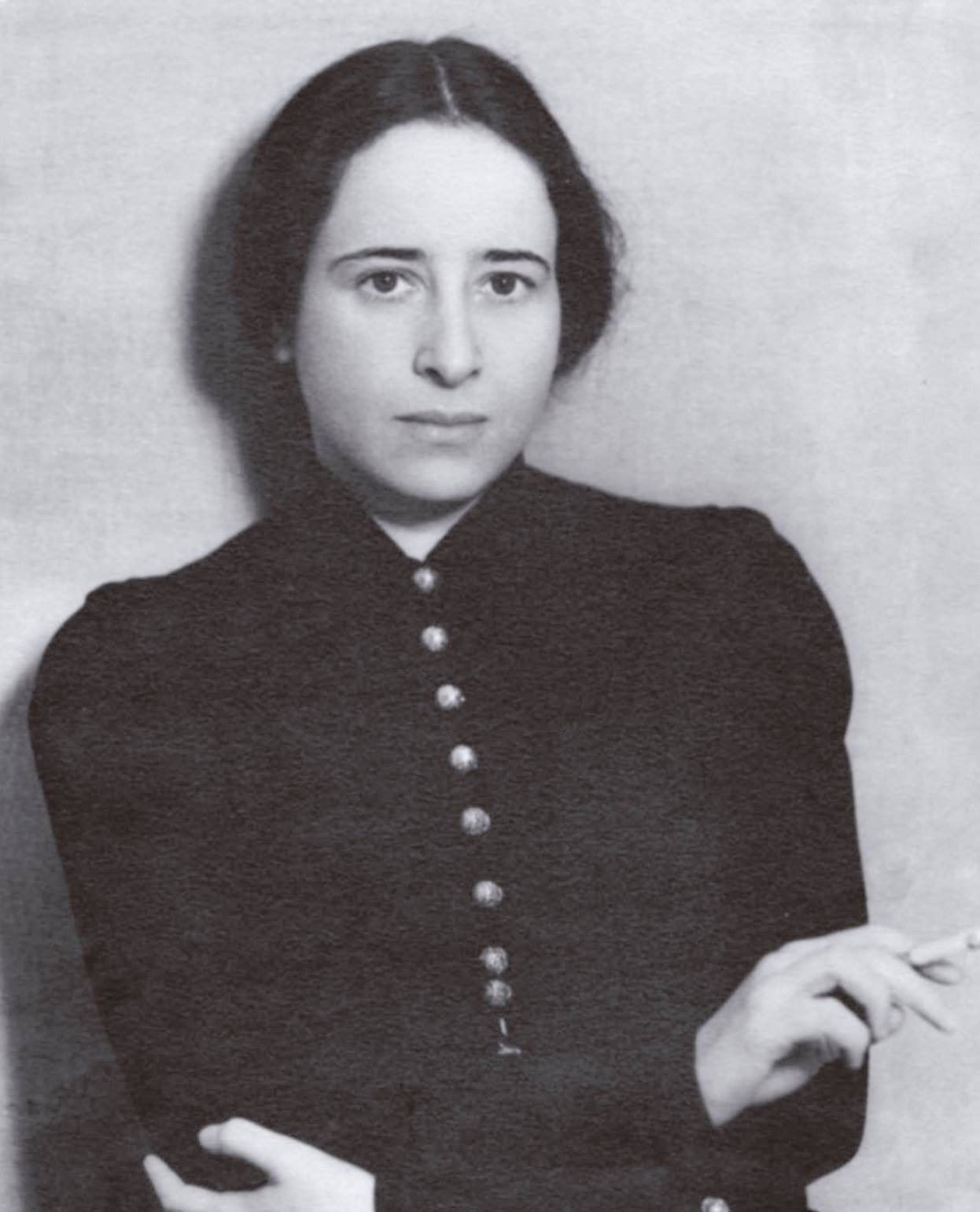
Hannah Arendt (1906–1975)
Hannah Arendt was a German-Jewish political philosopher who fled Nazi Germany in 1933 and spent eighteen years stateless before obtaining U.S. citizenship in 1951. That experience of displacement shaped everything she wrote. The Origins of Totalitarianism (1951) remains one of the most searching analyses of how democratic societies collapse into terror; her masterwork, The Human Condition (1958), examined the activities that define what it means to be human — labor, work, and action.
Covering the trial of Adolf Eichmann for The New Yorker in 1961, she coined "the banality of evil" — the chilling observation that Eichmann was not a monster but a bureaucrat who had ceased to think for himself. The phrase was controversial; Arendt argued she was not diminishing the evil but making a more disturbing point, that it does not require demonic motivation. Her three-way distinction among labor, work, and action gives us one of the most nuanced vocabularies for asking what, exactly, we lose when machines take over human activities.
Arendt's Three Activities
In The Human Condition, Arendt argues that there are three fundamentally different kinds of human activity and that modern societies have systematically confused them — a difference, she believed, essential to understanding what is at stake when we redesign the world of human effort.
Labor (Arendt)
The cyclical, repetitive activity required to sustain biological life — eating, cleaning, cooking. Labor corresponds to our nature as mortal animals: its products are consumed almost as fast as they are made, leaving nothing permanent behind. Arendt associates it with animal laborans, the laboring animal.
You cook a meal; it is eaten. You wash clothes; they are dirtied again. Nothing is wrong with labor — survival requires it — but the Tramp on the assembly line produces nothing bearing his mark. He is, in Arendt's vocabulary, an animal laborans.
It is indeed the mark of all laboring that it leaves nothing behind, that the result of its effort is almost as quickly consumed as the effort is spent.
Hannah Arendt, The Human Condition (1958)
Arendt is not contemptuous of labor; she is pointing out that the modern tendency to reduce all activity to it — to productivity, to outputs, to what can be measured and monetized — is a kind of impoverishment.
Work (Arendt)
The fabrication of durable objects — tools, buildings, artworks, institutions — that outlast the individual and constitute a shared human world. Arendt associates it with homo faber, the maker. Unlike labor, work has a definite beginning and end, and leaves something behind.
The carpenter who builds a chair, the architect who designs a library, the programmer who writes an algorithm thousands of people use — all create objects that outlast their makers. This is why Arendt thinks work has a dignity mere labor lacks: it is how we leave traces.
Her third category — Action — is the realm of politics and human relationships: the self-disclosure of speaking and acting in public, revealing who we are and not just what we do. This chapter focuses on the labor/work distinction, which maps most directly onto AI and automation.
animal laborans
Cyclical • Consumed • Leaves nothing behind"] -->|"raises to"| B["🔨 Work
homo faber
Durable • World-building • Creates objects"] B -->|"transcends to"| C["💬 Action
bios politikos
Self-disclosure • Politics • Reveals who we are"]
The Luddites and the Historical Anxiety
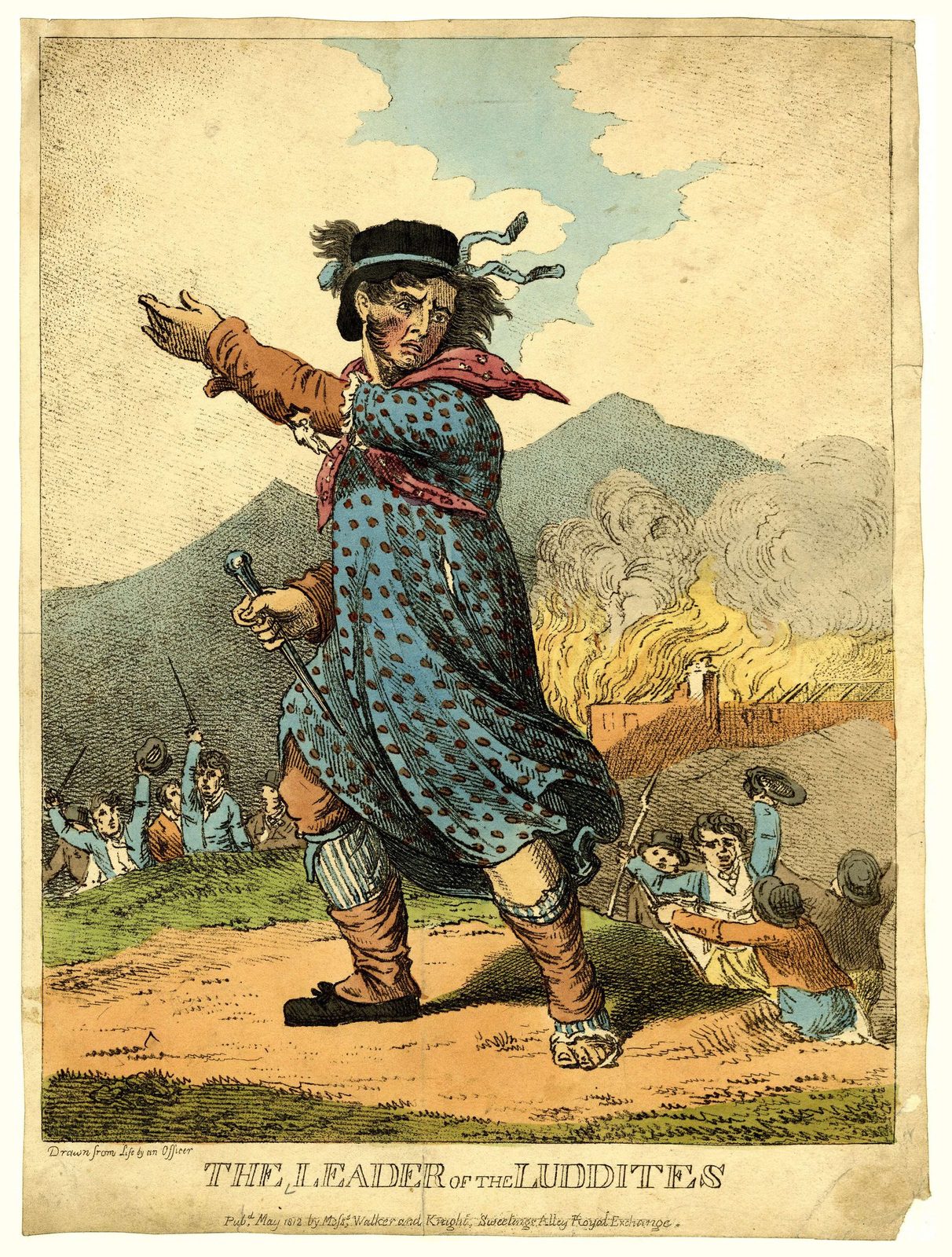
Anxiety about machines taking human work is not new. Beginning in Nottinghamshire in 1811 and spreading through the Midlands and the north of England until about 1816, textile workers destroyed the new machinery — wide stocking frames, shearing frames, power looms — that was displacing their skilled trades. These Luddites, named for the probably legendary Ned Ludd ("King Ludd" in their letters), were not technophobes. They were skilled craftsmen whose craft knowledge was being rendered worthless and whose communities were being broken up; their target was not machinery as such but machinery used to undercut trained labor. The British state made machine-breaking a capital offense, and leaders were hanged or transported. Their protest answered what we would now call deskilling: skilled making turned into repetitive tending. The modern use of "Luddite" to mean "person who fears technology" inverts what they actually argued.
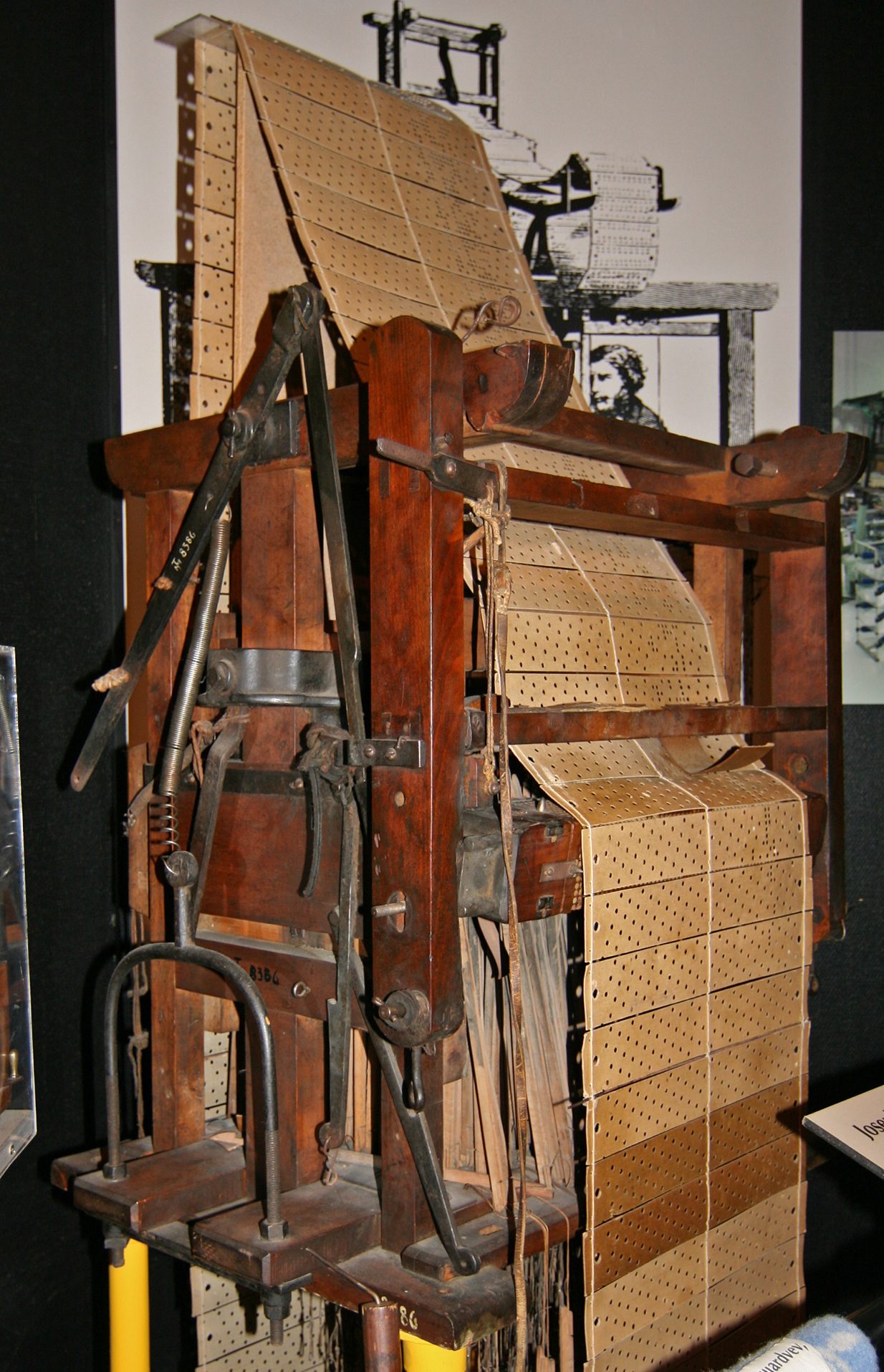
The mechanization of weaving had an interesting afterlife. A closely related machine — the Jacquard loom of 1804, which used punched cards to control the pattern being woven — directly inspired Charles Babbage's Analytical Engine and Ada Lovelace's notes on it. As she put it, the Engine "weaves algebraical patterns just as the Jacquard-loom weaves flowers and leaves." The technology that eliminated skilled weaving became an ancestor of the computers now threatening to automate knowledge work. History rhymes.
Self-Determination Theory: Why Work Satisfies Us
Arendt distinguishes types of activity; psychologists tell us what happens to people when those activities are frustrated. The most influential psychological account of meaningful work is Self-Determination Theory (SDT), developed by Edward Deci and Richard Ryan over decades of empirical research.
SDT proposes three fundamental psychological needs that, when satisfied, produce flourishing, and when frustrated, produce alienation and diminished motivation. Crucially, they can be satisfied or frustrated at work — one major reason work matters beyond its economic function. Some researchers add a fourth ingredient, beneficence: the sense that what you do benefits someone else. A job can offer real autonomy and skill and still feel hollow if it contributes nothing to anyone.
| Need | What It Means | Satisfied by… | Frustrated by… |
|---|---|---|---|
| Autonomy | Acting from one's own values, not external compulsion | Creative freedom, choice in how to do one's job | Micromanagement, algorithmic surveillance, rigid scripts |
| Competence | Developing and exercising genuine skills | Mastery, learning, challenging problems | Deskilling, repetitive tasks, tools that do the thinking |
| Relatedness | Feeling meaningfully connected to others | Collaborative work, care relationships, shared purpose | Isolation, remote-only interaction, treating workers as interchangeable |
SDT explains why "having a job" is not the same as having meaningful work: a job that frustrates all three needs at once can be deeply alienating even if it pays well. The Tramp on Chaplin's assembly line has a job. He does not have meaningful work.
What's the Argument?
The Meaningful Work Argument
- Human beings have deep psychological needs for autonomy, competence, and relatedness (Self-Determination Theory).
- Meaningful work — involving genuine skill, choice, and human connection — is a primary means by which these needs are satisfied.
- Chronic frustration of these needs seriously diminishes well-being.
This shifts the ethical focus from jobs to meaningful activity. An AI system that eliminates dull labor while opening space for creative activity might be beneficial even if it reduces employment; one that "creates jobs" while stripping them of skill, autonomy, and connection might be harmful even if unemployment falls.
Thought Questions
- Think of a job you have held or observed closely. Which of Arendt's categories — labor, work, or action — best describes what it involved? Was there a mix?
- The Luddites are now a byword for irrational resistance to progress. Is that characterization fair, given what you know about what they were actually protesting?
- Is there a difference between work you find meaningful and work that is meaningful? Who gets to decide?
Part II: Why Is Meaningful Work Ethically Valuable?
Meaningful work satisfies deep psychological needs — but that is not all ethics cares about. Is it valuable from a broader ethical perspective, and why? Three major frameworks each answer differently, and together they make a formidable case.
| Framework | Key Value | Why Meaningful Work Matters | Concern About AI Automation |
|---|---|---|---|
| Utilitarianism | Maximize overall well-being | A major source of happiness and life satisfaction for most people | Automation could reduce total well-being even if it raises GDP |
| Deontology (Kant) | Respect persons as ends in themselves | Using people as mere instruments of production violates their dignity | Treating workers as interchangeable inputs fails to respect their humanity |
| Virtue Ethics | Human flourishing through the exercise of virtues | A primary site for developing excellence, practical wisdom, and character | Deskilling removes the challenges through which virtues are cultivated |
What's the Argument?
The Utilitarian Argument for Meaningful Work
- The goal of social policy is to maximize overall well-being across society.
- Meaningful work is a major source of well-being for most adults — purpose, social connection, structure, identity.
- Automating it without replacement could reduce overall well-being even while increasing economic output.
What's the Argument?
The Deontological Argument for Meaningful Work
- Persons have dignity — they are ends in themselves, not merely means to others' ends (Kant's Formula of Humanity).
- Work that reduces a person to a cog — monitoring every motion, eliminating all judgment, treating them as interchangeable — treats them as a mere means.
- We have a moral duty not to treat persons as mere means.
What's the Argument?
The Virtue Ethics Argument for Meaningful Work
- Human flourishing (eudaimonia) consists in the exercise of distinctively human excellences — practical wisdom, creativity, justice, courage.
- Meaningful work — involving genuine skill, problem-solving, and craft — is a primary arena in which these excellences are exercised and developed.
- Removing challenge, judgment, and skill from work undermines the conditions for flourishing.
Their independence is part of what makes them formidable: each tradition reaches the conclusion by its own route. They differ over what counts as a fix. The utilitarian will accept almost any trade-off if the aggregate numbers come out right; the Kantian will not accept degrading work at any price; the virtue ethicist cares less about the transaction than about what kind of people the work produces over a lifetime.
Thought Questions
- The three arguments converge from different starting points. Does that make the conclusion more credible, or just mean it was popular enough that each tradition found a route to it?
- The utilitarian values meaningful work for the well-being it produces. If a pill produced the same well-being without the work, would the work no longer matter?
- Steelman the opposite view: what is the best case that work is simply a way of earning a living, and that loading it with expectations about meaning is a mistake — perhaps a convenient one for employers?
Marx on Alienation
Before virtue ethics was revived, the most systematic analysis of what work does to workers came from Karl Marx, writing as industrial capitalism was transforming labor. His concept of alienation remains influential in debates about automation. The relationship to Arendt is worth stating plainly: Arendt asks what work is; Marx asks who owns the process and its products. Two thinkers can agree the assembly line is degrading and still disagree about the fix.
Key Thinker
Karl Marx (1818–1883)
Karl Marx was a German philosopher, economist, and revolutionary whose analysis of capitalism remains one of the most influential intellectual projects in modern history. Born in Trier, he spent most of his adult life in exile, settling in London where he wrote his major works — including Capital (1867) — supported financially by his collaborator Friedrich Engels.
His early work, especially the Economic and Philosophic Manuscripts of 1844 (unpublished in his lifetime), contains his most sustained analysis of what industrial labor does to human beings — the theory of alienation. Capitalism, Marx argued, systematically separates workers from the products they make, from the activity of making, from their human nature, and from each other, transforming an activity that should express creativity into a burden endured only for wages.
Whether or not one accepts his broader political claims, the phenomenology of alienated labor he describes maps closely onto what SDT identifies as the frustration of autonomy, competence, and relatedness — and gives a precise vocabulary for what is lost when AI deskills or replaces human work.
Alienation (Marx)
The condition in which workers are estranged from their own labor — its products, its process, their human nature, and their fellow workers. Work becomes not an expression of the self but an imposition on it: something done under compulsion, for wages.
In the Economic and Philosophic Manuscripts of 1844, Marx identified four distinct forms of alienation. The worker is alienated from the product of labor (the object belongs to the capitalist, not the maker); from the activity of labor (the work is not the worker's to direct); from species-being (free, creative production is what makes us human, so degraded work degrades us); and from other workers (who meet as competitors). These map onto the SDT needs: alienation from activity disrupts autonomy, from species-being competence, from other workers relatedness.
Each has a contemporary echo, best stated as a question: who owns an AI-assisted worker's output; who sets the pace when an algorithm assigns the next task; is prompting a model creative production or selection from someone else's menu; and does gig work whose "workplace" is a dispatch queue connect a worker to anyone? Marx does not answer these, but he makes sure we ask all four.
MacIntyre and Internal Goods
One of the richest contemporary accounts of what makes work valuable comes from Alasdair MacIntyre's After Virtue (1981), which distinguishes the internal goods of a practice from its external goods.
Internal Goods vs. External Goods (MacIntyre)
External goods are rewards that come from a practice but are not essential to it — money, status, recognition. Internal goods can only be recognized and appreciated by participating in the practice itself: the surgeon's satisfaction in a technically perfect procedure, the chess player's appreciation of an elegant combination, the craftsman's pride in a well-made object. They are intrinsically valuable and cannot be obtained any other way.
This matters enormously for AI and work. External goods can be delivered without meaningful work — a universal basic income could provide money without jobs. Internal goods cannot. If AI does the surgery, the surgeon does not obtain the internal good of surgical excellence, however large her paycheck. What we owe workers is partly a question of whether we owe them access to the internal goods of their practices:
- A chess player who wins using a hidden computer has the trophy but not the internal good of mastery. This is why cheating scandals (Hans Niemann was publicly accused by Magnus Carlsen in 2022, though the over-the-board allegations were never substantiated) are taken so seriously.
- A radiologist whose role is confirming AI diagnoses has the salary but has been separated from the trained perception that makes radiology intellectually rich.
- A student whose essay is AI-written has a grade but not the understanding it was meant to build — which is why educators treat such work as dishonesty even when it is not technically plagiarism.
MacIntyre makes explicit what many people sense intuitively: the value of doing something is inseparable from doing it yourself.
Thought Questions
- Marx argues that alienated labor reduces humans to animals. Hyperbole, or does it capture something real? Can you think of jobs that are alienating in his sense?
- MacIntyre's internal goods can only be obtained by practicing a skill yourself. Does AI assistance necessarily diminish the internal goods of creative work — or could it enhance them?
- If a Universal Basic Income freed everyone from economic necessity, would that make work more or less meaningful?
Part III: How Might AI Transform Work?
How, specifically, might AI transform work, and what are the ethical stakes of each possibility? Three broad scenarios dominate the literature and the policy debate.
AI does the job;
workers displaced"] AI --> D["Scenario 2: Deskilling
Work → Labor;
jobs remain but emptied of meaning"] AI --> A["Scenario 3: Augmentation
AI does the labor;
humans do the work"] R --> R2["❗ Mass unemployment
Loss of identity, income,
social connection"] D --> D2["⚠️ 'Bullshit jobs' at scale
Employment without
meaningful activity"] A --> A2["✅ Human flourishing
More craft, creativity,
and judgment for humans"]
Scenario 1: Replacement
The most dramatic scenario is straightforward: AI replaces human workers entirely in a given domain. A 2017 McKinsey Global Institute report estimated that 400 to 800 million workers globally could be displaced by automation by 2030, the most affected roles involving predictable physical tasks and data processing.
That number deserves a warning label, and so does every number like it. The 400–800 million range is not a measurement; it is the spread between a slow-adoption and a fast-adoption scenario in a model, and its width admits how much depends on assumptions the modelers had to guess at. The most famous figure here has the same problem. In 2013, the Oxford economists Carl Benedikt Frey and Michael Osborne estimated that 47 percent of U.S. employment was in occupations at "high risk" of computerization within one or two decades — repeated ever since as though it forecast 47 percent unemployment. It did not. It estimated how many occupations might become largely automatable, not how many people would lose work. OECD economists re-ran a similar analysis at the level of individual tasks and arrived at roughly 9 percent for the United States , because most jobs are bundles of tasks and some tasks in almost every bundle resist automation.
None of this means automation is harmless. It means such projections are contested models rather than observations, that they have historically run ahead of events, and that the ethics of automation should not rest on any figure. The questions below stay live even if the true number lands at the bottom of every published range.
Case Study
Autonomous Vehicles and the Trucking Industry
Trucking is one of the most common occupations in the United States. The Bureau of Labor Statistics counts roughly 2.1 million heavy and tractor-trailer drivers; industry estimates of around 3.5 million are higher because they include delivery and light-truck drivers. It is a pathway into the middle class without a four-year degree: the BLS put the median wage for heavy and tractor-trailer drivers at about $57,000 in 2024, with experienced long-haul and specialized drivers earning more. It provides precisely the autonomy and competence SDT identifies as ingredients of meaningful work.
Autonomous trucking has moved slowly and unevenly. Waymo shelved its trucking program in 2023 to concentrate on robotaxis; TuSimple, once the sector's most visible startup, wound down its U.S. operations in 2024. Aurora Innovation began running commercial freight with no human in the cab on Texas highways in 2025, and Kodiak Robotics has operated driverless trucks in limited settings — real milestones, but on a small number of fixed Sun Belt routes in favorable weather. If the technology generalizes, replacement predicts the end of much long-haul driving in communities with limited alternative employment. If it does not, the likelier outcome is a hybrid: machines on the interstate, humans handling the first and last miles — a deskilling story rather than a replacement one.
The stakes are not just economic. For many of these workers trucking is meaningful work in Arendt's sense, and displacement costs identity as well as income. Policy responses will determine whether replacement is catastrophic or manageable.
Scenario 2: Deskilling (Work → Labor)
The second scenario is subtler and perhaps more pervasive. AI does not replace workers but transforms their work into Arendt's "labor." The job title remains; the meaning has been extracted.
Deskilling
The reorganization of a job so that it requires less trained judgment — typically by breaking a skilled task into simpler steps, moving the expertise into a machine, a procedure, or a manager, and leaving the worker to execute and monitor. The job may survive and may even pay the same; what disappears is the skill it demanded.
Deskilling is not an invention of the AI era. The classic account is Harry Braverman's Labor and Monopoly Capital (1974), which argued that industrial management does not merely happen to simplify skilled trades — it does so systematically, for reasons having as much to do with control as with efficiency. His analysis of Frederick Winslow Taylor's "scientific management" showed a repeating pattern: take a craft that lives in the heads and hands of experienced workers, decompose it into prescribed motions, move the planning into a separate management layer, and you get a job cheaper to staff, easier to monitor, harder to bargain from — and emptier to perform. Critics say he underrated how new technologies also create skilled roles, but the point survives: deskilling is a management strategy, not a consequence of better machines, and algorithmic management reproduces the pattern rather than inventing it.
Luciano Floridi describes a related phenomenon he calls enveloping: rather than AI adapting to human work patterns, humans adapt to the affordances of AI systems. The doctor who once exercised clinical judgment follows algorithmic recommendations; the writer who once crafted prose prompts a model and edits its output — shedding the judgment-intensive elements along the way.
| Profession | Skilled Work Before AI | Potential Post-AI Role | What Is Lost |
|---|---|---|---|
| Radiologist | Pattern recognition, clinical judgment, patient communication | Confirming or overriding AI-generated diagnoses | Diagnostic craft, perceptual skill, clinical autonomy |
| Writer/Journalist | Research, voice, structure, argument, prose craft | Prompting, editing, fact-checking AI output | Creative authority, distinctive voice, the struggle of composition |
| Graphic Designer | Visual thinking, client collaboration, iterative refinement | Selecting from AI-generated options | Design judgment, technical mastery, the internal goods of craft |
| Software Developer | Problem decomposition, algorithm design, debugging | Reviewing and accepting AI code suggestions | Deep understanding of systems, problem-solving satisfaction |
Case Study
Amazon Fulfillment Centers: The Algorithmic Workplace
Amazon's fulfillment warehouses employ hundreds of thousands of workers globally and are among the most fully realized implementations of algorithmic management. Associates are assigned tasks by algorithms optimizing for continuous flow; handheld scanners record each item and the seconds between them, and a "time off task" metric flags gaps in activity. (Amazon also patented a haptic wristband in 2018 that would track hand position by ultrasound; the patent drew wide criticism, though there is no public evidence the device was ever deployed at scale.) Reporting by The Verge in 2019, based on documents produced in a legal proceeding, described a system that could generate productivity warnings and termination notices automatically, with limited human review.
Workers describe being unable to take unscheduled bathroom breaks without risking productivity flags. Many report injuries from the relentless physical demands, and turnover is extremely high. Amazon pays above minimum wage — the external goods are present — but the work has been stripped of nearly every internal good.
This is a vivid illustration of Arendt's warning: labor, not work. Associates are not making anything durable or developing expertise — they are biological components in a logistics system optimized toward pure mechanism. Does this treat workers as ends in themselves, or as means to Amazon's efficiency?
A future in which AI creates record employment — but all those jobs consist of monitoring, confirming, and serving AI systems — is one of universal alienation.
Scenario 3: Augmentation
The most optimistic scenario is augmentation: AI takes over the labor so that humans can do more work, handling the cyclical, judgment-free tasks and freeing people for the durable, skill-intensive activities that constitute world-building.
There is genuine historical precedent. Spreadsheet software in the 1980s made tedious accounting calculations automatic, freeing accountants for analysis; spell-check freed writers from part of the burden of proofreading. Recent examples point the same way, though they are promising rather than settled. In a widely cited 2016 evaluation of algorithms for spotting breast cancer metastases in lymph node images, the best model plus a human pathologist produced fewer errors than either alone — the system catches patterns a tired eye misses, the human catches context the model was never trained on — though whether that generalizes across specialties and hospitals is still open. Cybersecurity analysts who once reviewed thousands of log entries by hand now reserve their attention for novel threats; architects using computational design tools explore thousands of configurations in minutes. In each case, the AI handles the labor; the human does more work.
Case Study
GitHub Copilot and the Future of Programming
GitHub Copilot, an AI coding assistant built by GitHub and OpenAI, entered technical preview in 2021 and became generally available in 2022, generating code suggestions in real time as developers type. In a controlled experiment run by GitHub itself, developers using Copilot finished a single benchmark task — a small web server — about 55% faster than a control group. Treat the headline figure carefully: one narrow task, measured by the vendor, and later independent studies have found smaller and more variable effects. Copilot is particularly effective at boilerplate — imports, error handling, standard API calls — that requires little creative judgment.
In the optimistic reading, this is augmentation at its best: Copilot handles the labor so developers can focus on the work — architecture, novel problem-solving, user experience.
But junior developers typically learn by writing boilerplate; the tedious parts build the understanding that enables the creative parts later. If Copilot removes the learning gradient, the "work" that remains may become inaccessible to those who never developed foundational skills. Augmentation for senior developers could become a barrier to entry for newcomers.
Policy Implications
The choice between these scenarios is political and ethical, not merely technological. The same capabilities can replace, deskill, or augment; which outcome we get depends on choices made by firms, governments, and societies. Policy tools that could push toward augmentation include:
- Tax policy: Many jurisdictions tax labor income but not capital; rebalancing could reduce the incentive to replace workers with machines.
- Worker training and transition: Public investment in retraining can help workers develop the skills AI augments rather than replaces.
- Regulation of algorithmic management: Requiring human oversight of automated performance systems could prevent the most dehumanizing surveillance.
- Universal Basic Income (UBI): A guaranteed income could decouple survival from employment, freeing people to pursue meaningful work on their own terms.
- Worker voice: Unions and works councils that give workers a say in how technology is deployed have historically pushed toward augmentation.
Thought Questions
- Suppose the true displacement figure turns out to be a tenth of McKinsey's low end. Which ethical arguments in this chapter would that undermine, and which would survive intact?
- Amazon's warehouse workers are paid above minimum wage. Does good pay change the ethical evaluation of algorithmically managed work?
- Which of the three scenarios will dominate the next twenty years? What would need to be true for augmentation to win out?
Part IV: Meaningful Work Isn't the Only Value
Meaningful work is not the only thing that matters, and a complete account of AI and labor must weigh other values — some of which favor automation even when it displaces workers.
Much agricultural labor is backbreaking, dangerous, and exploitative, done by the most vulnerable workers under conditions that cause chronic injury. If robots can harvest crops, it is not obvious that preserving the "meaningful work" of farm labor outweighs the gains in health and safety. Deep-sea mining, coal extraction, and hazardous chemical processing involve genuine skill — but also genuine risk. Consumers benefit too: automation reduces costs, and more efficient production can reduce resource use and emissions.
David Graeber and Bullshit Jobs
The most provocative contribution comes from the anthropologist David Graeber, whose 2018 book Bullshit Jobs argues that a large fraction of existing jobs are not merely unfulfilling but, by the workers' own assessment, socially pointless. His headline evidence was a 2015 YouGov poll in which 37 percent of British workers said their job made no meaningful contribution to the world; he suggested the real proportion ran higher still.
Key Thinker
David Graeber (1961–2020)
David Graeber was an American anthropologist and anarchist activist whose work at Yale, the London School of Economics, and Goldsmiths challenged mainstream economic assumptions. He is best known for Debt: The First 5,000 Years (2011), which argues that debt — not barter — is the foundation of economic life, and that the moral weight attached to repayment is historically contingent.
Bullshit Jobs: A Theory (2018) grew out of a viral 2013 essay arguing that the promised leisure society of the mid-twentieth century never arrived — not because automation failed, but because the economy had proliferated jobs workers themselves regarded as pointless. Graeber died in September 2020. His work poses the sharpest challenge to the premise that preserving existing jobs is automatically an ethical good: if many are bullshit by the assessment of the people doing them, automating them away might be a liberation rather than a loss.
Bullshit Jobs (Graeber)
Jobs that workers themselves consider socially pointless — existing primarily to make someone look busy, to manage people managing people, or to satisfy bureaucratic requirements that serve no genuine purpose. The defining feature is not that they are unpleasant but that they are meaningless by the standards of the person doing them.
He identified five categories: flunkies, who make a boss look important; goons, who harm competitors or the public on an employer's behalf (telemarketers, lobbyists paid to block regulations); duct-tapers, who fix problems that shouldn't exist (patching systems that should have been replaced); box-tickers, who create the appearance of compliance (slide decks summarizing reports no one reads); and taskmasters, who manage people who don't need managing. He collected testimonies from thousands of workers describing, often bitterly, being paid to perform the appearance of work.
The thesis is contested. A 2021 study by Magdalena Soffia, Alex Wood, and Brendan Burchell tested Graeber's claims against representative European survey data and found the share of workers describing their own job as useless was around 5 percent, and falling rather than rising — nothing like the 20 to 50 percent Graeber suggested . They did confirm that useless work is corrosive to well-being, Graeber's most important point, but concluded that what he had identified was ordinary alienation and that he had misjudged how widespread the extreme cases are. His evidence was self-selected testimony: powerful for showing a phenomenon exists, unreliable for showing how common it is. Read as a thought experiment about what we protect when we protect jobs, the argument keeps its force; read as a measurement, it does not.
Even so, the politics is more complex than "preserve meaningful jobs, automate the meaningless ones." Some skilled, well-paid jobs are experienced as meaningless, while many supposedly menial ones — care work, teaching, skilled trades — are deeply meaningful but poorly compensated. The priority should be expanding access to meaningful activity, not preserving jobs.
The Automation Paradox: WALL-E's Warning
Pixar's 2008 film WALL-E imagines a future in which all human labor has been automated. The humans of the Axiom — a luxury spaceship where humanity has retreated while robots clean up Earth — spend their lives in hover chairs, watching screens, consuming. Their bodies have atrophied and their connections are entirely screen-mediated. They have every external good and no internal ones: no practices, no challenges.
The utilitarian calculus seems satisfied — preferences met, suffering eliminated — but something is obviously missing, something that looks very much like what Aristotle, Arendt, MacIntyre, and SDT all point to: the activity of striving, making, and connecting that constitutes a genuinely human life. Automation without attention to flourishing might optimize us right out of our own humanity.
| Framework | Values Beyond Meaningful Work | How to Balance Against Work's Value |
|---|---|---|
| Utilitarian | Health, safety, consumer welfare, leisure, environmental impact | Aggregate all well-being effects; automate dangerous or pointless work; preserve meaningful work where the benefit is high |
| Kantian | Dignity covers protection from harm as much as meaningful activity | Automate work that degrades or endangers dignity; preserve work that expresses it |
| Virtue Ethics | Leisure (scholē) is itself a good, not merely a break from work; the good life includes contemplation and friendship | Automation that creates genuine leisure, not passive consumption, could enable flourishing |
| Graeber's Lens | Pointless employment is itself an ethical problem; not all jobs deserve preservation | Prioritize creating meaningful activity over preserving employment as such |
Thought Questions
- If workers privately consider their jobs socially pointless, should we be less concerned about AI replacing them? Or does the meaninglessness call for a different response?
- Care work is often the most meaningful work people do, yet is consistently underpaid. Is there a connection between how much we value meaning in work and how much we pay for it?
- Aristotle distinguished between leisure (scholē) — the free activity of a free person — and mere rest from labor. Is streaming Netflix leisure in Aristotle's sense?
Part V: Can AI Do "Real" Work?
A prior question lurks in all of this, unavoidable once we consider AI-generated art, music, writing, and code: can AI do genuine work at all? Or is it merely a tool — an instrument through which human creativity flows, but not an originator in its own right?
The stakes are practical as well as philosophical. If AI-generated art is genuine creative work, it can substitute for human creative work and the question is mainly about distribution and compensation. If it is not — if it is pattern recombination lacking true originality — the questions become ones about misrepresentation and what we are actually consuming.
What AI Can Now Do
The capabilities are substantial and growing rapidly. DALL·E, Midjourney, and Stable Diffusion generate photorealistic images from text prompts; music systems compose full arrangements; large language models write essays, poetry, and code. In each domain the outputs are indistinguishable from human work to many observers, and sometimes judged superior by evaluators who do not know the source.
The question is not whether these systems produce impressive outputs — they clearly do — but whether that suffices for the activity to count as genuine work, in Arendt's sense of making something durable that expresses a maker.
Ada Lovelace's Objection, Revisited
The oldest version of the objection comes from Ada Lovelace in 1843, nearly two centuries before the systems we are discussing were built.
The Analytical Engine has no pretensions whatever to originate anything. It can do whatever we know how to order it to perform.
Ada Lovelace, Note G to her translation of L. F. Menabrea's Sketch of the Analytical Engine (1843)
Her point is not that such machines cannot produce impressive outputs, but that they cannot originate: they only recombine, however sophisticatedly, what has been put into them. The objection was aimed at Babbage's engine, but it maps almost exactly onto debates about large language models, which are at bottom pattern-matching systems trained on human-generated text.
What's the Argument?
The Originality Argument
- Genuine creative work requires origination — new ideas, combinations, or expressions that are not merely recombinations of existing material.
- AI systems are, at bottom, pattern-matching and recombination systems trained on existing human-generated data; they do not originate in this sense.
- Work that lacks origination lacks what makes creative work genuinely creative.
Supporting argument
Human creativity also recombines prior influences. The novelist's plot borrows from stories they have read; the composer's melody echoes earlier music; the scientist's hypothesis builds on existing theory. If recombination were disqualifying, no human would be creative either. The Originality Argument may set the bar too high.
Objection
There is a difference between a human who recombines influences through the filter of lived experience, intention, struggle, and mortality — and a system that recombines statistical patterns from training data. Human recombination is selective and embedded in a life; AI recombination is probabilistic sampling from a distribution. The process differs in kind, even if the outputs look similar.
Arguments Against and For AI as Creator
Against AI creativity: Critics argue that genuine creative work requires intention (the artist means something by the work); lived experience (the brush carries the weight of what the painter has seen); struggle (breakthroughs emerge from sustained effort); and mortality (the knowledge of death gives urgency to expression). AI has none of these. Its outputs may be beautiful but are, in this view, empty: a mirror that reflects without understanding.
For AI creativity: Defenders argue we should focus on outcomes rather than processes. Photography was initially dismissed as not "real" art because it was mechanical, yet photographs are now recognized as genuine creative works. What matters is whether the output has aesthetic value and moves audiences, not whether the substrate was carbon or silicon. And many AI artworks are better understood as collaborations: the human supplies intent, curation, and judgment, the AI computational power. The result may be genuinely creative even if neither could produce it alone.
Case Study
Refik Anadol: AI as Artistic Medium
Turkish-American media artist Refik Anadol uses machine learning to create large-scale immersive data sculptures. His 2022 work "Unsupervised" at the Museum of Modern Art in New York trained neural networks on MoMA's entire collection and displayed the generative outputs in the museum's lobby, attracting enormous audiences and serious critical attention.
It illustrates the strongest case for AI-as-medium: the AI is a tool, but the artistic vision and curatorial decisions are human. Anadol decides what data to train on, what to ask the model, how to frame the output, and what the work means. In this light the AI is no different from a paintbrush — a medium through which intention is expressed.
But the analogy has limits. A paintbrush does not make aesthetic choices; a model does, in some sense. The line between Anadol as artist and the AI as collaborator is genuinely blurry — and that blurriness is arguably part of the meaning. "Unsupervised" raises authorship as an explicit theme.
Case Study
Greg Rutkowski and the Style Replication Problem
Greg Rutkowski is a Polish digital artist known for a distinctive fantasy-realist style — luminous, detailed, painterly. By late 2022, analyses of public Stable Diffusion prompt data found his name among the most frequently invoked of any artist's, ahead of Picasso and Michelangelo: users had discovered that adding "by Greg Rutkowski" to a prompt reliably produced images closely resembling his own.
He had not consented to his work being used in training data, had not been compensated, and had not authorized his name as stylistic shorthand. Most concretely, his livelihood was threatened: clients who once paid for custom illustrations could now generate Rutkowski-style images in seconds, for free.
The case crystallizes several distinct issues: intellectual property (was training on his work fair use or infringement?); consent (should artists be able to opt out?); compensation (if a style is valuable, should its originator share in that value?); and attribution. These are not merely theoretical. They are the subject of ongoing litigation — most prominently Andersen v. Stability AI, a class action brought by visual artists in 2023 and still working its way through the federal courts as of 2026, in which some claims have been dismissed and the core copyright claims allowed to proceed.
Even if AI-generated art is not "real" creative work philosophically, it creates real problems economically. Artists whose styles are replicated without consent are harmed in their livelihoods and in the recognition they deserve for developing distinctive identities over years of work.
Proposed responses include mandatory labeling of AI-generated content, opt-out registries, and collective licensing that would compensate artists when their work contributes to commercial AI products. None has become standard practice as of this writing, but the debate is active and consequential.
Thought Questions
- The Originality Argument says AI only recombines. Does the same objection apply to human artists heavily influenced by their predecessors? What, if anything, is the relevant difference?
- Anadol treats AI as a medium like a paintbrush; Rutkowski's case suggests it is something more, able to replicate and displace an individual style. Which framing is more accurate?
- If an AI-generated song moves listeners to tears, is that emotional response evidence of genuine artistic value — regardless of how the song was made?
Key Points
Key Points
- Arendt's three activities: labor (cyclical, leaves nothing behind), work (durable objects), action (self-disclosure) — automation poses different risks at each level.
- Self-Determination Theory (Ryan & Deci) names autonomy, competence, and relatedness as needs meaningful work helps satisfy, giving work ethical significance beyond its economic function.
- Three ethical frameworks (utilitarian, deontological, virtue ethics) give independent reasons to value meaningful work and to worry about automation that deskills it.
- Marx's alienation framework, from the Economic and Philosophic Manuscripts of 1844, names four estrangements — from the product, the activity, species-being, and other workers — that map onto SDT's need-frustration; where Arendt asks what work is, Marx asks who owns it.
- Three AI scenarios — Replacement, Deskilling (work → labor), Augmentation (AI handles labor; humans do more work) — are settled by policy, not by technology alone.
- Displacement forecasts are model projections, not measurements: McKinsey's 400–800 million is a scenario spread, Frey and Osborne's 47% estimates automatable occupations rather than predicting 47% unemployment, and OECD task-level analysis yields roughly 9%.
- Deskilling has a history: Harry Braverman's Labor and Monopoly Capital (1974) argued that management systematically breaks skilled trades into monitorable steps — a pattern algorithmic management repeats rather than invents.
- Having a job is not the same as having meaningful work: full employment paired with deskilled, algorithmically managed work is universal alienation, not a solution.
- Graeber's bullshit jobs thesis complicates the case for job preservation, though survey evidence suggests he overstated their prevalence; the goal is expanding meaningful activity, not preserving employment as such.
- The Originality Argument holds that creative work requires origination rather than recombination — contested as applied to AI, but a useful lens on what we value in creative work.
- Policy interventions — AI labeling, artist opt-out registries, collective licensing — address the harms of style replication regardless of how the philosophical question resolves.