The Tuskegee and Guatemala Syphilis Studies: Research Ethics, Whistleblowing, and Medical Distrust
Deception and the Long Half-Life of Distrust — a bioethics case study
- Who: About 600 Black men of Macon County, Alabama — 399 with latent syphilis, 201 uninfected controls — and, later, more than 1,300 Guatemalans deliberately infected by the same U.S. agency.
- What: The U.S. Public Health Service watched untreated syphilis progress to autopsy for 40 years (1932–1972). The agency withheld penicillin and deceived the men into believing they were being treated. A parallel PHS project in Guatemala (1946–1948) infected prisoners, soldiers, and psychiatric patients on purpose.
- Where / When: Tuskegee/Macon County, Alabama, 1932–1972; Guatemala, 1946–1948. Exposed by a whistleblower and the press in 1972. The Guatemala records were found in 2003.
- Why it matters: Tuskegee is widely called the single most important event in the rise of American bioethics. It produced the modern rules — informed consent, the IRB, the Belmont principles — and a debate, still unsettled, about whether rules were ever the thing that was missing, and about the medical distrust the study left behind.
- Pair with: History & the Making of Research Ethics
The Case
In 1932, the United States Public Health Service (PHS) — the federal agency that would become the CDC — began what its own scientists titled the Tuskegee Study of Untreated Syphilis in the Negro Male. The premise was simple. To its designers, it was scientifically attractive: find people with untreated syphilis and observe what the disease does to a human body if nothing is done, all the way to autopsy.
They chose Macon County, Alabama. Most residents were Black. Most were poor. Almost none had access to a doctor. That was the point. The men recruited — about 600 in all — were sharecroppers working white-owned land in a system of debt peonage. Of the 600:
- 399 had latent syphilis.
- 201 served as healthy controls.
The PHS enlisted the respected Tuskegee Institute and a trusted Black public-health nurse, Eunice Rivers, whose constancy kept the men coming back for decades. The men were never told they had syphilis. They were told they had “bad blood,” a vague local phrase, and that the government doctors were treating them for it.
What untreated syphilis does. Syphilis is a bacterial infection. After an early stage it can go latent — silent for years — and then, in roughly a third of untreated cases, attack the heart, blood vessels, brain, and spinal cord. The consequences the PHS’s own venereal-disease workers printed on a matchbook to scare people into testing were blunt and accurate: “Blindness, heart injury, insanity, death.” None of that was named to the Tuskegee men.
The deception was not passive. To collect the data they wanted, investigators did several specific things:
- They performed painful diagnostic spinal taps and called them a free “spinal shot” — a treatment.
- One PHS officer wrote that the men might refuse the procedure if they understood it was only diagnostic. Its real purpose, he said, should “be kept from them as far as possible.”
- Because the study’s final data point was the autopsy, the PHS offered burial insurance. This was a powerful inducement in a poor rural community where a proper funeral mattered. Families would surrender the bodies in return.
- One investigator wrote that the team had “no further interest in these patients until they die.”
- When a mobile treatment unit later swept the county offering free penicillin to everyone, PHS staff quietly flagged their enrollees to local doctors with the instruction that the man was under study and not to be treated.
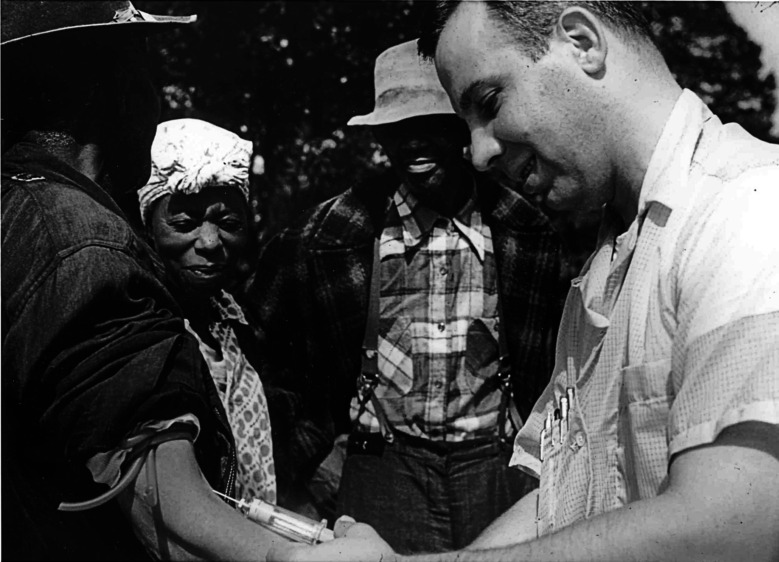
National Archives and Records Administration. Public domain. Reproduced in (Tobin 2022).
Penicillin became the standard cure for syphilis in the mid-1940s. The men were not given it. PHS scientists argued that the arrival of a cure made the study more valuable, not less. It was a never-to-be-repeated chance to see the full natural course of a disease that would soon no longer run its course anywhere else. The study generated about fifteen papers in reputable medical journals over thirty-seven years. The titles alone announced what it was — one 1964 article was called “The Tuskegee Study of Untreated Syphilis; the 30th Year of Observation.” A 1955 paper reported that more than thirty percent of the autopsied men had died directly of syphilis. No physician, anywhere, published a letter of objection.
It ended only because one PHS employee would not let it go. By the most-cited later reckonings:
- Dozens of the men had died of syphilis or its complications.
- Dozens of their wives had been infected.
- Children had been born with congenital syphilis.
In 1973, after the story broke, a class-action suit produced an out-of-court settlement. The government eventually provided lifetime medical care to survivors and affected families. In 1997 — a quarter century after the study stopped — President Clinton apologized: what the government did “was shameful,” a study “so clearly racist.” No scientist was ever prosecuted.
The case is usually taught as a failure of consent. The questions it actually raises are harder than that, and they are still open.
The Argument Tuskegee Started
Few cases have produced as much agreement that something monstrous happened and as much disagreement about what the monstrous thing was. That second question is not academic. Nearly every reform that followed — federal consent rules, the Belmont Report, the very existence of review boards — rests on some answer to it, and the answers do not all point the same way.
“We were missing rules”
The official lesson is institutional. Tuskegee, on this view, happened because the United States had no system requiring that subjects consent and no body to review research before it ran. So the country built one:
- The 1974 National Research Act.
- Institutional review boards (IRBs) to approve and monitor studies.
- Federal informed-consent regulations.
- In 1979, the Belmont Report’s three principles — respect for persons, beneficence, and justice.
Informed consent, the IRB, and Belmont. Informed consent means a competent person is told the truth about a study’s risks, benefits, and purpose and freely agrees to take part. An IRB is a committee that must approve human research before it begins and can stop it. The Belmont Report distilled the post-Tuskegee consensus into three duties:
- Respect persons as autonomous agents.
- Do not harm and maximize benefit.
- Distribute research’s burdens and benefits fairly.
These are the spine of every research-ethics rulebook in use today (National Commission for the Protection of Human Subjects of Biomedical and Behavioral Research 1979).
The Regulatory-Gap Argument
- If a system lacks independent review and consent regulations, then research abuses like Tuskegee are inevitable.
- Modern research systems now have independent review and consent regulations.
- Therefore, research abuses like Tuskegee are no longer possible in modern research systems.
Premise 1 is where this breaks. It assumes the gap was the absence of rules. The next move denies that.
“The rules existed — and were ignored”
The Nuremberg Code was written in 1947 after Nazi doctors were tried for experimenting on prisoners. It opens with the sentence “The voluntary consent of the human subject is absolutely essential.” It existed for the last twenty-five years of Tuskegee. American researchers of the era reportedly dismissed it as “a good code for barbarians” — something for Nazis, not for them. Rules were not missing. They were not felt to apply.
Then there is Guatemala. While researching Surgeon General Thomas Parran’s papers in 2003, the historian Susan Reverby opened the donated files of a PHS doctor named John Cutler and found something worse than Tuskegee (Reverby 2011). Between 1946 and 1948, the same Public Health Service had deliberately infected more than 1,300 Guatemalans — prisoners, soldiers, and patients in a psychiatric hospital — with syphilis, gonorrhea, and chancroid, to test prevention. When infection through arranged contact proved unreliable, investigators inoculated subjects directly. At least eighty-three deaths were recorded. One psychiatric patient, after months of induced disease, was dying when a researcher infected her further. She died days later.
The decisive fact about Guatemala is not its cruelty but its respectability. Consider the chain of approval:
- The principal investigator, John Mahoney, was arguably the most honored American physician-scientist of his day. He won a Lasker Award the year the experiments began.
- The proposal was reviewed and funded by an NIH study section staffed by physicians from the country’s leading medical schools.
- The Surgeon General was kept informed and enthusiastic. He is recorded remarking that “we couldn’t do such an experiment in this country.”
Nothing failed in the chain of command. Everyone with authority approved.
The Conscience Argument
- Rules only prevent abuse if researchers believe the rules apply to them and their subjects.
- The PHS researchers did not believe existing ethical rules applied to their subjects.
- Therefore, the failure was a failure of institutional and individual conscience, not a lack of rules.
That individual was Peter Buxtun. The PHS hired him in 1965 as a venereal-disease interviewer in San Francisco. He was a Czech-born social worker whose family had fled to America in 1937. He learned of the study from a coworker, obtained a folder of internal “roundup” reports, and recognized the shape of what he was reading. He had read the Nuremberg trial record. His path inside the agency went like this:
- He filed formal objections in 1966 and again in 1968.
- The CDC summoned him to Atlanta, and a senior official berated him.
- A blue-ribbon panel was convened in 1969. Its dominant voice argued, “You will never have another study like this; take advantage of it.” Only one member, Gene Stollerman, urged that the men be treated as patients rather than as a data set.
- The panel voted to continue. Buxtun asked the CDC, in writing, “What is the ethical thing to do?” He received no answer.
- He took the documents to the press. The story broke in July 1972.
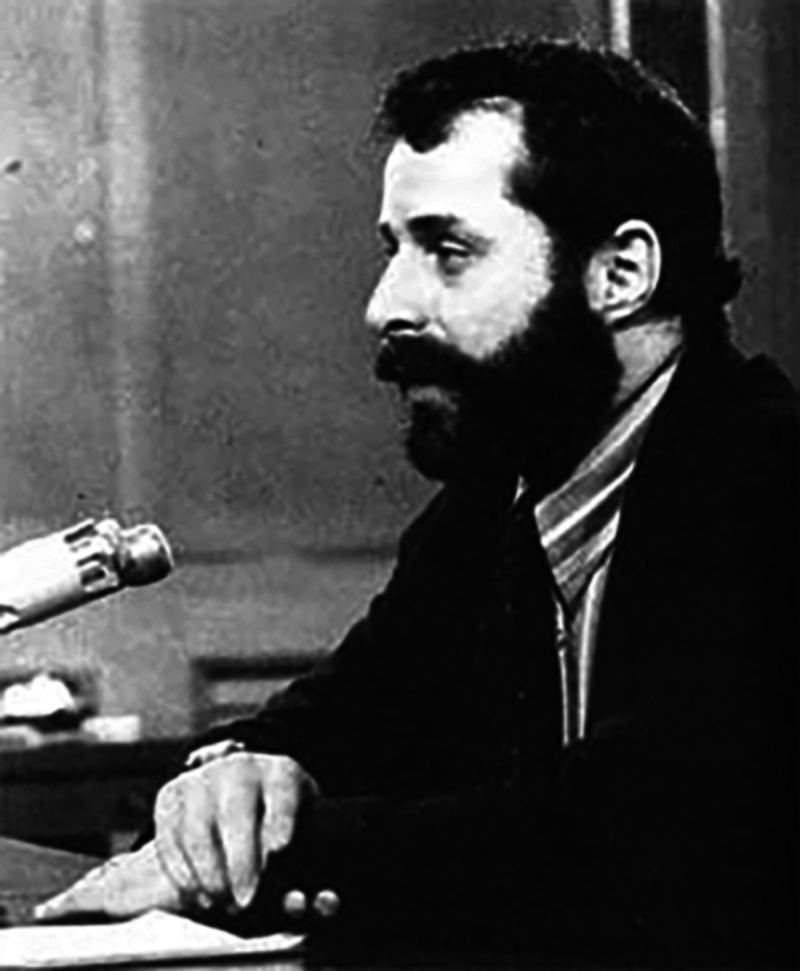
Public domain. Reproduced in (Tobin 2022).
Why did it take one outsider seven years, when no insider acted in forty? Buxtun’s own answer was wry: “It’s tough being a whistleblower when you don’t even know you’re a whistleblower.” The stronger pressure to weave in here is from social psychology. Stanley Milgram’s obedience experiments — and a later study modeled on them, in which university students were asked to recruit others into an obviously dangerous sham experiment — found that most people, given a legitimate-seeming authority, comply and look away. They do this even when dissent is safe, anonymous, and easy (Elliott 2018). Milgram called this surrender the “agentic state”: we recast ourselves as instruments of the authority and let our conscience go quiet. The Tuskegee physicians were not monsters by Milgram’s lights. They were ordinary people inside a structure that made silence feel normal.
“But heroes are not a policy”
If the Conscience Argument is right, it leaves a problem. You cannot run a research system on the hope that each abuse will produce its own Buxtun — especially since the system punishes the ones it gets.
The Institutional-Design Reply
- Relying on individual conscience only works if whistleblowers can safely come forward.
- Under current institutional designs, whistleblowers who come forward are routinely punished.
- Therefore, preventing future research abuses requires structural institutional reform, not just appeals to personal courage.
The constructive half of this comes, again, from Milgram. Obedience dropped sharply under three specific conditions:
- When the authority figure was made less imposing.
- When the victim was made more present.
- And — most powerfully — when even one other person in the room dissented.
The design implication is concrete:
- Deflate the prestige of the lead researcher.
- Make subjects visible rather than abstract.
- Protect real (not cosmetic) channels for objection.
- Make it possible for objectors to find each other.
The recurring real-world successes — the New Zealand “unfortunate experiment,” for instance — came from teams of clinicians acting together, not solitary martyrs. An anonymous “ethics hotline,” the usual institutional answer, is the thing the evidence trusts least.
Who was chosen, and why
There is a wrong here that none of the moves above quite names. The Tuskegee men were not random. They were selected because they were poor, Black, unschooled, and without doctors. They were chosen for the very powerlessness that made them easy to deceive and unlikely to be believed. A PHS internal phrasing reduced them to a single compound label, a string of demographic adjectives ending in “men.” That is not a consent failure or an oversight failure. It is a justice failure: a vulnerable group made to carry a burden for a science that would never have been done to the powerful.
Vulnerability and fair subject selection. Kenneth Kipnis argued that “vulnerable” is not a list of groups but a set of pressures a participant is under — economic, social, deferential, institutional — that compromise a genuinely free choice (Kipnis 2001). The Belmont principle of justice demands fair subject selection. Research must not load its risks onto those least able to refuse, nor (the mirror error) exclude groups from research’s benefits. Tuskegee is the textbook case of wrongful exploitation of the vulnerable. Modern ethics also watches for wrongful exclusion.
The Justice Reframing
- In Tuskegee, subjects were selected specifically because their poverty and race made them unable to refuse or complain.
- Selecting subjects because of their vulnerability is a form of exploitation that violates the principle of justice.
- Therefore, the deepest wrong of Tuskegee was a violation of justice, which cannot be fixed merely by improving consent procedures.
This is not safely historical. Research today still gravitates toward people under exactly Kipnis’s pressures:
- The institutionalized.
- The incarcerated.
- The cognitively impaired.
- The poor.
That is why “fair subject selection” remains an active demand and not a settled box to check.
The argument that hasn’t ended
There is a final move, and it is the one with the most current stakes. The standard account says: Tuskegee is why many Black Americans distrust medicine and research, so the remedy is outreach, apology, and education to repair the trust the study broke. After 1972, the empirical legacy is, in fact, measurable. Marcella Alsan and Marianne Wanamaker found that disclosure of the study was followed by reduced medical contact among older Black men and worse health outcomes — a real and lasting cost (Alsan and Wanamaker 2018).
But Vanessa Northington Gamble and Susan Reverby press a sharp objection to the standard account. Black medical distrust did not begin with Tuskegee and is not exhausted by it. It tracks a long history and, more importantly, present mistreatment — documented disparities in pain treatment and outcomes, structural barriers in care now (Gamble 1997). To explain today’s distrust by pointing only to a study that ended in 1972 can become a way of locating the problem safely in the past. It can cast Black patients as irrationally haunted rather than accurately observant. (Reverby also notes a precise irony: the Tuskegee men were not distrustful refusers. They trusted the government doctors, which is exactly how they were used.) The COVID-19 vaccination gap became the live test of this dispute: was the right response to recite Tuskegee and reassure, or to address the present-day inequities that make wariness a reasonable inference?
What actually moved the gap is instructive. Early 2021 messaging that leaned on history-and-reassurance — that was then, the rules are different now, the vaccine is safe — tended to land poorly. It answered a question many Black patients were not asking. A review of equity strategies found that the interventions that raised uptake were structural and relational rather than rhetorical:
- Vaccine sites placed inside trusted Black churches and barbershops.
- Outreach delivered by community health workers, clergy, and Black clinicians rather than by the institutions themselves (Dada et al. 2022).
The recurring mechanism is concordance — patients are more likely to accept advice, including vaccination, from clinicians who share their background or have earned standing in their community. A randomized field experiment in Oakland found that Black men assigned to a Black physician agreed to substantially more preventive services, including invasive screening, than those assigned to a non-Black physician — a gap that no recitation of history opens or closes (Alsan et al. 2019). The lesson tracks Reverby’s point precisely: the operative variable was not how vividly the past was explained but how much present trustworthiness the patient could actually observe in the room.
That gives a clinician something to do rather than something to recite. It does not, however, settle the argument. It arguably concedes the critique’s premise — trust follows present conditions, not historical correction — while leaving the standard view’s strongest reply intact: history is part of why those present conditions are read the way they are, and a patient who invokes Tuskegee is often naming a pattern, not a date — distrust as a response to everyday racism, not only to one archived study (Bajaj and Stanford 2021). The dispute is which description should drive the response.
The Distrust Dispute
- If historical events like Tuskegee are the primary cause of medical distrust, then distrust should be solved by historical education and apology.
- Medical distrust is primarily caused by ongoing, present-day systemic medical racism and disparities.
- Therefore, medical distrust can only be solved by changing present-day medical practices, not just explaining the past.
Fifty years on, that is where the argument rests — not at a verdict, but at a question that a nurse, a researcher, and a public-health officer each have to answer the next time someone says, reasonably, that they are not sure they trust the people offering to help them.
Discussion Questions
Write out The Regulatory-Gap Argument and The Conscience Argument in your own words — premises first, then the conclusion. They disagree about one premise. Identify it. Then explain what the Guatemala study — run by a respected lead researcher, reviewed by NIH, approved by the U.S. Surgeon General — tells us about which side has the better case.
Nurse Eunice Rivers was trusted by the men in the study because she was caring, consistent, and one of their own. That trust is part of what kept them enrolled for decades. Imagine you are a nurse who has just realized that the “treatment” you have been giving is a deception. What do you owe these particular patients that the institution does not? What, concretely, do you do — knowing that nurses who reported similar abuses often lost their jobs?
The Justice Reframing says the deepest wrong of Tuskegee was who the researchers chose as subjects, not the missing consent forms. Imagine a future study with perfect informed consent — but where the volunteers are poor, uninsured, and badly need the money. Would the consent fix Tuskegee’s wrong, or just move it somewhere else? Use the idea of fair subject selection to defend your answer.
The Institutional-Design Reply says hospitals can do specific things to keep individual dissent from being silenced. Pick a hospital you know. Name one concrete change — not an ethics hotline — that would make a dissenting nurse or resident less alone. Drawing on Milgram’s obedience studies, explain why your change would actually work.
A patient eligible for a new vaccine tells you she does not trust it. She mentions Tuskegee. The case describes two ways to respond: reassure her and explain the science, or acknowledge that present conditions still give some patients real reasons to distrust. Give the strongest version of each response. Then say which you would actually give her, and why.
Further Reading
- James H. Jones, Bad Blood: The Tuskegee Syphilis Experiment (Free Press, 1981; rev. 1993) (Jones 1981) — the definitive history.
- Susan M. Reverby, Examining Tuskegee: The Infamous Syphilis Study and Its Legacy (University of North Carolina Press, 2009) (Reverby 2009).
- Harriet A. Washington, Medical Apartheid (Doubleday, 2006) (Washington 2006) — the longer history of which Tuskegee is one chapter.
- Carl Elliott, “Tuskegee Truth Teller,” The American Scholar 87, no. 1 (2018) (Elliott 2018) — the Buxtun profile and the whistleblowing evidence.
- Presidential Commission for the Study of Bioethical Issues, “Ethically Impossible”: STD Research in Guatemala from 1946 to 1948 (2011) (Presidential Commission for the Study of Bioethical Issues 2011).
References
Alsan, Marcella, Owen Garrick, and Grant Graziani. 2019. “Does Diversity Matter for Health? Experimental Evidence from Oakland.” American Economic Review 109 (12): 4071–111. https://doi.org/10.1257/aer.20181446.
Alsan, Marcella, and Marianne Wanamaker. 2018. “Tuskegee and the Health of Black Men.” The Quarterly Journal of Economics 133 (1): 407–55. https://doi.org/10.1093/qje/qjx029.
Bajaj, Simar Singh, and Fatima Cody Stanford. 2021. “Beyond Tuskegee — Vaccine Distrust and Everyday Racism.” New England Journal of Medicine 384 (5): e12. https://doi.org/10.1056/NEJMpv2035827.
Dada, Damilola, Joseph Nguemo Djiometio, SaraJane M. McFadden, et al. 2022. “Strategies That Promote Equity in COVID-19 Vaccine Uptake for Black Communities: A Review.” Journal of Urban Health 99 (1): 15–27. https://doi.org/10.1007/s11524-021-00594-3.
Elliott, Carl. 2018. “Tuskegee Truth Teller.” The American Scholar 87 (1): 44–56. https://www.jstor.org/stable/26756050.
Gamble, Vanessa Northington. 1997. “Under the Shadow of Tuskegee: African Americans and Health Care.” American Journal of Public Health 87 (11): 1773–78. https://doi.org/10.2105/AJPH.87.11.1773.
Jones, James H. 1981. Bad Blood: The Tuskegee Syphilis Experiment. The Free Press.
Kipnis, Kenneth. 2001. “Vulnerability in Research Subjects: A Bioethical Taxonomy.” In Ethical and Policy Issues in Research Involving Human Participants, Volume II. National Bioethics Advisory Commission.
National Commission for the Protection of Human Subjects of Biomedical and Behavioral Research. 1979. The Belmont Report: Ethical Principles and Guidelines for the Protection of Human Subjects of Research. U.S. Department of Health, Education, and Welfare. https://www.hhs.gov/ohrp/regulations-and-policy/belmont-report/index.html.
Presidential Commission for the Study of Bioethical Issues. 2011. “Ethically Impossible”: STD Research in Guatemala from 1946 to 1948. Washington, D.C., September 2011. https://bioethicsarchive.georgetown.edu/pcsbi/node/654.html.
Reverby, Susan M. 2009. Examining Tuskegee: The Infamous Syphilis Study and Its Legacy. University of North Carolina Press.
Reverby, Susan M. 2011. “‘Normal Exposure’ and Inoculation Syphilis: A PHS ‘Tuskegee’ Doctor in Guatemala, 1946–1948.” Journal of Policy History 23 (1): 6–28. https://doi.org/10.1017/S0898030610000291.
Tobin, Martin J. 2022. “Fiftieth Anniversary of Uncovering the Tuskegee Syphilis Study: The Story and Timeless Lessons.” American Journal of Respiratory and Critical Care Medicine 205 (10): 1145–58. https://doi.org/10.1164/rccm.202201-0136SO.
Washington, Harriet A. 2006. Medical Apartheid: The Dark History of Medical Experimentation on Black Americans from Colonial Times to the Present. Doubleday.