Lecture 4 — Abortion
Part B: Abortion and the Law, in the US and Around the World
0.1 On Call in Lubbock
You are the doctor on call in Lubbock, Texas. A 26-year-old patient arrives at 20 weeks after her water has broken. She has a fever of 101.8°F, and test results are still pending. The fetus cannot survive at this stage. Continuing the pregnancy is likely to lead to serious infection, including sepsis. Right now her vital signs are stable, and there is still fetal cardiac activity.
Texas law allows abortion only for “a life-threatening physical condition” that creates “a serious risk of substantial impairment of a major bodily function.”
- What would you want to do for her, clinically, and why?
- Does the wording of the law clearly allow it?
- If the team waits until she is much sicker, has the law already harmed her, even if she survives?
0.2 After You’ve Discussed
Note
The exception is clear on paper and unclear at the bedside. Previable rupture of membranes, sepsis from an incomplete miscarriage, an ectopic pregnancy at risk of rupture: at what point is the threat serious enough? The statute is read by prosecutors, not physicians. Act too early and a clinician risks a felony carrying up to 99 years; wait too long and the patient’s life is at risk.
In Zurawski v. Texas, more than twenty women denied care under this statute sued. In May 2024 the Texas Supreme Court ruled against them, holding that the “medical emergency” language was already clear and that physicians were misreading it. The paired case study follows Kate Cox, who was refused the same exception in December 2023.
0.3 Kate Cox, 31, Texas, December 2023
At twenty weeks pregnant, Kate Cox learned her fetus had trisomy 18 — almost always fatal at or shortly after birth. Her physician recommended termination.
Texas law banned abortion except to prevent “substantial impairment of a major bodily function.” Cox sued. A trial court granted permission; the Texas Supreme Court reversed within days. She traveled to New Mexico for care.
She was not alone. Zurawski v. Texas, filed the same year, gathered twenty-plus women denied care under the same statute — some after their water broke before viability, some after sepsis set in. In May 2024 the Texas Supreme Court ruled against them, holding that the statute’s “medical emergency” language was already clear enough and that the problem lay with physicians misreading it, not with the law.
Write or discuss:
- Should the physician have been allowed to make this call, or is it right that the legislature draws the line?
- The Texas law uses the phrase “substantial impairment of a major bodily function.” What does that mean to a doctor in a hospital at 2 a.m.?
- If a clinician guesses wrong, the penalty is up to 99 years in prison and loss of license. How does that change how she practices?
0.4 Today
By the end of Part B, you will be able to:
- Trace how abortion law has varied historically, from common-law “quickening” through 19th-century criminalization
- Explain precedent and stare decisis in plain English
- Reconstruct the Roe and Dobbs majorities in standard form and identify the load-bearing premise of each
- Describe the post-Dobbs landscape: state tiers, medication abortion, and conflicts between states
- Place the US within four global regulatory models
1 A Brief History
1.1 Before the 19th Century
- In ancient Greece and Rome, abortion and infant exposure were widely practiced, lightly regulated, and not understood through anything like fetal personhood. Roman law treated the fetus as part of the mother.
- Aristotle held that the soul entered the fetus at 40 days (male) or 90 days (female), a view that shaped European thought for two millennia.
- For roughly seven hundred years, English common law, inherited by colonial America, made abortion a crime only after quickening, the first felt fetal movement at about 16–20 weeks. Even then it was a misdemeanor, not murder.
- The line was evidential, not metaphysical: quickening was the first reliable sign the pregnancy was real. Roe later leaned on this history.
1.2 The 19th-Century Criminalization Campaign
Between roughly 1830 and 1880, every US state outlawed abortion at every stage of pregnancy. The driving force was not religion but a professional movement led by the American Medical Association (founded 1847).
- Dr. Horatio Storer launched an AMA campaign in 1857 arguing that scientific embryology had shown fetal life began at conception — quickening, he said, was obsolete.
- The campaign also served the AMA’s interest in displacing midwives and homeopaths from reproductive care.
- By 1880, abortion was a felony in every US state. The Catholic Church did not formally adopt its current position until 1869 (Pope Pius IX).
1.3 The Back-Alley Era (1900–1973)
Criminalization did not end abortion; it moved it underground.
- 1930s: illegal abortion was a leading cause of maternal death — 5,000 to 17,000 deaths per year.
- Sherri Finkbine (1962): a Phoenix TV host took thalidomide, learned of its effects on fetal development, and traveled to Sweden for an abortion. A turning point in US opinion.
- The Jane Collective (Chicago, 1969–1973): a clandestine, mostly non-medical network that performed an estimated 11,000 abortions before Roe.
- By the early 1970s, fourteen states had reformed their laws; four (Alaska, Hawaii, New York, Washington) had legalized abortion on request before Roe.
1.4 Activity — A Different Country’s History
Abortion law in Central Europe and Germany followed a strikingly different arc:
- Weimar Germany (1920s): broad legalization for medical reasons — among the most liberal in the world at the time.
- Nazi Germany (1933–1945): abortion banned, with the death penalty for some cases — but forced on women deemed “racially undesirable.”
- East Germany (1972) and most of the Eastern Bloc: abortion on request to 12 weeks, decades before US legalization.
- Reunified Germany (1995): a compromise system — abortion remains technically illegal but unpunished in the first trimester with mandatory counseling.
1.5 Activity 1 - Discuss
- The same act — terminating a pregnancy — has been called a right, a duty, a felony, and a regrettable choice by the same country within a single century. What does that tell you about the relationship between abortion and political ideology?
- Both Nazi Germany (forcing abortion on some, banning it for others) and Romania (banning it on everyone — we’ll see this later) used reproductive law as a tool of demographic engineering. What makes that misuse possible?
2 How US Legal Argument Works
2.1 Three Sources of Law
US law comes from three layers; conflicts resolve by going up the stack.
Most abortion law lives at the state level — but federal court rulings on the US Constitution can override it. Roe and Dobbs are both such rulings.
2.2 Precedent — In Plain English
A precedent is a prior court decision that later courts treat as authoritative.
- When the Supreme Court decides a case, the reasoning — not just the outcome — becomes binding on every lower federal court.
- Lawyers and judges argue by analogy: “the situation in front of us is relevantly like Miranda, so the same rule applies.”
- Precedent is what makes law predictable. Without it, every case would be argued from scratch.
Note
Example. In Miranda v. Arizona (1966), the Supreme Court ruled that police must inform suspects of their right to remain silent. That single decision is now cited every time a “Miranda warning” is given — millions of times per year. The rule did not exist before Miranda; it exists because precedent made it stick.
2.3 Stare Decisis — and When Courts Overturn It
Stare decisis (Latin: “to stand by things decided”) is the principle that even when a current judge disagrees with a precedent, the precedent should usually be followed. It is a presumption, not an absolute.
When the Supreme Court does overturn precedent, it typically invokes one or more of four standard reasons:
- Workability — the rule has proved too vague or unstable for lower courts to apply
- Reliance — has society reorganized itself around the rule? Strong reliance counts against overturning
- Doctrinal coherence — does the rule fit with related areas of law, or stick out as an anomaly?
- Factual or social change — have the assumptions on which the rule rested been disproved?
We will see all four contested in the Roe → Casey → Dobbs arc.
2.4 Reading a Court Opinion
Three things in every Supreme Court decision:
Majority opinion
The official ruling. Binds lower courts. Written by one justice on behalf of however many agree — five out of nine is enough.
Concurrence
A justice voted with the majority but wants to add reasoning of her own. Often signals where the law may go next.
Dissent
A justice disagrees with the majority. Has no legal force now — but dissents have a long history of becoming majorities later.
2.5 Legal Argument Is Just Argument
The good news: legal argument follows the same standard-form structure we learned in Part A. A Roe or Dobbs majority is, at bottom, a numbered list of premises ending in a conclusion. The premises just happen to be claims about constitutional text, history, and precedent.
This means the move from Part A still works: locate the premise the disagreement really turns on, and you have an argument worth having.
2.6 Activity — Miranda in Standard Form
Here is the core of the Miranda ruling in everyday language. Reconstruct it as an argument with three premises and a conclusion.
“The Fifth Amendment protects people from being forced to incriminate themselves. Custodial police interrogation is inherently coercive — being held by armed officers in a closed room is the kind of pressure the Fifth Amendment was meant to guard against. Unless suspects are told they may remain silent and may have an attorney, any ‘confession’ they give cannot really be called voluntary. Therefore, police must warn suspects of these rights before custodial questioning, or anything they say is inadmissible at trial.”
Write or discuss:
- Pull the passage apart into P1, P2, P3, C.
- Which premise would a critic of Miranda most likely attack?
- Notice the structure. We will use the same one for Roe and Dobbs.
3 The Constitutional Arc: Roe → Casey → Dobbs
3.1 How to Read a Ruling
- A precedent is a prior decision that later courts treat as binding. It is what makes law predictable.
- Stare decisis (“stand by things decided”) says to follow precedent even when you disagree. It is a presumption, not an absolute.
- Courts overturn precedent for four standard reasons: the rule is unworkable; society has not relied on it; it fits badly with related law; or its factual assumptions have failed.
- The majority opinion binds. A concurrence agrees but adds reasoning; a dissent has no force now, though dissents sometimes become later majorities.
- A ruling is an argument whose premises are claims about text, history, and precedent, so the tool from Part A still works.
3.2 Roe v. Wade (1973) — What It Actually Held
- A 7–2 decision written by Justice Harry Blackmun.
- Held that the Fourteenth Amendment’s Due Process Clause implicitly protects a “right of privacy” broad enough to cover the abortion decision.
- Created the trimester framework: 1st — woman and physician decide; 2nd — state may regulate for maternal health; 3rd — state may prohibit except for life or health.
- Drew on the common-law history of quickening.
Framed not as creating a new right but as recognizing one already implicit in Griswold (1965, contraception) and Loving (1967, interracial marriage).
3.3 Roe in Standard Form
The Roe Majority Argument
Blackmun, J., for a 7–2 Court (Supreme Court of the United States 1973)
- The Fourteenth Amendment’s Due Process Clause protects a sphere of personal liberty (the “right of privacy”) that the government may not enter without a compelling reason.
- The decision whether to terminate a pregnancy lies inside that sphere — it is among the most intimate and consequential choices a person can make.
- The state has two interests that might override that liberty: protecting maternal health, and protecting “potential life.” Neither becomes compelling until certain points in pregnancy (roughly the second and third trimesters, respectively).
- Therefore, before those points, the state may not prohibit abortion.
3.4 Roe, in Justice Blackmun’s Words
“This right of privacy, whether it be founded in the Fourteenth Amendment’s concept of personal liberty and restrictions upon state action, as we feel it is, or, as the District Court determined, in the Ninth Amendment’s reservation of rights to the people, is broad enough to encompass a woman’s decision whether or not to terminate her pregnancy.”
Roe v. Wade, 410 U.S. 113, 153 (1973). Majority opinion, Blackmun, J. (Supreme Court of the United States 1973)
3.5 Planned Parenthood v. Casey (1992)
- 5–4 decision; unusual joint opinion by three Republican-appointed justices (O’Connor, Kennedy, Souter).
- The Court was expected to overturn Roe. Instead it reaffirmed the central holding on stare decisis grounds.
- Replaced the trimester framework with viability as the dividing line and the undue burden standard — states may regulate, but not place substantial obstacles before viability.
Casey works the four standard reasons for overturning precedent (workability, reliance, coherence, factual change) through in plain view — a controversial exhibit of stare decisis in action.
3.6 Casey, in the Joint Opinion’s Words
“At the heart of liberty is the right to define one’s own concept of existence, of meaning, of the universe, and of the mystery of human life. Beliefs about these matters could not define the attributes of personhood were they formed under compulsion of the State.”
Planned Parenthood of Southeastern Pennsylvania v. Casey, 505 U.S. 833, 851 (1992). Joint opinion of O’Connor, Kennedy, and Souter, JJ. (Supreme Court of the United States 1992)
This is the famous “mystery passage” — one of the most cited and most mocked sentences in modern constitutional law. Critics call it philosophically empty; supporters call it the most honest articulation of what liberty actually means in a pluralistic society.
3.7 Dobbs v. Jackson Women’s Health (2022)
- 6–3 decision (5 for full overruling, 1 for the narrow result only), Justice Alito writing.
- The case challenged Mississippi’s 15-week ban — well before viability under Casey.
- The Court overturned both Roe and Casey entirely and returned the question to state legislatures. Within a year, 13 states activated “trigger laws.”
- Justice Thomas’s concurrence suggested the same reasoning could reach Griswold, Lawrence, and Obergefell.
3.8 Dobbs in Standard Form
The Dobbs Majority Argument
Alito, J., for a 5-justice majority (Supreme Court of the United States 2022)
- Rights protected by the Due Process Clause beyond those listed in the Bill of Rights must be “deeply rooted in this Nation’s history and tradition” and “implicit in the concept of ordered liberty.”
- Abortion was a crime in most American states from the mid-19th century until Roe in 1973 — so it is not deeply rooted in our history and tradition.
- Stare decisis is a presumption, but it gives way when a prior decision was “egregiously wrong” from the start, has proved unworkable, and has not generated strong reliance interests of the kind that justify keeping it.
- Roe and Casey meet that test.
- Therefore, Roe and Casey are overruled; the Constitution does not protect a right to abortion; the question returns to the states.
3.9 Dobbs, in Justice Alito’s Words
“We hold that Roe and Casey must be overruled. The Constitution makes no reference to abortion, and no such right is implicitly protected by any constitutional provision… It is time to heed the Constitution and return the issue of abortion to the people’s elected representatives.”
Dobbs v. Jackson Women’s Health Organization, 597 U.S. ___ (2022). Majority opinion, Alito, J. (Supreme Court of the United States 2022)
3.10 The Dobbs Dissent, in Their Words
“Whatever the exact scope of the coming laws, one result of today’s decision is certain: the curtailment of women’s rights, and of their status as free and equal citizens… With sorrow — for this Court, but more, for the many millions of American women who have today lost a fundamental constitutional protection — we dissent.”
Dobbs, joint dissent of Breyer, Sotomayor, and Kagan, JJ. (Supreme Court of the United States 2022)
3.11 Activity — Circle the Weakest Premise
You now have both Roe and Dobbs in standard form. The dispute between them is not really about whether abortion is moral — it is about what the Constitution requires.
Write or discuss:
- In the Roe argument, which premise (P1, P2, P3) carries the most weight, and which would a critic most likely target?
- In the Dobbs argument, the same question. (Hint: look hard at P1 — is “deeply rooted in history and tradition” really the right test?)
- Both arguments could be valid while disagreeing fundamentally. If the fight is over which premises are true, how should you evaluate the next Supreme Court decision you read?
4 The Post-Dobbs US Landscape
4.1 Where Things Stand — A US Map
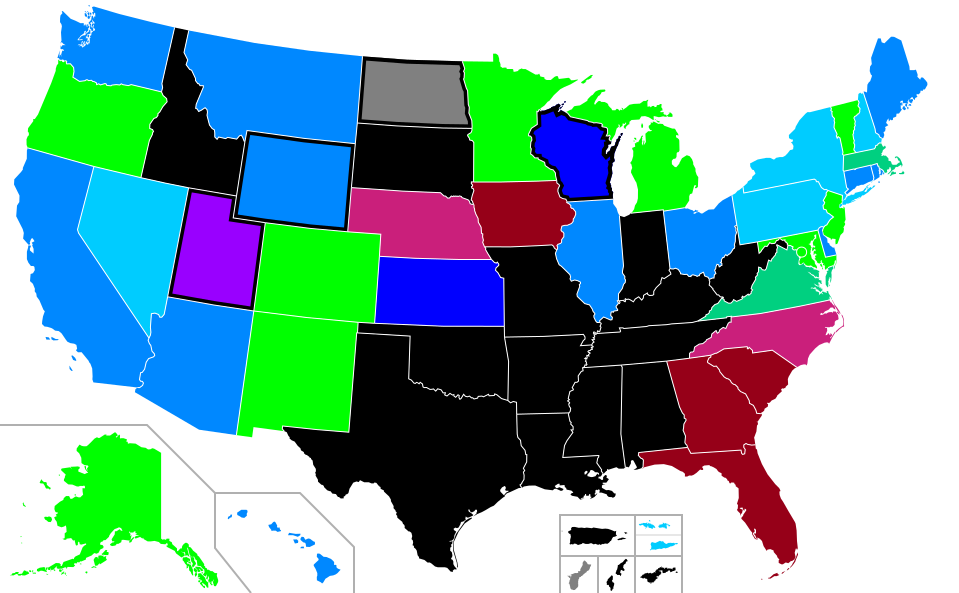
Wikimedia Commons, “Gestational limits for elective abortion in the United States” (May 2025). This map is a snapshot and is already out of date in places, Missouri in particular. Treat it as a picture of how varied the landscape is, not as a current legal reference. For live status, use the Guttmacher Institute or Center for Reproductive Rights trackers.
4.2 Five Regulatory Tiers
| Tier | Approx. gestational limit | Representative states |
|---|---|---|
| No state restriction beyond federal law | Up to viability or later (some allow later for health) | Colorado, New Jersey, Minnesota, Oregon |
| Viability standard (~24 wk) | Roughly the pre-Dobbs federal floor | California, Illinois, New York, Wisconsin |
| Mid gestational limit | 12–22 weeks | North Carolina (12 wk), Nebraska (12 wk), Utah (18 wk) |
| Six-week (“heartbeat”) laws | ~6 weeks LMP — before many know they’re pregnant | Florida, Georgia, Iowa, South Carolina |
| Near-total ban | Conception, with narrow life/health exceptions | Alabama, Arkansas, Kentucky, Mississippi, Texas, ~7 others |
Compiled from Guttmacher Institute state-policy tracking (Guttmacher Institute 2024). Tiers move constantly — verify before relying on any row.
Missouri: why a tier table is never finished. Missouri held a near-total ban until November 2024, when voters passed a constitutional amendment (Amendment 3) making reproductive freedom a state right — the first time a public vote overturned a near-total ban. What followed was two years of trench warfare: injunctions blocking the ban, the Missouri Supreme Court reinstating it on procedural grounds in May 2025, then further rulings restoring access, including a June 2026 circuit-court decision striking down most remaining restrictions.
The fight is not over. A new Amendment 3 — drafted by the legislature to re-ban abortion, with exceptions for life and, up to 12 weeks, rape and incest — goes before Missouri voters on November 3, 2026, in the middle of our term (Ballotpedia 2026). Watch it as it happens: you are seeing a state’s abortion law contested through courts and ballots at the same time.
4.3 Medication Abortion and the Comstock Act
- Since 2020, more than half of US abortions have been medication abortions (mifepristone + misoprostol).
- Pills travel by mail, across state lines, and from overseas, which makes abortion harder to ban completely.
- The Comstock Act of 1873, an obscenity statute still on the books, prohibits mailing items “intended for producing abortion.” For a century it was treated as a dead letter.
- Access to mifepristone by telehealth and mail now rests on a Supreme Court stay, a temporary order, not a settled rule.
Where the pill fight actually stands (as of July 2026). The federal government has not brought Comstock prosecutions, but the statute is now doing work in litigation rather than enforcement.
- States are suing the FDA. In Louisiana v. FDA, states argue that the FDA’s 2016–2023 decisions permitting telehealth prescribing and mail/pharmacy dispensing violated the Administrative Procedure Act and the Comstock Act.
- May 1, 2026: a Fifth Circuit panel sided with Louisiana and moved to roll back telehealth and pharmacy dispensing while the appeal proceeded.
- May 14, 2026: the Supreme Court stayed that order (Guttmacher Institute 2026). Mifepristone remains available by telehealth and mail for now. The Court did not rule on the merits — it froze the status quo while the case continues (KFF 2026). In a dissent, Justice Thomas argued the Comstock Act should be enforced as written.
- Separately, the FDA opened a safety review of mifepristone in late 2025. Several other mifepristone cases are paused awaiting its outcome.
Access to the most common method of abortion in the US currently rests on a stay, a temporary order, not a settled rule. What does it do to clinical practice when the legality of a standard treatment can change between one semester and the next?
4.4 Travel, Shield Laws, and Interstate Conflict
Travel for care. After Dobbs, abortion travel surged: an estimated 150,000–200,000 Americans now travel for abortion care each year.
Shield laws. A growing set of states (NY, MA, CA, CO, WA) have passed laws shielding their providers from out-of-state subpoenas and prosecutions when they ship pills to or treat patients from ban states. This is no longer a prediction — it is a live fight, likely headed to the Supreme Court under the Full Faith and Credit Clause.
Dr. Margaret Carpenter, a New York physician who mailed pills to patients in ban states, has been indicted in Louisiana, fined more than $100,000 in Texas, and protected by New York. All three claim to be applying the law correctly.
One doctor, two states, two legal universes. Dr. Margaret Carpenter, a New York physician, prescribed abortion medication by telehealth to patients in ban states.
- Louisiana indicted her on a felony charge — the first criminal case against a physician for mailing pills across state lines after Dobbs.
- Texas obtained a civil default judgment against her of more than $100,000.
- New York refused to cooperate. The governor declined Louisiana’s extradition demand, and in October 2025 a New York court rejected Texas’s attempt to enforce its judgment (Texas Tribune 2025).
Nothing has been resolved. Carpenter is charged in one state, fined in another, and protected in a third — and all three claim to be applying the law correctly. This is precisely the conflict the Full Faith and Credit Clause exists to settle, and it has not yet been settled.
Write or discuss: If the same act is a felony in Louisiana and lawful in New York, whose law should govern — the state where the doctor sits, or the state where the patient sits? What would each answer do to telemedicine generally, beyond abortion?
4.5 Conscience Clauses
A second post-Dobbs legal fault line: when may a clinician refuse to participate?
- Federal Church Amendments (1973) protect clinicians who refuse to perform abortions on religious or moral grounds.
- About 45 states have their own conscience laws — varying enormously in scope.
- The ANA Code of Ethics (Provision 5) recognizes conscientious objection but requires that the nurse not abandon the patient and provide referral.
- The hard cases are referral (in some states, refusing to refer is also protected) and emergencies.
EMTALA: the question that got un-asked. EMTALA (1986) requires any hospital taking Medicare to stabilize a patient with an emergency condition. Does that federal duty override a state abortion ban when stabilizing treatment is an abortion?
The federal courts came close to answering and then backed away:
- 2024: in Moyle v. United States, the Supreme Court took the Idaho case and then dismissed it as improvidently granted — deciding not to decide, and sending it back down.
- March 2025: the federal government dropped the Idaho suit entirely.
- May 2025: HHS and CMS rescinded the 2022 guidance that had told hospitals EMTALA covered emergency abortion care (Hall Render 2025).
So the conflict was never resolved on the merits — the case that would have resolved it was withdrawn. What protection remains comes from private suits (Idaho’s largest hospital system won an injunction covering only itself) rather than from a national rule. A nurse or physician in a ban state today has less federal clarity than in 2023, not more.
5 Abortion Law Around the World
5.1 A World Map
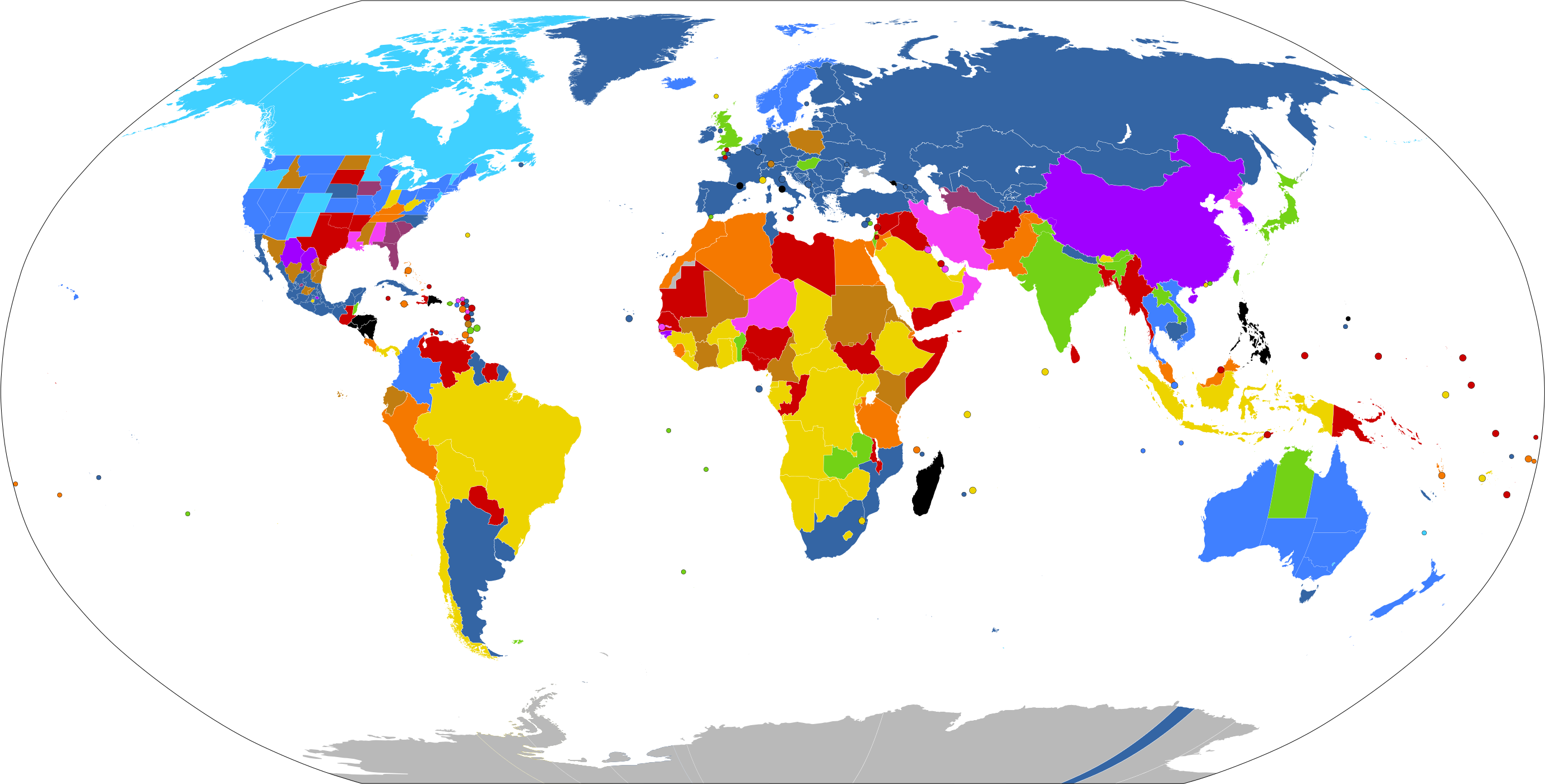
Wikimedia Commons, “Abortion Laws” — based on the Center for Reproductive Rights’ classification (Center for Reproductive Rights 2024).
5.2 Four Global Tiers
The Center for Reproductive Rights groups countries into four tiers by legal grounds.
| Tier | Grounds | Examples | % of reprod.-age women |
|---|---|---|---|
| I. Prohibited | None, or only implicit necessity | El Salvador, Nicaragua, Senegal, Egypt | ~5% |
| II. To save the woman’s life | Threat to life only | Nigeria, Iran, Indonesia, Brazil | ~22% |
| III. Health grounds | Plus mental/social/economic in some | UK, Finland, Israel, India, Japan | ~14% |
| IV. On request | No grounds, early in pregnancy | Canada, W. Europe, China, S. Africa, most of Latin America | ~36% |
Estimates from Center for Reproductive Rights, 2024 (Center for Reproductive Rights 2024; Roy and Klobucista 2024).
5.3 The Western European Consensus
Despite enormous cultural variation, most of Western Europe has converged on a strikingly similar settlement:
- Abortion on request during a first window — most often 12 weeks (Germany, France, Italy, Belgium, Spain) or 14 weeks (France since 2022)
- Mandatory counseling and often a brief waiting period (Germany’s “Beratungsregelung”: 3 days)
- After the first window: only on specific grounds (maternal health, fetal anomaly, rape) — but those grounds are interpreted fairly broadly by most national health services
- Public funding through national health insurance in most countries
Note
The puzzle. Western Europe’s settlement is more restrictive than Casey’s viability standard (~24 wk) but less restrictive than most US ban states. Both sides of the US debate routinely point to Europe to support their position — usually selectively.
5.4 Latin America’s “Green Wave”
For most of the 20th century, Latin America had some of the world’s most restrictive abortion laws. That has changed remarkably fast.
- Argentina (2020): Senate legalized abortion on request to 14 weeks, after years of mass green-bandana protests
- Mexico (2021, 2023): Supreme Court decriminalized abortion, then extended ruling to all states
- Colombia (2022): Constitutional Court legalized abortion on request to 24 weeks — among the most permissive standards anywhere
- Chile (2017, 2024 attempt): narrowly legalized for three grounds; broader liberalization stalled
5.5 Two European Tipping Points
Ireland’s Eighth Amendment repeal (2018)
For 35 years, Ireland’s constitution treated the fetus as equal to the mother. The 2012 death of Savita Halappanavar from sepsis after being denied an abortion during a miscarriage at 17 weeks galvanized national reform. A 2018 referendum repealed the amendment by 66% to 34%, ushering in legal abortion on request to 12 weeks.
Poland’s tightening (2020)
Poland was already among Europe’s most restrictive. In 2020 its constitutional tribunal — packed with allies of the ruling party — ruled that abortion for severe fetal anomaly was unconstitutional, eliminating the most common legal ground. Mass protests followed. The 2023 election change has so far not produced legislative reform.
5.6 Activity — Why Does the World Converge Around 12–15 Weeks?
A striking pattern: nearly every liberal democracy that has settled the question — Germany, France, Italy, Belgium, Spain, the Netherlands, Argentina, Ireland — has landed on a first-trimester (or slightly later) on-request window, with stricter standards beyond it.
Write or discuss:
- What features of 12–15 weeks make it a natural settling point? Biological? Practical? Political?
- Why might the US have failed to reach such a settlement? (Hint: think about the difference between constitutional and legislative resolution.)
- Is convergence here evidence that this is the right answer, or only that it is a politically stable one?
6 When the State Wants More Babies — or Fewer
6.1 Coercive Anti-Natalism: China’s One-Child Policy (1979–2015)
After the Great Leap Forward famine and rapid population growth, China in 1979 imposed a one-child-per-couple policy on most urban families. Enforcement included:
- Heavy fines scaled to several years’ income
- Mandatory IUD insertion after a first child, sterilization after a second — in the hundreds of millions
- Forced abortions, sometimes at late gestational ages, where local quotas were enforced aggressively
- Hukou denial for unregistered children, locking them out of school and health care
Combined with cultural preference for sons, the policy produced an estimated 30 million “missing women” by 2010.
6.2 China’s Sudden Pivot
By 2015 China’s birth rate had fallen below replacement, and the country was aging faster than any in history.
- 2015: two-child policy
- 2021: three-child policy
- 2023: most restrictions formally removed; tax incentives, housing subsidies, and propaganda campaigns added
- Birth rates have continued to fall
Note
Coercive anti-natalism produced a demographic crisis that coercive pro-natalism has so far been unable to reverse.
6.3 Coercive Pro-Natalism: Romania’s Decree 770 (1966–1989)
Under Communist leader Nicolae Ceaușescu, Romania’s Decree 770 banned abortion and most contraception for women under 45 with fewer than five children. The goal: 30 million Romanians by 2000. The consequences:
- Maternal mortality rose seven-fold as illegal abortion became the leading cause of death for women of reproductive age
- The birth rate doubled briefly, then collapsed as families found workarounds
- Tens of thousands of unwanted children were warehoused in state orphanages — discovered by the world only after Ceaușescu’s 1989 fall, with conditions that became a textbook case in developmental psychology
6.4 Non-Coercive Pro-Natalism
Many democracies face falling birth rates and have responded with incentives rather than bans:
- Hungary (since 2019): tax exemptions for life for women with four+ children; subsidized housing loans forgiven on third child; ~5% of GDP on family policy
- South Korea: cash payments per child; expanded parental leave; ~$280 billion spent over 16 years
- Singapore: “Baby Bonus” cash plus subsidized childcare
- France: longstanding family allowances; childcare guarantees; modest but real effect on fertility
- Nordic countries: generous parental leave, near-universal childcare, gender-egalitarian leave-sharing
These have resulted in modest stabilization at best. No incentive package has restored a country to replacement-rate fertility once it fell well below.
6.5 Activity — Where Is the Line?
A spectrum of state involvement in reproduction:
- A: free contraception and parental leave
- B: $10,000 tax credit per child
- C: $100,000 tax credit per child
- D: priority access to housing for families with three children
- E: tax penalties on childless adults over 30 (proposed in Hungary in 2010s)
- F: criminalize sterilization for adults under 35
- G: ban contraception (Romania, 1966)
- H: forced sterilization of those deemed unfit (China; US, 1907–1979)
Write or discuss:
- Where on this spectrum does incentive become pressure? Where does pressure become coercion?
- Apply each of the four principles — autonomy, beneficence, non-maleficence, justice — to step C and to step E. Which principle does the most work?
- Is the relevant question whether the state has a legitimate demographic interest, or which means it may use to pursue one?
6.6 The Four Principles, Applied to Law
| Principle | What it pushes toward in abortion law | Where it pulls back |
|---|---|---|
| Autonomy | Decisions about one’s own body and reproductive future belong to the person living them | Limits when the autonomy of another being is plausibly at stake (later gestational ages, viability) |
| Beneficence | Maximize access to safe care — bans drive abortion underground, not away | Includes weighing the interests of fetuses, families, and future children |
| Non-maleficence | Avoid the foreseeable harms of restrictive regimes — maternal deaths, denied miscarriage care, clinician moral injury | Avoid the foreseeable harms of liberal regimes that some claim (coarsening of moral attitudes, late-term cases) |
| Justice | Equal access — burdens of restrictive laws fall most heavily on the poor and on rural patients | Distributive concerns also push toward considering future generations and demographic balance |
6.7 Mini-Recap
Law has answered the abortion question in radically different ways across time and place: the common law treated early abortion as no crime; 19th-century America criminalized it everywhere; Roe and Casey read a privacy-and-liberty right into the Fourteenth Amendment; Dobbs returned the question to state legislatures; Latin America has liberalized while the US restricted. The argumentative tool from Part A travels: every Supreme Court opinion and every state statute can be put into standard form and tested at its load-bearing premise.
6.8 Review Questions
Recall
Pick two of the standard reasons a court gives for overturning one of its own past decisions. Which of the two did the most work in Dobbs?
Apply
A pharmacist in a ban state hesitates to fill methotrexate for a patient’s diagnosed ectopic pregnancy, worried the drug counts as an abortifacient. What should the clinician do, and what does the hesitation show about how bans reach care beyond abortion?
Debate
Should a ban’s medical exception list specific conditions, or leave the judgment to the treating physician? Defend one approach.
6.9 Key Terms
- Quickening — the first felt fetal movement; the common-law line below which abortion was not a crime.
- Precedent — a prior court decision treated as authoritative in later cases.
- Stare decisis — the presumption that courts should follow precedent unless very strong reasons compel otherwise.
- Trimester framework — Roe’s original standard, replaced in Casey.
- Undue burden — Casey’s standard: states may regulate but not place substantial obstacles before viability.
- Viability — the gestational point at which a fetus could plausibly survive outside the womb (~22–24 weeks).
- Trigger law — a state law written to take effect automatically when a Supreme Court precedent is overturned.
- Shield law — a state law protecting in-state providers from out-of-state legal action.
- Comstock Act — 1873 federal anti-obscenity statute that, on a literal reading, prohibits mailing abortion-related items.
6.10 Further Reading
- Greenhouse, Linda, and Reva B. Siegel. Before Roe v. Wade: Voices That Shaped the Abortion Debate Before the Supreme Court’s Ruling. Kaplan, 2010.
- Ziegler, Mary. Roe: The History of a National Obsession. Yale University Press, 2023.
- Greenhalgh, Susan. Just One Child: Science and Policy in Deng’s China. University of California Press, 2008.
- Stanford Encyclopedia of Philosophy, “The Ethics of Abortion.” (Harman 2025)
- Internet Encyclopedia of Philosophy, “Abortion.” (Gordon, n.d.)
- Center for Reproductive Rights, The World’s Abortion Laws (live map). (Center for Reproductive Rights 2024)
- Council on Foreign Relations, Abortion Law: Global Comparisons. (Roy and Klobucista 2024)
6.11 References
Ballotpedia. 2026. Missouri Amendment 3, Prohibit Abortion and Gender Transition Procedures for Minors Amendment (2026). Ballotpedia. https://ballotpedia.org/Missouri_Amendment_3,_Prohibit_Abortion_and_Gender_Transition_Procedures_for_Minors_Amendment_(2026).
Center for Reproductive Rights. 2024. The World’s Abortion Laws. Center for Reproductive Rights. https://reproductiverights.org/maps/worlds-abortion-laws/.
Dienerowitz, F. M., and M. David. 2026. “On the History of Abortion from Antiquity to the Present Day, with a Focus on Central Europe and Germany.” Geburtshilfe Und Frauenheilkunde. https://www.ncbi.nlm.nih.gov/pmc/articles/PMC11645126/.
Gordon, John-Stewart. n.d. Abortion. Internet Encyclopedia of Philosophy. https://iep.utm.edu/abortion/.
Guttmacher Institute. 2024. An Overview of Abortion Laws (State Policy Trends). Guttmacher Institute. https://www.guttmacher.org/state-policy/explore/overview-abortion-laws.
Guttmacher Institute. 2026. US Supreme Court Blocks Fifth Circuit Decision on Mifepristone. Guttmacher Institute news release. https://www.guttmacher.org/news-release/2026/us-supreme-courts-blocks-fifth-circuit-decision-mifepristone.
Hall Render. 2025. HHS and CMS Rescind Guidance on Emergency Reproductive Health Care Under EMTALA. Client alert, June 9, 2025. https://hallrender.com/2025/06/09/hhs-and-cms-rescind-guidance-on-emergency-reproductive-health-care-under-emtala/.
Harman, Elizabeth. 2025. “The Ethics of Abortion.” In The Stanford Encyclopedia of Philosophy, Summer 2025, edited by Edward N. Zalta and Uri Nodelman. Metaphysics Research Lab, Stanford University. https://plato.stanford.edu/archives/sum2025/entries/abortion-ethics/.
KFF. 2026. Louisiana v. FDA: Access to Mifepristone Back at the Supreme Court. KFF Women’s Health Policy. https://www.kff.org/womens-health-policy/louisiana-v-fda-access-to-mifepristone-back-at-the-supreme-court/.
Roy, Diana, and Claire Klobucista. 2024. Abortion Law: Global Comparisons. Council on Foreign Relations. https://www.cfr.org/article/abortion-law-global-comparisons.
Supreme Court of the United States. 1973. Roe v. Wade, 410 U.S. 113. United States Reports. https://supreme.justia.com/cases/federal/us/410/113/.
Supreme Court of the United States. 1992. Planned Parenthood of Southeastern Pennsylvania v. Casey, 505 U.S. 833. United States Reports. https://supreme.justia.com/cases/federal/us/505/833/.
Supreme Court of the United States. 2022. Dobbs v. Jackson Women’s Health Organization, 597 U.S. ___. United States Reports. https://www.supremecourt.gov/opinions/21pdf/19-1392_6j37.pdf.
Texas Tribune. 2025. New York Tosses Ken Paxton Challenge in Abortion Pills Case. Texas Tribune, October 31, 2025. https://www.texastribune.org/2025/10/31/texas-lawsuit-new-york-abortion-provider-shield-law-ken-paxton/.