Lecture 2 — History & the Clinical Relationship
Part A: From Hippocrates to the Belmont Report: A History
1 A Case to Open With
1.1 A Study You Should Refuse
You are a physician asked to help run a syphilis study.
- The subjects are poor Black men in Alabama.
- They are told they have “bad blood,” not syphilis.
- Penicillin now works, but the study keeps going.
- Your supervisors say the knowledge will help future patients.
Do you stay in the study? If not, what principle tells you to walk away?
1.2 After You’ve Discussed
Note
The study was never secret. Between 1936 and 1973 the researchers published thirteen reports on it in medical journals, the first in 1936 and roughly one every four to six years after that. The men were sometimes described in print as volunteers. No one in the medical community objected in print.
So the question is not only whether you would refuse. It is whether you would have noticed anything to refuse.
1.3 Today
By the end of Part A, you will be able to:
- Trace the move from “doctor knows best” to patient consent
- Tell what actually happened in the Carrie Buck, Nuremberg, Willowbrook, and Tuskegee cases
- Explain which protection each scandal forced into existence
- Compare the Nuremberg Code, Helsinki, and the Belmont Report
- Explain why IRBs and ethics committees exist today
2 The Old Deal: Doctor Knows Best
2.1 The Default for 2,400 Years
- For most of Western medical history the doctor decided, the patient trusted, and no one else asked questions.
- The Hippocratic tradition (5th century BCE) gave medicine real duties: help the sick, avoid harm, keep confidences.
- Consent, disclosure, and patient choice appear nowhere in the Hippocratic Oath. The patient in it is silent.
- What it never included was any idea that the patient should be informed, or asked.
- Paternalism is caring for someone by deciding for them, and it was the default for roughly 2,400 years.
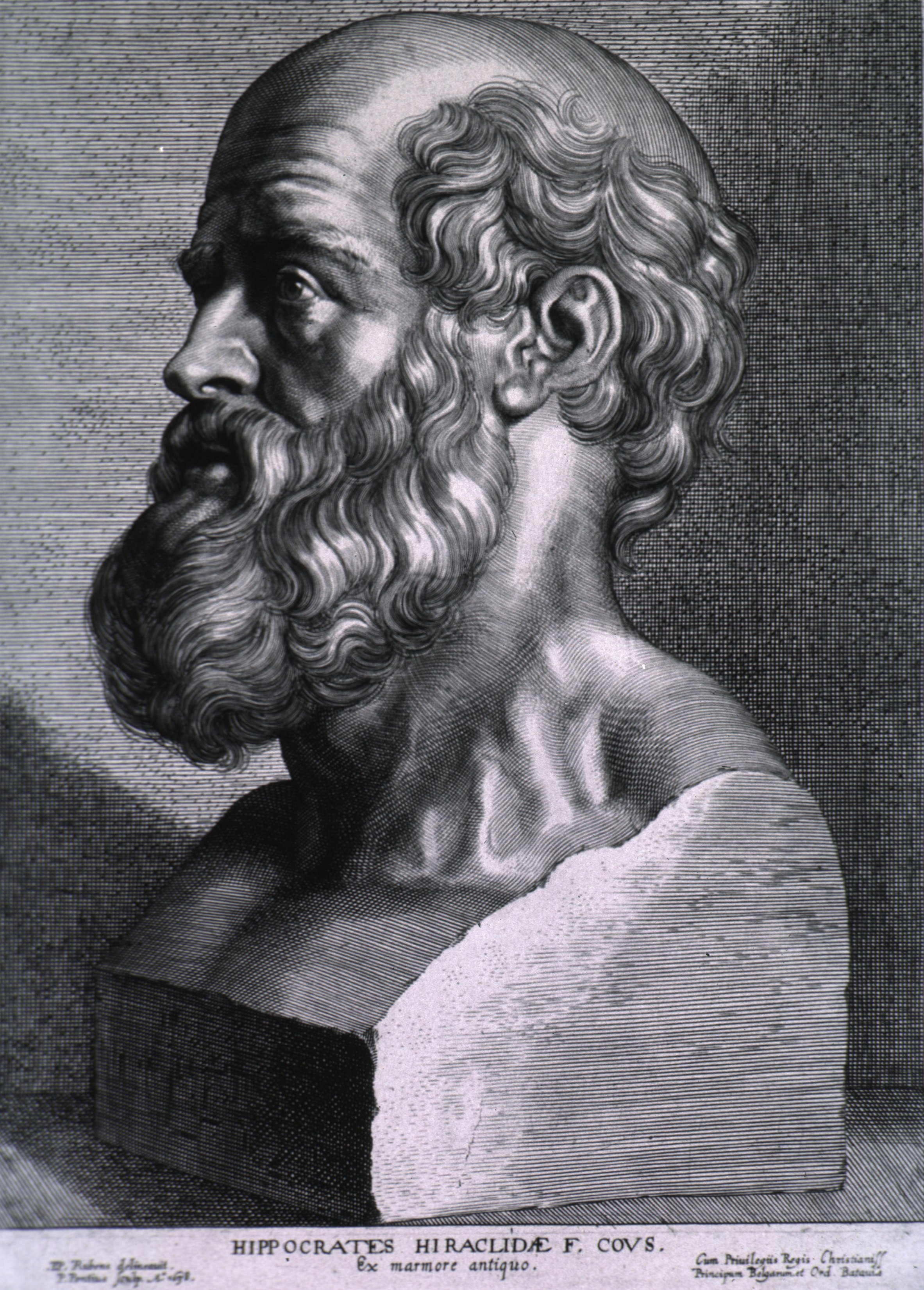
Hippocrates of Kos. Public domain. (U.S. National Library of Medicine 2002)
2.2 What Paternalism Got Right — and Wrong
What it got right
- Clinicians genuinely did know more.
- Emergencies genuinely do demand fast judgment.
- Frightened patients often want a confident recommendation, not a menu of options.
- Medicine cannot function without expert judgment.
Where it failed
- Expertise slid easily into domination.
- Good intentions could quietly mask coercion.
- The patient became an object medicine acted upon, not a person it reasoned with.
- A profession that policed only itself protected its own reputation first.
2.3 A Bedside Moment
Protective lying. A physician tells the family of a seriously ill man, “Don’t tell him it’s cancer yet — he’ll give up.” Everyone in the room means well, and for most of medical history this was considered good practice, even kind.
- Is this kindness, or is it control?
- Is it beneficence — or a failure of respect dressed up as beneficence?
- The patient is the only person not in the conversation about his own life. What is missing from this encounter?
Paternalism was usually defended as expertise plus benevolence, not cruelty. That is exactly why it lasted so long — and why the abuses ahead were so hard to see from the inside.
3 When Medicine Serves the State
3.1 The Idea Called Eugenics
- Eugenics was the belief that society could be improved by controlling who reproduces: encouraging the “fit,” preventing the “unfit.”
- Not fringe pseudoscience. It was taught at major universities, funded by foundations, and run from the Eugenics Record Office at Cold Spring Harbor (1910).
- Some 32 states passed sterilization laws; more than 60,000 Americans were sterilized without meaningful consent.
- Its targets had the least power: disabled people, the poor, immigrants, and Black and Indigenous Americans.
- Nazi Germany’s 1933 sterilization law drew on these American statutes, especially California’s.
3.2 Carrie Buck, Age 17
- In Virginia in 1924, Carrie Buck was a poor 17-year-old placed with a foster family.
- She became pregnant after being raped by a relative of that family.
- To hide the family’s shame, she was labeled “feebleminded” and committed to a state institution.
- Her infant daughter Vivian was judged “defective” by a social worker who watched the baby for a few minutes.
- Carrie was in fact of ordinary intelligence, and Vivian later made her school’s honor roll before dying young.
3.3 “Three Generations of Imbeciles”
“It is better for all the world if, instead of waiting to execute degenerate offspring for crime or to let them starve for their imbecility, society can prevent those who are manifestly unfit from continuing their kind.… Three generations of imbeciles are enough.”
Justice Oliver Wendell Holmes Jr., Buck v. Bell (1927), 8–1 decision (Supreme Court of the United States 1927)
The Court did not merely permit Carrie’s sterilization — it endorsed the reasoning. Buck v. Bell has never been formally overturned. Here, the law did not fail to stop the harm; the law ordered it, and no protective rule followed for decades.
3.4 Thought Question
You are the physician at the Virginia institution in 1927. The court order to sterilize Carrie has arrived.
- Your supervisor calls it legal, routine, and “kind to society.”
- You suspect Carrie’s “feeblemindedness” is really poverty and a pregnancy from rape.
- Do you perform the operation? If you refuse, what are you appealing to — the law says you are the one in the wrong.
- Would it change anything if Carrie herself said yes? Could she give real consent in this situation?
- The state’s reasoning is “fewer ‘unfit’ children means a better society.” What is wrong with that argument even when it is sincere?
- Not safely in the past: 150 women sterilized in California prisons (2006—2010), and a Tennessee judge offering reduced jail time for a vasectomy (2017). Where is the line between an offer, pressure, and coercion?
3.5 After You’ve Discussed
Note
- “Legal” did not mean “right.” Buck v. Bell has never been formally overturned — law can lag ethics by decades.
- Consent does not erase coercion. A “yes” from a confined, dependent person may not be free. Ask who is asking and what saying no would cost.
- “For the good of society” is the move to watch. Trading one person’s body for a population-level gain treats her as a means, the reasoning later codes were written to block.
4 Atrocity and the First Rule
4.1 Medicine Inside the Camps
- In Nazi concentration camps, physicians used prisoners as experimental material. Refusal was not possible.
- The experiments included immersion in ice water, low-pressure chambers, forced seawater ingestion, deliberate wound infection, and mass sterilization.
- They were run by credentialed doctors and presented as legitimate military and scientific research.
- Many subjects were permanently injured. Many were killed, sometimes by the experiment itself.
- “Scientific progress” was the justification offered, which is why progress alone can never be one.
4.2 The Doctors’ Trial (1946–1947)
At Nuremberg, a U.S. military tribunal tried 23 defendants — 20 of them physicians — in United States v. Karl Brandt et al. The charges were war crimes and crimes against humanity. Sixteen were convicted and seven sentenced to death, including Karl Brandt, Hitler’s escort physician. The judges had outrage but no agreed international standard to point to, so with expert medical advisers they wrote one.
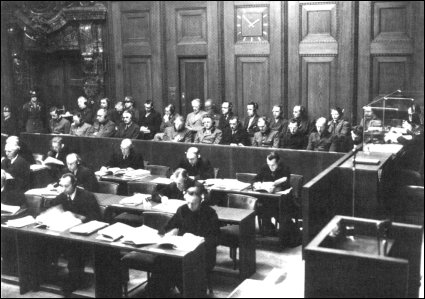
Nuremberg Doctors’ Trial. Public domain.
4.3 Nuremberg Code: The First Principle
“The voluntary consent of the human subject is absolutely essential. This means that the person involved should have legal capacity to give consent; should be so situated as to be able to exercise free power of choice, without the intervention of any element of force, fraud, deceit, duress, over-reaching, or other ulterior form of constraint or coercion; and should have sufficient knowledge and comprehension of the elements of the subject matter involved, as to enable him to make an understanding and enlightened decision.”
The Nuremberg Code, Principle 1 (1947) (Nuremberg Military Tribunals 1947)
4.4 The Code’s Nine Other Rules
- The Code has ten points. Voluntary consent is only the first.
- Research must promise real social value, unobtainable another way, resting on prior animal study and sound science.
- Risks must be minimized, and never disproportionate to the expected benefit.
- The subject may withdraw at any time; the investigator must halt a study that becomes dangerous.
- Its weakness: the Code had little legal force, and American physicians read it as a verdict on Nazis, not rules for themselves.
4.5 The Rules So Far
| Scandal | What was missing | The rule we got |
|---|---|---|
| Eugenics & Carrie Buck (1927) | Your body is yours | (gap still open) |
| Nazi experiments → Nuremberg Code (1947) | The subject’s free “yes” | Voluntary consent is absolutely essential |
5 “It Can’t Happen Here”
5.1 Why One Code Was Not Enough
- Nuremberg came from judges, about Nazis, so U.S. doctors filed it under “not us.”
- To make research ethics medicine’s own responsibility, the World Medical Association issued the Declaration of Helsinki in 1964 (World Medical Association 1964).
- Its 1975 Tokyo revision first required review by an independent committee, the seed of the modern IRB.
- A code on paper changes nothing if no one outside the lab ever checks the work.
- Two American cases proved that respectable, well-funded medicine could fail just as badly.
5.2 Willowbrook
Willowbrook State School on Staten Island was a severely overcrowded institution for children with intellectual disabilities, and hepatitis spread constantly through its wards. Beginning in 1956, a research team deliberately infected newly admitted children with hepatitis to study its course and test gamma globulin as a preventive. The defense offered was that the children would have been infected there anyway.

Willowbrook State School administration building postcard, via Wikimedia Commons and the New York Public Library, public domain.
5.3 Was the Consent Real?
The catch. For periods of time, Willowbrook’s general wards were closed to new admissions — but the research unit had space.
In effect, parents who could not care for a severely disabled child at home were told: enroll your child in the hepatitis study, or keep waiting. Desperate parents signed. A signature obtained under those conditions is what makes the word voluntary so hard — it looks like consent, but the choice was not free.
5.4 Beecher’s Warning (1966)
- Henry Beecher was a Harvard anesthesiologist and a respected insider, not an activist critic.
- In a 1966 New England Journal of Medicine article he laid out 22 unethical studies, all already published in reputable journals (Beecher 1966).
- They included penicillin withheld from servicemen, live cancer cells injected into patients at the Jewish Chronic Disease Hospital (1963), and Willowbrook.
- His boldest claim: the consent form is not the real safeguard. A signature can be collected from a frightened patient who understands nothing.
- He trusted the conscientious investigator. History drew the opposite lesson: character is not enough, and oversight had to become structural.
The tension is the point. Beecher bet on individual virtue; the system that followed bet on structure. Ask yourself whether we need both — and whether either works without the other. Case 2 gives the question its sharpest test.
5.5 The Rules So Far
| Scandal | What was missing | The rule we got |
|---|---|---|
| Eugenics & Carrie Buck (1927) | Your body is yours | (gap still open) |
| Nazi experiments → Nuremberg (1947) | The subject’s free “yes” | Voluntary consent |
| Willowbrook & Beecher (1956–66) | Someone outside the team must say yes | Independent review — the future IRB |
5.6 Thought Question
Your child has a severe intellectual disability and you cannot care for him at home.
- The only institution with an open bed will admit him — but only into the hepatitis research ward.
- The wait for a non-research bed is years.
- You sign the form. Was your consent voluntary? What would have to be true for it to count?
- Researchers said the children “would have caught hepatitis here anyway.” Is that a good reason to deliberately give it to them?
- Suppose instead the research ward simply had better staffing and nicer conditions. Is that offer fine, or still a problem?
5.7 After You’ve Discussed
Note
Three different failures hide in this one case — keep them apart:
- Coercion — a threat (“no bed unless you enroll”). The choice is not free.
- Undue inducement — an offer so strong it clouds judgment: a $5,000 payment for a Phase I study, or simply the better-staffed ward.
- Exploitation — taking unfair advantage of someone’s bad situation, even with honest consent and no deception.
And the “they’d get it anyway” defense fails: a background risk does not license deliberately imposing harm (Jonsen 1998).
6 Forty Years: Tuskegee
6.1 Tuskegee: The Setup
The U.S. Public Health Service began the study in 1932 in Macon County, Alabama. It enrolled 600 Black men — 399 with latent syphilis, 201 uninfected controls — to observe untreated syphilis all the way to autopsy. The men were poor sharecroppers with almost no access to medical care, which is exactly why they were chosen. Eunice Rivers, a trusted Black public-health nurse, was the liaison who kept them enrolled for decades.
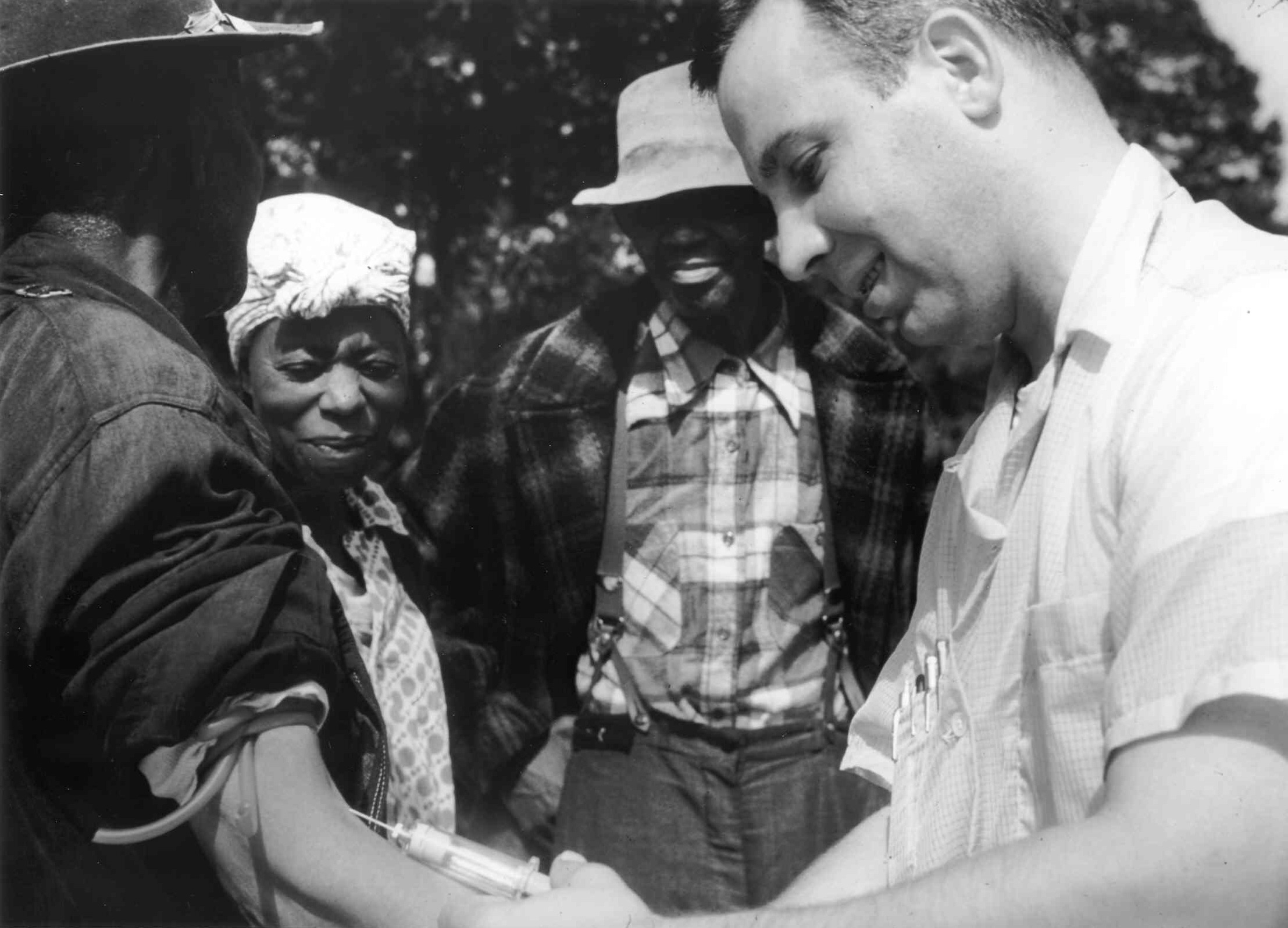
CDC Archives. Public domain.
6.2 What They Were Told vs. What Was True
| The men were told… | The reality was… |
|---|---|
| They had “bad blood” | They had latent syphilis, never named to them |
| They were getting “special free treatment” | Painful diagnostic spinal taps were given as the “treatment” |
| The study was for their health | The goal was to observe the disease until they died and could be autopsied |
| Care was a gift for joining | Free meals, exams, and burial insurance were incentives to stay until death |
| — | When penicillin became standard (~1947), it was deliberately withheld, and the draft board was asked not to treat them |
6.3 Forty Years — and What Finally Broke It
6.4 Why Nobody Stopped It
- The subjects were poor, Black, and politically powerless, and racism made their suffering easy for officials to discount.
- The study was bureaucratically routine, renewed and re-funded for forty years without anyone with power asking whether it should continue.
- Peter Buxtun, a Public Health Service interviewer, filed formal ethical objections in 1966 and pressed them again in 1968.
- The CDC, the federal agency that by then ran the study, convened a panel in 1969 that reviewed it and decided it should continue.
- Only in 1972 did Buxtun give the documents to journalist Jean Heller, whose Associated Press story ended the study.
6.5 Thought Question
What was the deepest wrong in Tuskegee?
- The deception?
- The withholding of treatment?
- The racist choice of subjects?
- The 40 years of institutional indifference?
You can argue for more than one answer, but which wrong seems most central?
6.6 After You’ve Discussed
Note
- Map each wrong to a principle. Deception → respect for persons; withheld penicillin → beneficence; choosing poor Black men → justice. The forty years of silence maps to none of them: codes do not legislate moral courage.
- Justice runs both ways. Tuskegee was wrongful inclusion. Modern ethics also worries about wrongful exclusion: fair selection means neither dumping risk on the vulnerable nor denying them benefit.
7 Belmont and the Rise of Bioethics
7.1 From Scandal to a Field, and a Statute
- Van Rensselaer Potter coined “bioethics” in 1970: a “bridge to the future” between scientific knowledge and human values (Potter 1970).
- New institutions gave the field a home: the Hastings Center (1969) and Georgetown’s Kennedy Institute of Ethics (1971).
- Medicine now faced public, not merely professional, moral questions, and needed a shared public language.
- Tuskegee’s exposure in 1972 created political pressure Congress could not ignore.
- The National Research Act (1974) created a national commission, required IRB review of federally funded research, and told the commission to name the governing principles.
7.2 The Belmont Report (1979)
- The Belmont Report was written by that commission, drafted at a 1976 retreat at the Smithsonian’s Belmont Conference Center (National Commission for the Protection of Human Subjects of Biomedical and Behavioral Research 1979).
- It is deliberately brief: a framework, not a checklist and not a criminal code.
- It names three principles: respect for persons, beneficence, and justice.
- Its decisive move is pairing each principle with a concrete protection.
- Those pairings became the backbone of U.S. human-research regulation (the “Common Rule”).
7.3 Belmont’s Three Principles
| Principle | Plain meaning | The protection it became | The scandal that exposed the need |
|---|---|---|---|
| Respect for persons | People are agents; protect those with reduced autonomy | Informed consent | Willowbrook & Tuskegee deception |
| Beneficence | Secure welfare; minimize harm; justify every risk | Risk–benefit assessment | Nazi & Willowbrook harm |
| Justice | Burdens and benefits must be distributed fairly | Fair subject selection | Tuskegee’s targeting of the poor and Black |
7.4 Three Foundational Documents Compared
| Document | Origin | Main emphasis | Best one-line summary |
|---|---|---|---|
| Nuremberg Code | War-crimes tribunal | Voluntary consent | Persons are not raw material |
| Helsinki | Medical profession | Research governance by physicians | Research needs disciplined review |
| Belmont | U.S. national commission | Respect, beneficence, justice | Turn principles into oversight |
7.5 Bioethics Timeline
8 Oversight Today
8.1 Two Kinds of Oversight
- An IRB (Institutional Review Board) reviews research before it begins: are risks minimized, subjects fairly selected, consent adequate?
- A clinical ethics committee works during care, advising on bedside conflicts: capacity, surrogates, end-of-life decisions, team disagreement.
- Both are deliberately multidisciplinary. One person’s conscience is an unreliable safeguard.
- Hospital ethics committees spread after the 1976 Karen Ann Quinlan case. The 1962 Seattle “God committee,” which rationed dialysis, was a troubling forerunner.
- The common thread is structural review: not “trust the good doctor” but “make the reasoning answerable to others.”
8.2 How an IRB Thinks
8.3 The Rulebook You Just Built
| Scandal | What was missing | What it became |
|---|---|---|
| Carrie Buck (1927) | Your body is yours | The body-autonomy idea the law had skipped |
| Nuremberg (1947) | The subject’s free “yes” | Voluntary consent |
| Willowbrook & Beecher (1956–66) | An outside check | Independent review (IRBs) |
| Tuskegee (1932–72) | Honesty, treatment, fair selection | Belmont: respect, beneficence, justice |
8.4 Wrapping Up Part A
Medical ethics moved from professional paternalism toward explicit respect for persons because abuse made the older model impossible to defend. Nuremberg named consent. Willowbrook and Beecher showed abuse can look respectable. Tuskegee exposed racism, deception, and 40 years of institutional failure. Belmont turned these lessons into a framework that still governs research and echoes through bedside care. The same shift reshaped ordinary clinical ethics: the governing question moved from “What should the doctor do?” to “How should clinicians decide with patients?” That is where Part B begins.
8.5 Review Questions
Write a brief answer to each, or use them as discussion prompts.
Recall
How did Nuremberg, Willowbrook and Beecher, and Tuskegee each add a different safeguard to the modern research-ethics rulebook?
Apply
A hospital wants its IRB for a new drug study to be made up entirely of physicians from the sponsoring department because “they understand the science best.” Using the history in this lecture, explain why self-policing is not enough and what safeguards an adequate review process needs.
Debate
Do health systems and governments owe material repair for past medical abuses such as forced sterilization and Tuskegee, or are apology, memorialization, and better oversight enough?
8.6 Key Terms
- Paternalism — overriding a person’s choices for what is judged to be their own good.
- Eugenics — the early-20th-century project of “improving” the population by controlling who reproduces; underwrote forced sterilization laws.
- Nuremberg Code (1947) — the ten-point statement issued after the Nazi doctors’ trial; first to require voluntary consent of the human subject.
- Declaration of Helsinki — the World Medical Association’s research-ethics statement (1964, repeatedly revised), addressing consent, risk, and obligations to subjects.
- Willowbrook hepatitis study — research at a NY institution for children with intellectual disabilities, criticized for coerced consent and deliberate infection.
- Beecher’s exposé (1966) — Henry Beecher’s NEJM article cataloguing 22 unethical studies in mainstream U.S. medicine.
- Tuskegee Study (1932–1972) — USPHS study of untreated syphilis in Black men in Alabama; subjects deceived and denied penicillin after it became standard.
- Belmont Report (1979) — National Commission report naming the three principles of research ethics: respect for persons, beneficence, justice.
- IRB (Institutional Review Board) — the committee that reviews and approves human-subjects research at an institution.
- Bioethics — the field that emerged in the 1970s in response to these scandals and to new biomedical capacities.
8.7 References
Beecher, Henry K. 1966. “Ethics and Clinical Research.” New England Journal of Medicine 274 (24): 1354–60. https://doi.org/10.1056/NEJM196606162742405.
Jonsen, Albert R. 1998. The Birth of Bioethics. Oxford University Press.
National Commission for the Protection of Human Subjects of Biomedical and Behavioral Research. 1979. The Belmont Report: Ethical Principles and Guidelines for the Protection of Human Subjects of Research. U.S. Department of Health, Education, and Welfare. https://www.hhs.gov/ohrp/regulations-and-policy/belmont-report/index.html.
Nuremberg Military Tribunals. 1947. The Nuremberg Code. Trials of War Criminals before the Nuremberg Military Tribunals under Control Council Law No. 10.
Potter, Van Rensselaer. 1970. “Bioethics, the Science of Survival.” Perspectives in Biology and Medicine 14 (1): 127–53.
Supreme Court of the United States. 1927. Buck v. Bell, 274 U.S. 200 (1927). U.S. Supreme Court decision.
U.S. National Library of Medicine. 2002. Greek Medicine: The Hippocratic Oath. History of Medicine Division. https://www.nlm.nih.gov/hmd/greek/greek_oath.html.
World Medical Association. 1964. “Declaration of Helsinki: Ethical Principles for Medical Research Involving Human Subjects.” JAMA.