Andrew Wakefield and the MMR-Autism Myth: Misinformation, Vaccine Hesitancy, and Public Trust
“The facts were settled, and the belief grew anyway” — a bioethics case study
- Who: Andrew Wakefield (b. 1957), a British gastroenterologist; and the millions of parents who came to fear the MMR vaccine.
- What: A 1998 study falsely linked the measles-mumps-rubella vaccine to autism. The claim was wrong, and later shown to be fraud. The fear it started has outlived every correction.
- Where / When: London, 1998; then the US, Europe, and the world, up to today.
- Why it matters: The science here is not in doubt. The vaccine does not cause autism. The live questions are about vaccine hesitancy, manufactured doubt, and public trust — and how a clinic or a government should respond when facts alone do not work.
- Pair with: Public Health Ethics — False Beliefs and the Ethics of Correction.
The Case
A pediatrician has fifteen minutes. Across the exam table sits a mother with a healthy toddler and a folder of printouts. She is kind, college-educated, and certain: she will not allow the MMR shot. She has read that it causes autism. She loves her child, and she is not careless. The doctor has met this conversation a hundred times. Where did it come from?
It came from one paper. In February 1998, the British medical journal The Lancet published a study by Andrew Wakefield and twelve co-authors. It described twelve children with autism and bowel problems. It suggested their symptoms began soon after the MMR vaccine. The paper itself was cautious. At a press conference, Wakefield was not. He told reporters that parents should consider single shots instead of the combined vaccine. The story went around the world.
What the public did not learn for years was what sat behind it. The journalist Brian Deer spent years taking the study apart. He tracked down the families. He compared what the parents remembered to what the records said. The two did not match. Records had been altered to fit the story (Deer 2011). Some children had shown signs of autism before the shot. Some had no autism at all. One child described as healthy before the vaccine had, in fact, been delayed from birth.
Deer found the money, too. Wakefield had been paid more than £435,000 by lawyers who were preparing to sue vaccine makers. The lawyers wanted a study that pointed at the vaccine. They got one. Wakefield had also filed a patent on a rival, single-measles vaccine — a product that could profit if the combined shot fell out of favor. None of this appeared in the paper. The study was not just wrong. It was, in Deer’s word, a fraud.
The damage did not wait for the correction. In Britain, MMR vaccination fell from about 92% to below 80%. In some London boroughs it dropped further. Measles, once nearly gone, came back. In 2013, an outbreak in Swansea, Wales, infected more than 1,200 people and killed a young man. Outbreaks followed across Europe and the United States. Children who could not be vaccinated — newborns, kids with cancer — lost the shield that high vaccination had given them. The fear was abstract. The harm was not.
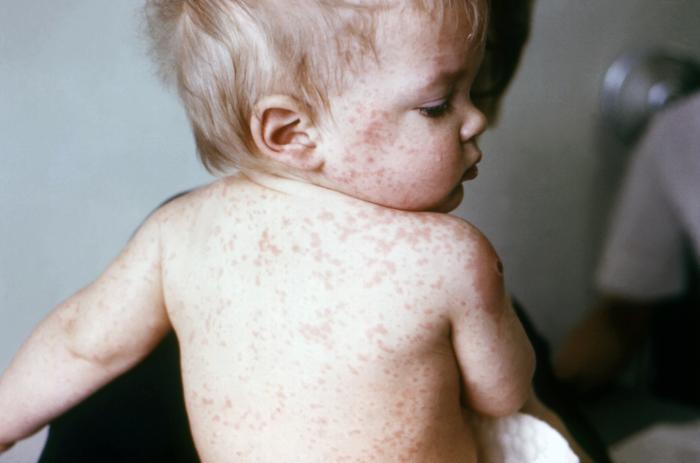
US Centers for Disease Control and Prevention. Public domain.
Herd immunity and R₀
A disease’s basic reproduction number, or R₀, is how many people one sick person infects in a group with no immunity. Measles is among the most contagious diseases known, with an R₀ near 12 to 18. Because it spreads so easily, a community needs about 95% of people vaccinated to stop it. That shared protection is called herd immunity. When vaccination dips even a little, measles is the first disease to return.
The official response came slowly but fully. In 2004, ten of Wakefield’s co-authors withdrew their support for the paper’s claims. In 2010, The Lancet retracted it. The same year, Britain’s medical board found Wakefield guilty of dishonesty and struck him off the register. He could no longer practice medicine.
He did not disappear. He moved to the United States. He became a leader of the anti-vaccine movement and directed a 2016 film, Vaxxed. He drew large, devoted crowds. The retraction had ended his career. It had not ended his influence. If anything, being cast out by the establishment made him, to his followers, more believable.
Meanwhile the science only grew stronger. This is the part the printouts in the mother’s folder leave out.
- A Danish study in 2002 followed 537,303 children. It found no link between MMR and autism (Madsen et al. 2002).
- A larger Danish study in 2019 followed 657,461 children, including those with autism risk factors. Again, no link (Hviid et al. 2019).
- Dozens of studies on several continents agree. The combined evidence covers millions of children.
There is also a simple reason the myth felt true. The MMR shot is given around 12 to 15 months. The first clear signs of autism often appear around the same age. One follows the other in time, so the mind links them. But timing is not cause. When researchers compared vaccinated and unvaccinated children, autism rates were the same.
So we reach a strange place. The evidence is overwhelming. The original study was retracted and exposed as fraud. And yet, more than twenty-five years later, the fear is stronger and broader than ever. The honest question is no longer whether the science is settled. It is. The question is why the belief grew anyway — and what a clinician or a government may rightly do about it.
The Argument Wakefield Started
The science here was settled years ago: the study was retracted, the fraud exposed, the supposed link disproven many times over. The argument Wakefield left behind is the one that won’t settle, and it sits one level below the facts. Scholars and clinicians who fully accept the science still split over two questions — why the false belief spread anyway, and what, if anything, can be said to undo it.
Just tell them the facts
The first response is the natural one. People believe a falsehood because they lack the truth. So give them the truth — clearly, often, and from trusted experts. Correct the record. Label the lies. Teach the science in school. This is the instinct behind most fact-checking and public health messaging. It is also the instinct of the tired clinician who simply hands the mother a fact sheet. The logic feels airtight.
The Correction Argument
- People reject the MMR vaccine because they hold a false belief.
- False beliefs are caused by missing or wrong information.
- Giving people correct information removes the false belief.
- Therefore, the cure for vaccine fear is better facts, clearly delivered.
The weak link is premise 3. It assumes that facts, once delivered, do their work. Sometimes they do. But the past twenty-five years are a hard test of that premise, and it often fails. The retraction, the fraud finding, the millions of children studied — all of it was delivered. The fear grew anyway. So the next question is: why doesn’t correction work?
Why correction can backfire
The philosopher C. Thi Nguyen offers an answer. He separates two things that look alike. In an epistemic bubble, people simply miss the other side; show them the evidence and the bubble can pop. An echo chamber is different and far more stubborn. It is a place where members are actively taught that outside sources — doctors, the CDC, “the media” — are liars. The chamber does not hide the experts. It discredits them in advance.
Once someone believes that, a fact-check is not neutral. It is proof of the plot. Hand such a parent the retraction, and she does not see a correction. She sees the establishment closing ranks. Wakefield’s own story feeds this. He was cast out by the medical board, so to his followers his exile is not disgrace. It is evidence that he was silenced for telling the truth.
The Backfire Reply
- Many vaccine-fearful people belong to communities that distrust mainstream experts on principle.
- To such a person, a correction from those experts looks like more evidence of a cover-up.
- So official corrections can deepen the false belief instead of removing it.
- Therefore, premise 3 of the Correction Argument is false: facts alone can make things worse.
This reply is strong, but it can sound smug. It risks treating every doubter as a brainwashed dupe. That picture is both unkind and, often, untrue. Many people who distrust the vaccine system are not trapped in a chamber. They are reading a real history. That history is the next move.
Sometimes the distrust is earned
Heidi Larson, who studies vaccine confidence around the world, argues that we misread hesitancy when we treat it only as ignorance. Trust is not refused at random. It is withheld from institutions that have broken it (Larson 2020). A parent who distrusts the drug industry is not making a wild leap. She is generalizing from a record. And medicine has handed her that record, more than once.
- Drug companies have hidden harms. Purdue Pharma marketed OxyContin as barely addictive and helped start the opioid crisis. Its makers paid billions in settlements.
- The Tuskegee study let Black men go untreated for syphilis for forty years. Its memory still shapes trust in Black communities today.
- During COVID, officials sometimes spoke with more certainty than the evidence allowed, then reversed course. Masks, school closures, and transmission all saw public flip-flops. Each reversal spent trust that was hard to earn back.
The Earned-Distrust Argument
- People reasonably lower trust in institutions that have deceived them before.
- Medical and government institutions have, in real cases, deceived the public.
- So some vaccine distrust is a rational response to a real record, not mere ignorance.
- Therefore, the cure is not louder facts but more trustworthy institutions.
This reframes the whole problem. If distrust is partly earned, then “just trust the experts” repeats the insult. The work moves from the patient’s head to the institution’s conduct. But this raises a harder political question. What happens when the distrust is bundled with a broad movement — one that mixes fair complaints with false ones?
Health freedom, and the trouble with bundles
By the 2020s, vaccine doubt had become more than a private worry. It had become an identity and a politics. The “Make America Healthy Again” (MAHA) movement is the clearest example. Its appeal is that it is not only about vaccines. It also raises concerns many experts share. Americans do eat too much ultra-processed food. Chronic disease is rising. Regulators and the companies they oversee are often too close. On these points, the movement is not crankery. It is closer to common sense.
This is exactly what makes it hard to answer. Its true claims and its false ones travel in the same bag. A parent arrives worried about food dyes and added sugar — fair worries — and leaves doubting the measles vaccine. The good points open the door. The dangerous one walks in behind them. A movement that was only false would be easy to refute. One that is half right is not.
Scholars who fully accept the vaccine science split sharply on what to do about this. The split is not about facts. It is about strategy, and about what counts as a clean hand.
The Engagement Argument
- A movement gains trust by being heard on the points where it is right.
- MAHA is right that chronic disease and processed food are neglected problems.
- Engaging those true concerns could rebuild the trust that moves people on vaccines.
- Therefore, public health should work with such movements where they are right, not just fight them.
The vaccine scientists Paul Offit and Peter Hotez push back hard (Offit 2011; Hotez 2021). To engage, they argue, is to lend your credibility to the false parts. Shaking hands on diet can legitimize a leader who also spreads vaccine lies. Stand next to such a figure on a stage, and you have endorsed the whole stage. Hotez goes further. He calls organized anti-vaccine activism a lethal force, one that has killed people who trusted it. You do not negotiate with that, he argues. You name it.
The disputed premise is 3: that engagement builds trust rather than laundering falsehood. Larson’s side answers that refusing to engage has its own cost. Treat every doubter as an enemy, and you push the merely worried into the arms of the truly committed. The clinician feels this directly. Lecture the mother, and she may never come back. Listen to her, and you keep the door open — but you may also seem to grant that her fears are reasonable. Which risk is worse is not a question of science. It is a question of strategy and ethics, and it is unresolved.
The move that hasn’t ended
The argument is no longer academic. It now runs the government. In 2025, Robert F. Kennedy Jr., a long-time vaccine skeptic and a face of the MAHA movement, became US Secretary of Health and Human Services. Supporters saw a long-overdue challenge to a captured system. Critics saw the fox handed the keys to the henhouse. Both were watching the same appointment.
What followed was not rhetoric but machinery:
- June 2025: Kennedy dismissed every sitting member of the ACIP — the federal advisory committee that recommends vaccines — and reconstituted it with his own appointees, several with records of vaccine skepticism.
- January 2026: he directed the CDC to rewrite the childhood immunization schedule, cutting routine recommendations from 17 diseases to 11. Flu, rotavirus, hepatitis A, hepatitis B, RSV, and some meningococcal vaccines were moved off the routine schedule and recommended only for “high-risk” groups. Notably, the Secretary can direct this change without an ACIP vote (Congressional Research Service 2026).
- March 16, 2026: a federal court in Massachusetts stayed the new schedule in a challenge led by the American Academy of Pediatrics, reverting it to the May 2025 version. The legal fight continues.
Meanwhile the disease came back. 2026 has been the worst US measles year since 1991 — more than 2,100 confirmed cases across 41 jurisdictions by mid-year, with months still to run, and three deaths since 2025: two unvaccinated children in Texas and one adult in New Mexico. The United States has held measles elimination status since 2000. The Pan American Health Organization is scheduled to review that status in November 2026 — during our term — and sustained transmission makes losing it a real possibility.
Sit with what that would mean. Elimination was one of the clearest public-health achievements of the twentieth century, and it can be reversed not by a new pathogen but by a change in belief. For the doubters, each outbreak is a tragedy to be explained away. For public health, it is the cost of the argument made real, in a way no study could be.
At the same time, the courts narrowed one tool. In Murthy v. Missouri (2024), the Supreme Court took up claims that federal officials had pressured social media platforms to remove “misinformation” (Supreme Court of the United States 2024). The case intensified a worry the Backfire Reply had already raised: when the government leans on speech it calls false, it can confirm the very story that officials are hiding the truth.
So the clinician’s fifteen minutes have become a national problem, and every move in the dialogue is now policy. Offit and Hotez would hold the line and refuse to legitimize the doubt. Larson would rebuild trust and engage the fair complaints. Nguyen would warn that the wrong response feeds the chamber. None of them disputes the science. They dispute the cure. And here the honest case must stop, not on an answer, but on the open question: when the facts are settled and the fear still spreads, what does a free society owe the people it is trying to protect — and what may it never do to them?
Discussion Questions
- Reconstruct the Correction Argument and the Backfire Reply in your own words. They share one disputed premise. Name it, and say which side you find more convincing and why.
- The Earned-Distrust Argument says some vaccine refusal is rational. Does calling it “rational” let people off the hook for a dangerous choice? Defend your view, and use at least one of the real betrayals named in the case.
- A premise in the Engagement Argument is that working with a movement on its true claims builds trust on its false ones. Argue either that this is wise or that it is a trap, using the MAHA example.
- You are the pediatric nurse with the mother and her folder of printouts. You have fifteen minutes and you know the facts may backfire. Describe exactly what you would do first, and explain why it is honest persuasion and not manipulation.
- After Murthy v. Missouri, should the government ask platforms to remove false vaccine claims? Argue for one clear policy, and address the risk that removal proves the doubters’ point.
Further Reading
- Deer, Brian. The Doctor Who Fooled the World: Science, Deception, and the War on Vaccines. Johns Hopkins University Press, 2020.
- Biss, Eula. On Immunity: An Inoculation. Graywolf Press, 2014.
- Larson, Heidi J. Stuck: How Vaccine Rumors Start — and Why They Don’t Go Away. Oxford University Press, 2020.